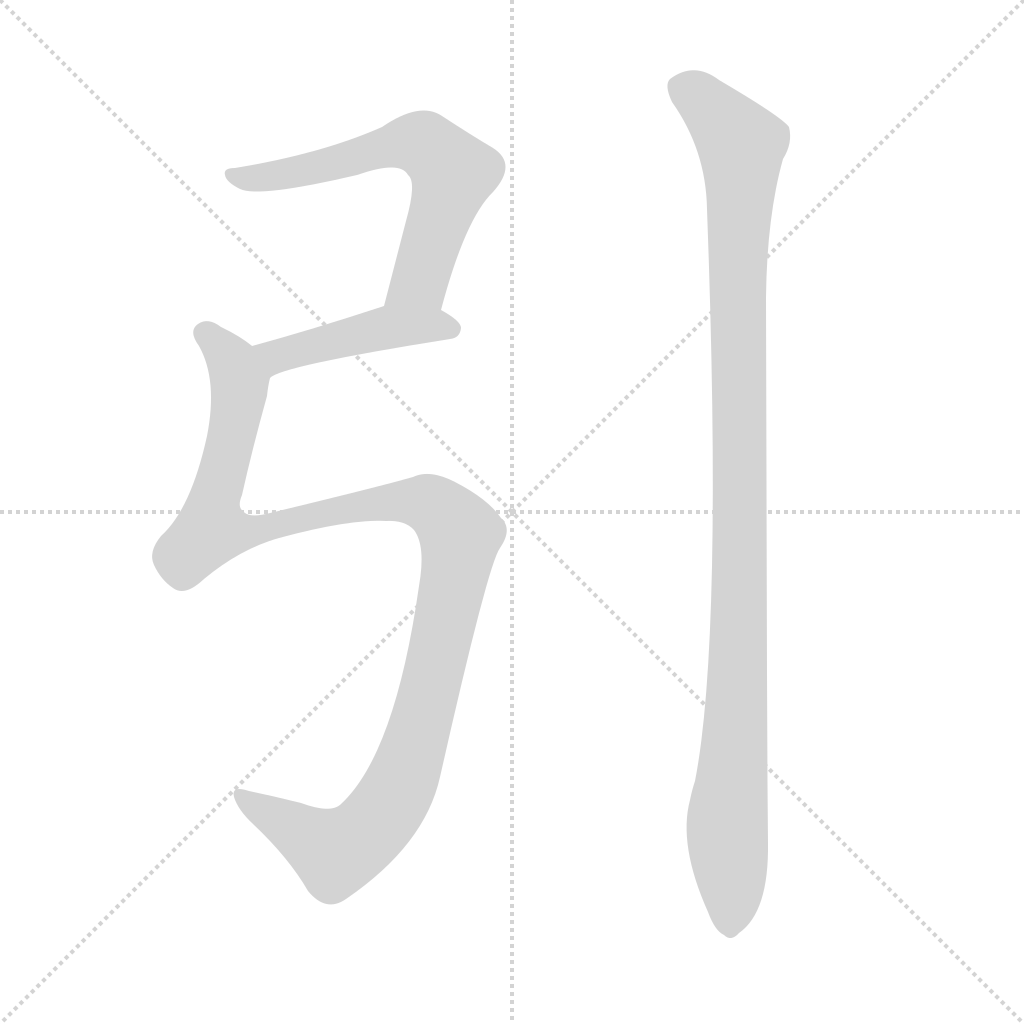
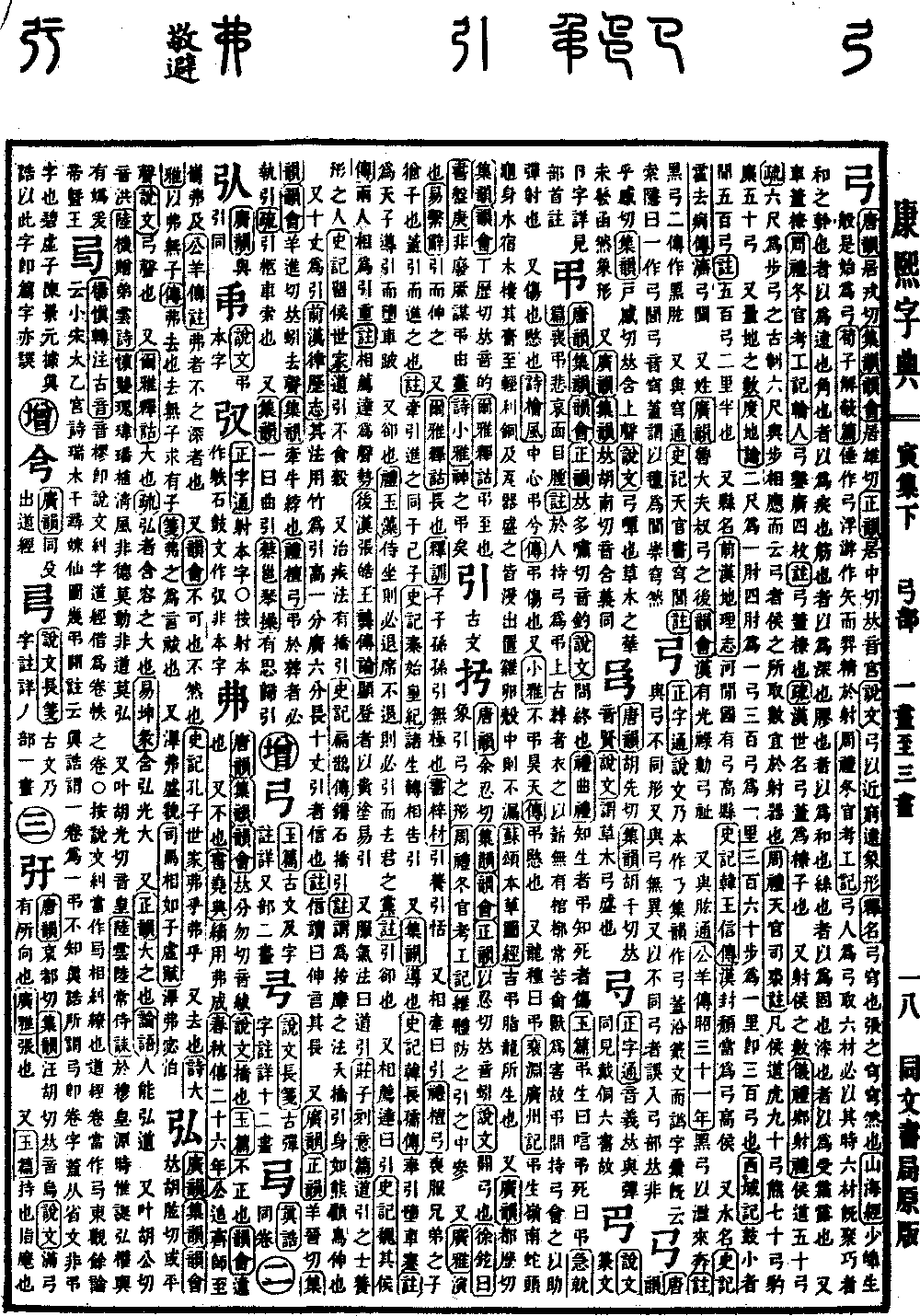
Yin Collection, Lower Volume
Radical: Bow (gōng)
Kangxi Strokes: 4
Page 356, Entry 08
Ancient form.
According to Tang Rhymes (Tangyun), pronounced yìn. According to Collected Rhymes (Jiyun), Rhyme Meetings (Yunhui), and Orthodox Rhymes (Zhengyun), pronounced yìn.
According to Explaining Graphs and Analyzing Characters (Shuowen), to draw a bow. Xu Xuan says it resembles the shape of a drawn bow.
According to Rites of Zhou (Zhouli), Winter Official, Artificer's Record (Kaogongji), tie the components to prevent their movement, then draw them into alignment.
To extend. According to Book of Changes (Yijing), Appended Statements (Xici), draw it out and extend it.
Long. According to Erya, Interpretation of Glosses (Shigu), it means long. In the Interpretation of Instructions (Shixun), it means children and grandchildren extended without limit. According to Book of Documents (Shujing), Timber of the Catalpa (Zicai), to draw out and nourish, to draw out and be peaceful.
To pull or lead. According to Book of Rites (Liji), Tan Gong, concerning mourning dress, the children of brothers are like one's own children, for one draws them forward. The commentary explains this as pulling and advancing them, treating them the same as one's own sons. According to Records of the Grand Historian (Shiji), Annals of Qin Shi Huang, the scholars informed and implicated one another.
To guide. According to Records of the Grand Historian (Shiji), Biography of Han Changru, he was acting as a guide when he fell from the carriage and became lame. The commentary notes he was guiding the Son of Heaven when he fell and was injured.
To retreat. According to Book of Rites (Liji), Jade Precepts (Yuzao), when attending someone of higher status, one must retreat from the mat; if one does not retreat, one must pull back and remove oneself from the vicinity of the lord. The commentary notes that to pull means to draw back.
To recommend or bring forward. According to Records of the Grand Historian (Shiji), Biography of Marquis Weiqi, the two men recommended one another to increase their influence. The commentary notes they recommended one another to build prestige. According to History of the Later Han (Hou Hanshu), Treatise on Zhang Hao and Wang Gong, those who were promoted easily recommended others through high-ranking paths.
Breathing exercises called daoyin. According to Zhuangzi, Intention Abridged (Keyi), those who practice daoyin and nourish their physical forms. According to Records of the Grand Historian (Shiji), Hereditary House of the Marquis of Liu, he practiced daoyin and did not eat grains.
Medical treatments involving stretching. According to Records of the Grand Historian (Shiji), Biography of Bian Que, he used stone needles and stretching techniques. The commentary explains this refers to massage methods, stretching the body as a bear looks behind it or a bird stretches itself.
Ten zhang in length is called an yin. According to Book of Former Han (Qian Hanshu), Treatise on Harmonics and Calendars, the method uses bamboo to create a measuring tape, one fen high, six fen wide, and ten zhang long. An yin implies credibility. The commentary notes that credibility is read as extension, referring to its length.
According to Extensive Rhymes (Guangyun) and Orthodox Rhymes (Zhengyun), pronounced yǐn. According to Collected Rhymes (Jiyun) and Rhyme Meetings (Yunhui), pronounced yǐn. The fourth tone. According to Collected Rhymes (Jiyun), a rope for pulling a bull. According to Book of Rites (Liji), Tan Gong, those attending a funeral must hold the pulling rope. The sub-commentary explains that this is the rope for the hearse.
According to Collected Rhymes (Jiyun), a type of curved musical piece. According to Cai Yong, Music Manual (Qincao), there is the Piece of Thinking of Returning.
The character previously was written in an ancient form.