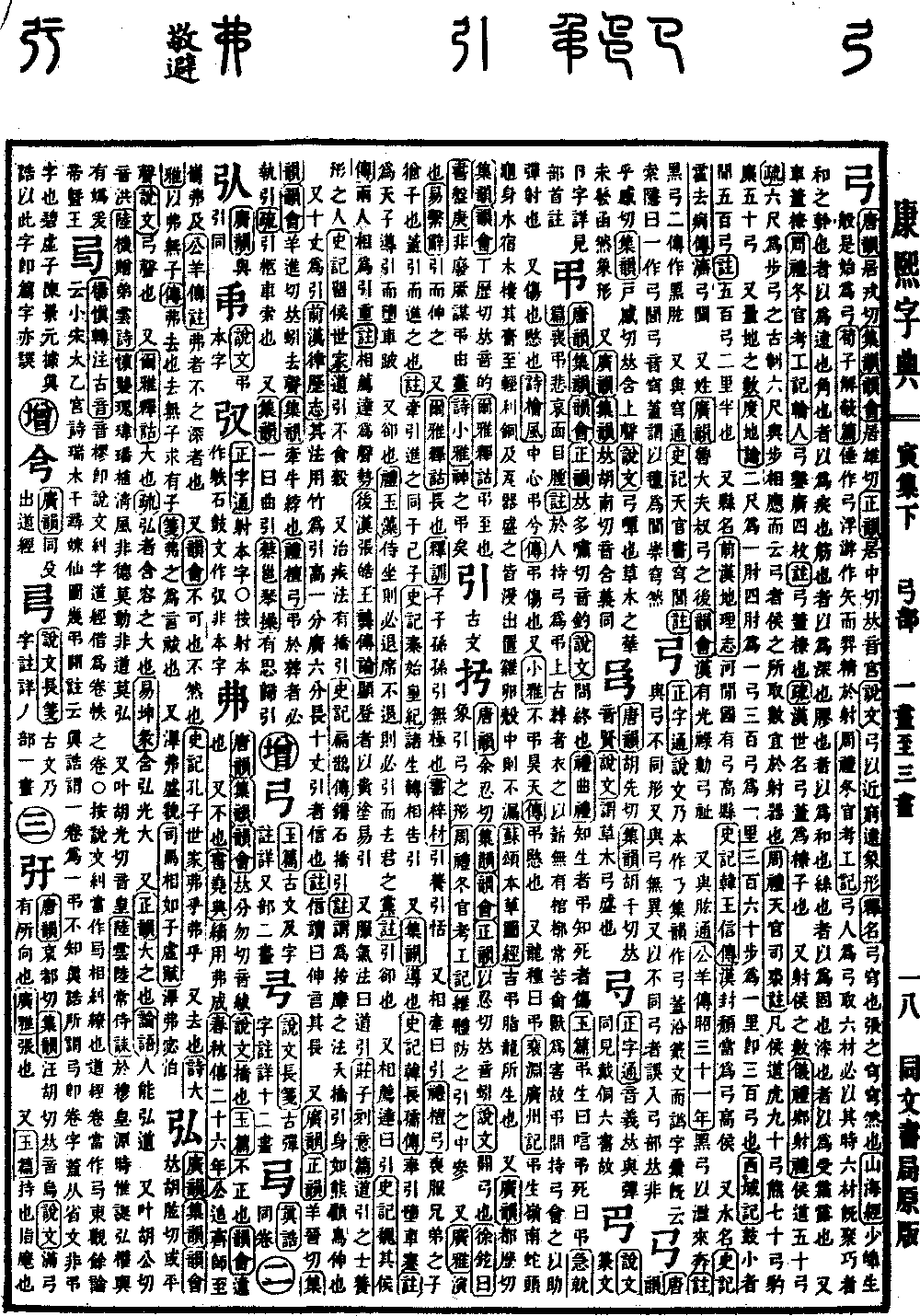
Yin Collection, Lower Volume
Radical: Bow (gōng)
Kangxi Strokes: 3
Page 356, Entry 01
Pronounced gong.
Shuowen Jiezi (Explanation of Simple and Compound Characters): The bow is an instrument used for striking distant targets. It is a pictograph.
Shiming (Explanation of Names): The bow refers to something arched or vaulted. It appears curved when pulled.
Classic of Mountains and Seas (Shanhaijing): Shaohao gave birth to Ban, who began to create bows.
Xunzi, Chapter on Dispelling Blindness (Jiebi): Chui created the bow, and Fouyou created the arrow, and thereafter Yi became proficient in archery.
Rites of Zhou, Winter Officials, Record of Trades (Kaogongji): The bow-maker crafts the bow by selecting six materials, which must be chosen at the appropriate seasons. When the six materials are all gathered, the skilled artisan harmonizes them. The bow stave is to ensure long range, the horn is to ensure speed, the tendon is to ensure depth of penetration, the glue is to ensure firm adhesion, the silk is to ensure structural integrity, and the lacquer is to withstand the erosion of frost and dew.
Also refers to the framework rafters of a chariot canopy.
Rites of Zhou, Winter Officials, Record of Trades, The Wheelwright (Lunren): The width of the bow mortise is four units.
Commentary: The bow refers to the rafters of a chariot canopy.
Sub-commentary: In the Han dynasty, the rafters of a chariot canopy were called bows.
Also refers to a unit of measurement for the distance to an archery target.
Book of Etiquette and Ceremonial (Yili), Ritual of Archery in the Countryside (Xiangsheli): The distance to the target is fifty bows.
Sub-commentary: Six feet make one pace. The ancient system defined a bow as six feet, corresponding to the length of a pace. The term bow is used because the distance to the target is appropriately named after the archery implement.
Rites of Zhou, Heavenly Officials, Master of Furs (Siqiu) Commentary: Regarding the distance to targets, the Tiger target is ninety bows, the Bear target is seventy bows, and the Leopard and Elk targets are fifty bows.
Also refers to a unit for measuring land.
Treatise on Land Measurement (Dudilun): Two feet make one elbow, four elbows make one bow, and three hundred bows make one mile. Three hundred and sixty paces make one mile, which is equivalent to three hundred bows.
Records of the Western Regions (Xiyuji): The sound of a small drum can travel five hundred bows away.
Commentary: Five hundred bows is equal to two and a half miles.
Also refers to a county name.
Book of the Former Han (Qian Hanshu), Treatise on Geography: There is Gonggao County in the state of Hejian.
Records of the Grand Historian (Shiji), Biography of King Xin of Han: The Han dynasty enfeoffed Tuidang as the Marquis of Gonggao.
Also refers to a river name.
Records of the Grand Historian (Shiji), Biography of Huo Qubing: Crossed the Gonglü River.
Also refers to a surname.
Guangyun (Broad Rhymes): Descendants of Shu Gong, an official of the State of Lu.
Rhyme Compilation (Yunhui): There was a Minister of the Imperial Household named Gong Zhi during the Han dynasty.
Also used interchangeably with the character for forearm (gōng).
Gongyang Commentary (Gongyangzhuan), 31st Year of Duke Zhao: Hei Gong arrived to defect, bringing the land of Lan.
Commentary: Hei Gong is written as Hei Hong in two other commentaries.
Also used interchangeably with the character for vault (qióng).
Records of the Grand Historian (Shiji), Treatise on Celestial Offices: Qionglü.
Commentary: The Suoyin (Search for Obscurities) states: One version is written as Gonglü. Gong is pronounced qiong, likely referring to tents made of felt, which appear high and arched.