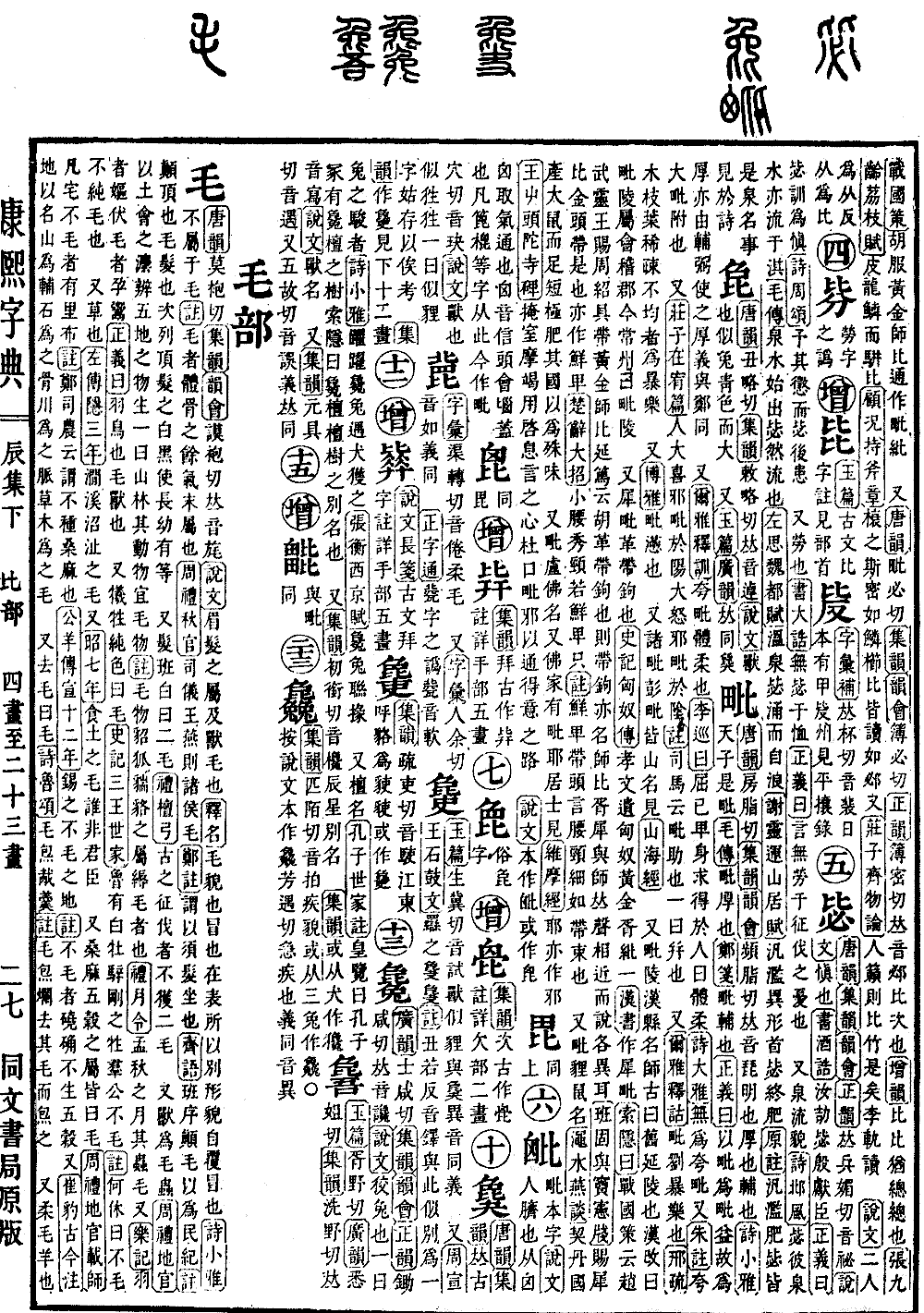
Chen Collection, Lower Volume
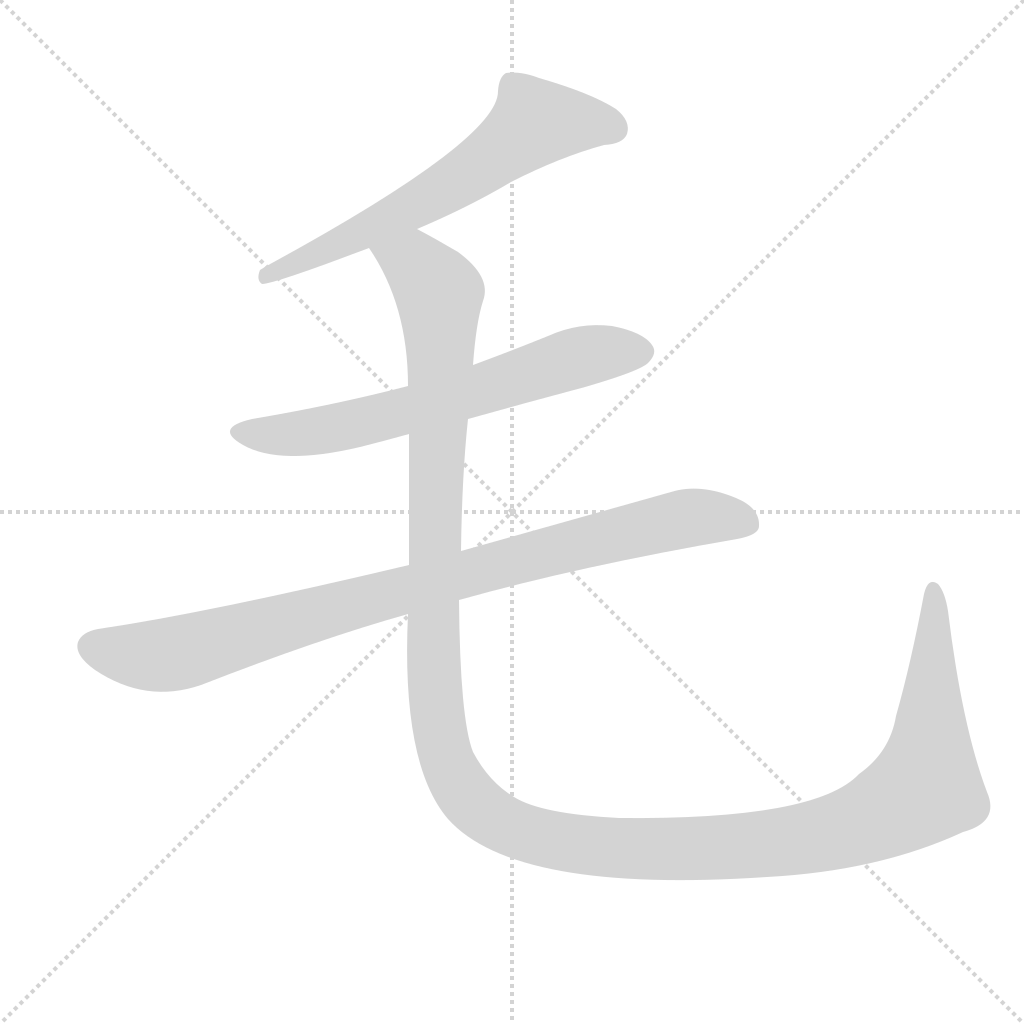
Radical: Hair (máo)
Page 591, Entry 22
Pronounced mao.
Pronounced mao.
Pronounced mao.
According to the Explaining Graphs and Analyzing Characters (Shuowen Jiezi), it refers to eyebrows, hair, and the fur of animals.
According to the Explaining Names (Shiming), mao means appearance or covering, used on the body surface to distinguish forms and cover the body.
Book of Odes (Shijing), Minor Odes of the Kingdom: Do not belong to the mao.
Note: Mao is the attachment of the remaining vital energy of the body’s skeletal system.
Rites of Zhou (Zhouli), Autumn Office, section on the Minister of Ceremonies: When the Son of Heaven holds a banquet, the feudal lords take their seats according to their mao (facial hair and head hair).
Note by Zheng Xuan: It means that seats are arranged according to the features of the beard and hair.
Discourses of the States (Guoyu), Discourses of Qi: Arrange the order of black and white in the hair on the crown of the head to serve as the guiding principles for the people.
Note: Dian refers to the crown of the head. Mao refers to hair. Arrange the black and white of the hair on the crown of the head in order to distinguish age and maintain the hierarchy of old and young. In addition, greying hair is called two-mao.
Book of Rites (Liji), Tan Gong: In ancient times, when going to war, one would not capture old people with grey hair.
Furthermore, animals are classified as hairy creatures.
Rites of Zhou, Earth Office: Use the method of calculating land taxes to distinguish between animals and plants produced by five types of land. The first is mountain forests, where the suitable animals are hairy creatures.
Note: Hairy creatures refer to sables, foxes, badgers, and raccoon dogs, which are animals with dense fur.
Book of Rites, Monthly Ordinances: In the first month of autumn, the representative creature is the hairy creature.
Music Record (Yueji): Birds incubate eggs, and animals gestate and give birth.
Orthodox Commentary (Zhengyi): Yu refers to birds. Mao refers to animals.
Used for sacrificial livestock with a uniform coat color, called mao.
Records of the Grand Historian (Shiji), Hereditary House of the Three Kings: The State of Lu had white oxen and red oxen for sacrifice, but the various ministers did not have mao (uniform coat color).
Note: He Xiu said: Not having mao means the coat color is not pure.
Refers to grass.
Zuo Tradition (Zuozhuan), Third Year of Duke Yin: Grass on mountain streams, marshes, and small islets.
Also, Seventh Year of Duke Xuan: Who among those who eat the plants grown on this land is not a subject of the king?
Mulberry, hemp, and the five grains are all called mao.
Rites of Zhou, Earth Office, Officer of Tax Revenues: Anyone who does not plant mao (mulberry and hemp) by their residence must pay the li cloth tax.
Note: Zheng Sinong said: It refers to not planting mulberry and hemp.
Gongyang Tradition (Gongyangzhuan), Twelfth Year of Duke Xuan: Bestowed upon them barren land.
Note: Not-mao refers to soil that is hard and thin, where the five grains do not grow.
Cui Bao, Ancient and Modern Notes (Gujin Zhu): The earth uses famous mountains as support, rocks are its skeleton, rivers are its blood vessels, and plants and trees are its hair.
To remove hair is called mao.
Book of Odes, Eulogies of Lu: Pig cooked with hair and then de-haired, chopped meat, and broth.
Note: Mao-pao means to roast while still hairy and then remove the hair.
Roumao (soft hair) refers to sheep.
Book of Rites, Quli: Sheep are called soft hair.
Sedge is called di-mao. Found in the Guangya.
Saomao is a type of salt-tolerant grass. Found in Lei Xiao, Preface to the Canon of Preparation and Roasting (Paozhi Lun).
In the Goryeo dialect, ramie is called mao, and ramie cloth is called mao-shi-bei. Found in the Jilin Leishi.
In the Minnan region, people call mao by the name mo. Found in the Jingguan Suoyan.
Sanskrit qin-ba-lu is called mao here in the Middle Kingdom.
Guo-bo-lu, in the Records of the Western Regions (Xiyuji), is described as a fine woolen fabric. He-lai-li, in the Records of the Western Regions, is described as a fabric woven from wild animal hair.
It is also a country name.
It is also a surname.
Zuo Tradition, Twenty-fourth Year of Duke Xi: The states of Lu, Wei, Mao, and Dan were all descendants of King Wen.
Guangyun: The descendants of the Duke of Mao, younger brother of King Wu of Zhou, took Mao as their surname. Originally residing in Julu, they moved to Xingyang to avoid enemies. During the Han dynasty, Mao Heng studied the Book of Odes, wrote a commentary, and passed it to his nephew Mao Chang; people at the time called Mao Heng the Great Duke Mao and Mao Chang the Small Duke Mao.
A type of bamboo.
Gu Kaizhi, Bamboo Catalog (Zhupu): There is mao bamboo in the Southern Ridge.
Liu Meizhi, Continued Bamboo Catalog (Xu Zhupu): Mao bamboo grows in the Wuyi Mountains.
Li Shangyin poem: Mao bamboo grows in the caves of the Wuyi Mountains.
Interchangeable with the character mao (with hair/mane).
Ceremonial and Rituals (Yili), Rites for the Burial of an Official: Do not trim the mane of the horse.
Note: The modern text version writes mao (with hair) as mao. Also written as mao (variant).
Rites of Zhou, Heaven Office, Note on the Master of Furs: In mid-autumn, the fur of birds and beasts is renewed and straightened. Also written as mao (with standard).
Records of the Grand Historian, Annals of Xia: Bird feathers, mao-ox tails, ivory, and rhinoceros hides.
Pronounced mao. Means to select.
Zheng Kangcheng (Zheng Xuan) sometimes wrote it with the hand radical. Interchangeable with the character mao (to pluck/select).
Pronounced mo.
Peixu Ji: In the Heishuo region, people say mao for wu (nothing).
Book of the Later Han (Hou Hanshu), Biography of Feng Yan: Hungry people have nothing to eat.
Note: Li Xian (Crown Prince Zhanghuai) said: I checked the Collected Works of Feng Yan, and it is written as wu (nothing). People in the common parlance still say it this way today; could it be that ancient usage is the same? It should be read as mo.
Also written as mao (variant).
Correction: Records of the Grand Historian, Annals of Xia: Yu, mao, chi, ge. Carefully revised according to the original text to read as yu, mao, chi, ge.