Yin Collection, Upper Volume
Radical: Sprout (chè)
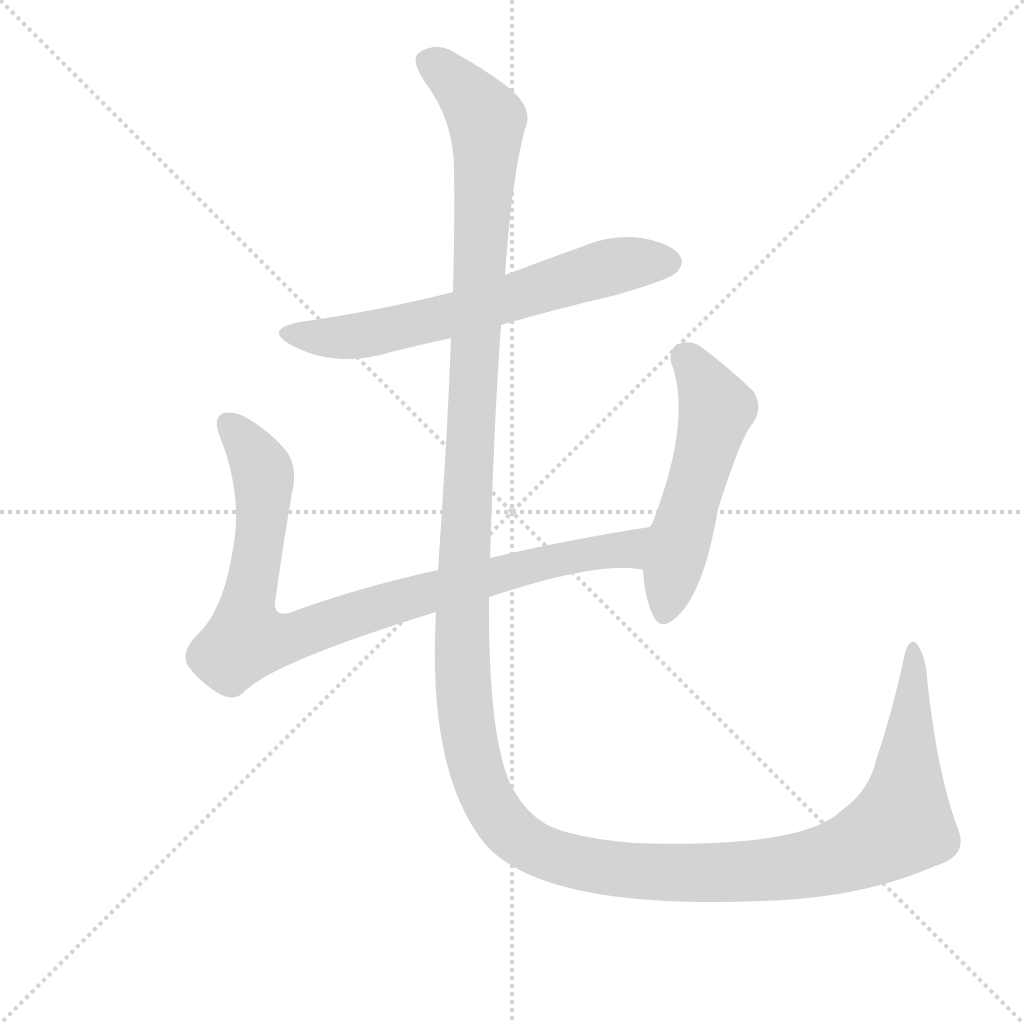
屯
Kangxi Stroke Count: 4
Page 304, Entry 11
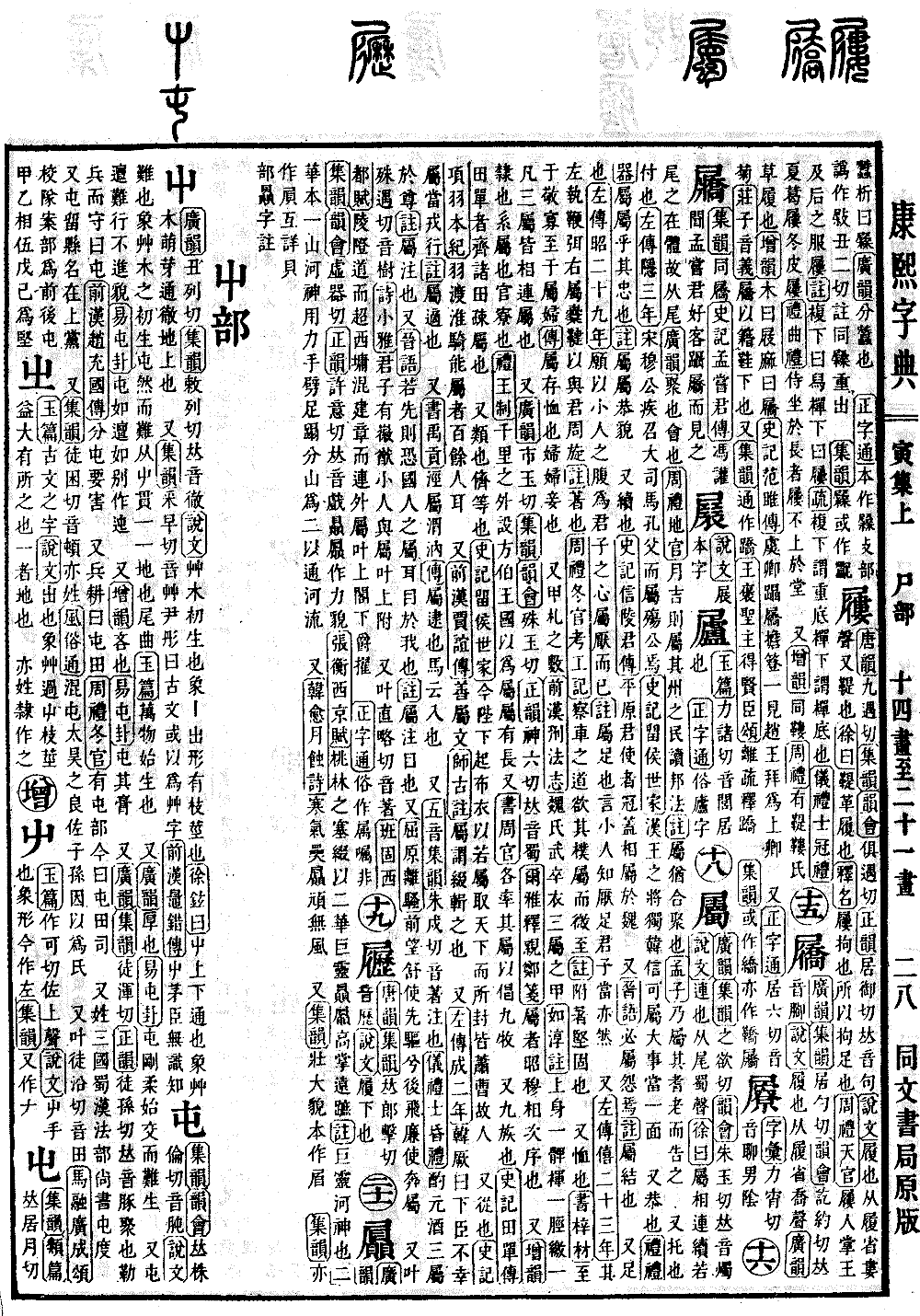
According to the Collection of Rhymes (Jiyun) and the Rhyme Gathering (Yunhui), the pronunciation is zhun. According to the Explaining Graphs and Analyzing Characters (Shuowen), it denotes difficulty. It resembles the initial growth of plants, which emerges with difficulty. It is composed of the radical for sprout and the character for one. The one represents the earth, and the tail is curved. According to the Jade Chapters (Yupian), it denotes the beginning of the growth of all things.
Also, according to the Broad Rhymes (Guangyun), it means thick. According to the Book of Changes (Yijing), in the Trigram for Difficulty (Tun), it states that difficulty is the beginning of the interaction between the firm and the yielding. It also appears in the phrase tun zhan, denoting a state of being unable to move forward. According to the Book of Changes (Yijing), it says as if in difficulty, as if unable to advance. It is also written in a variant form (zhun).
Also, according to the Supplementary Rhymes (Zengyun), it means stingy. According to the Book of Changes (Yijing), it states that it is stingy with its richness.
Also, according to the Broad Rhymes (Guangyun) and the Collection of Rhymes (Jiyun), and according to the Rectified Rhymes (Zhengyun), the pronunciation is tun. It means to gather; organizing troops to guard a position is called tun. According to the History of the Former Han (Qianhan Shu), in the biography of Zhao Chongguo, it describes dividing and stationing troops at key points. Furthermore, soldiers engaging in farming is called tun tian. According to the Rites of Zhou (Zhouli), in the Winter Officials section, there was a tun bureau; it is now called the Bureau of Stationed Farming. It is also a surname, such as Tun Du, a Minister of Law in the Shu Han state during the Three Kingdoms period. It is also the name of a county, Tunliu, located in Shangdang.
Also, according to the Collection of Rhymes (Jiyun), the pronunciation is dun. It is also a surname. According to the General Customs (Fengsu Tong), Huntun was a capable assistant to the Great Sovereign (Taixiao), and his descendants adopted it as their surname.
Also, rhyming with tian, according to the Ode of Guangcheng (Guangcheng Song) by Ma Rong, it states that the troops were organized into ranks, forming forward and backward positions. Group A and Group B formed units, and the central units were reinforced.