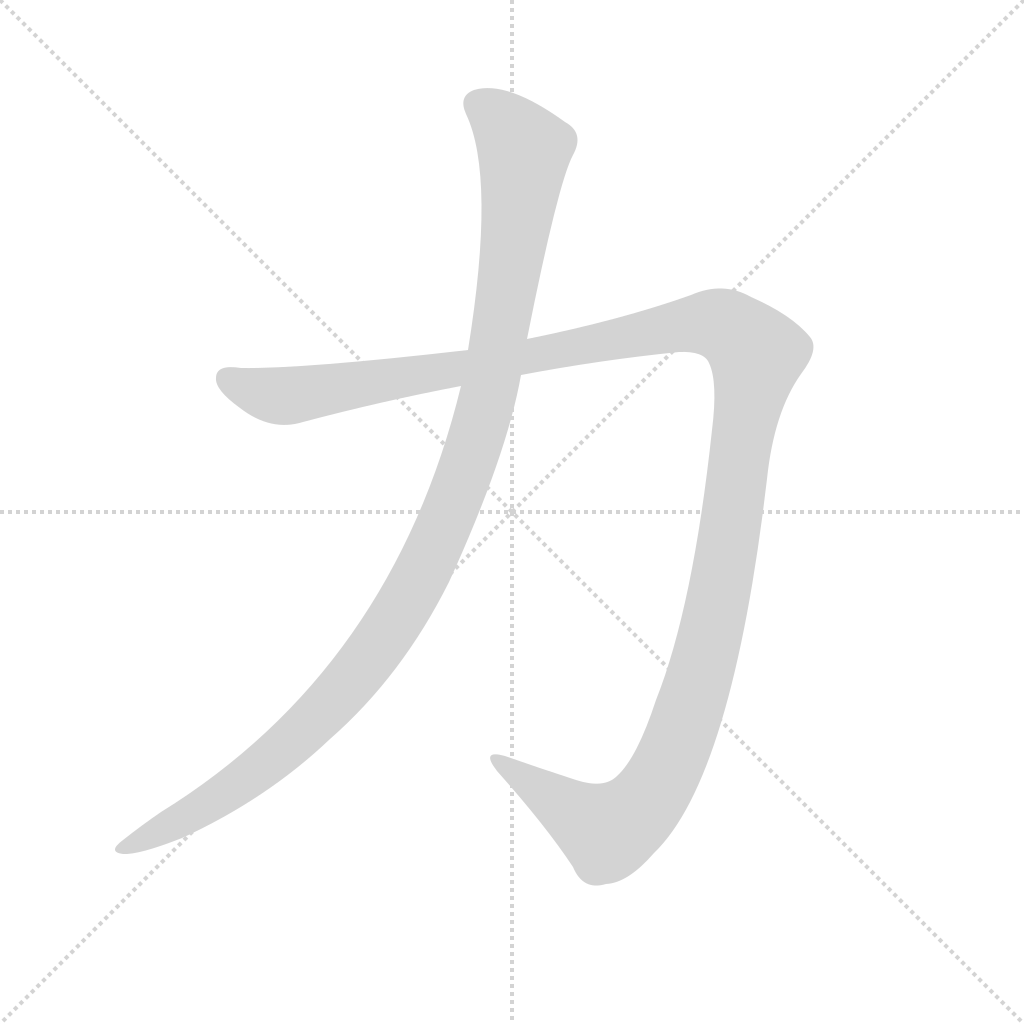
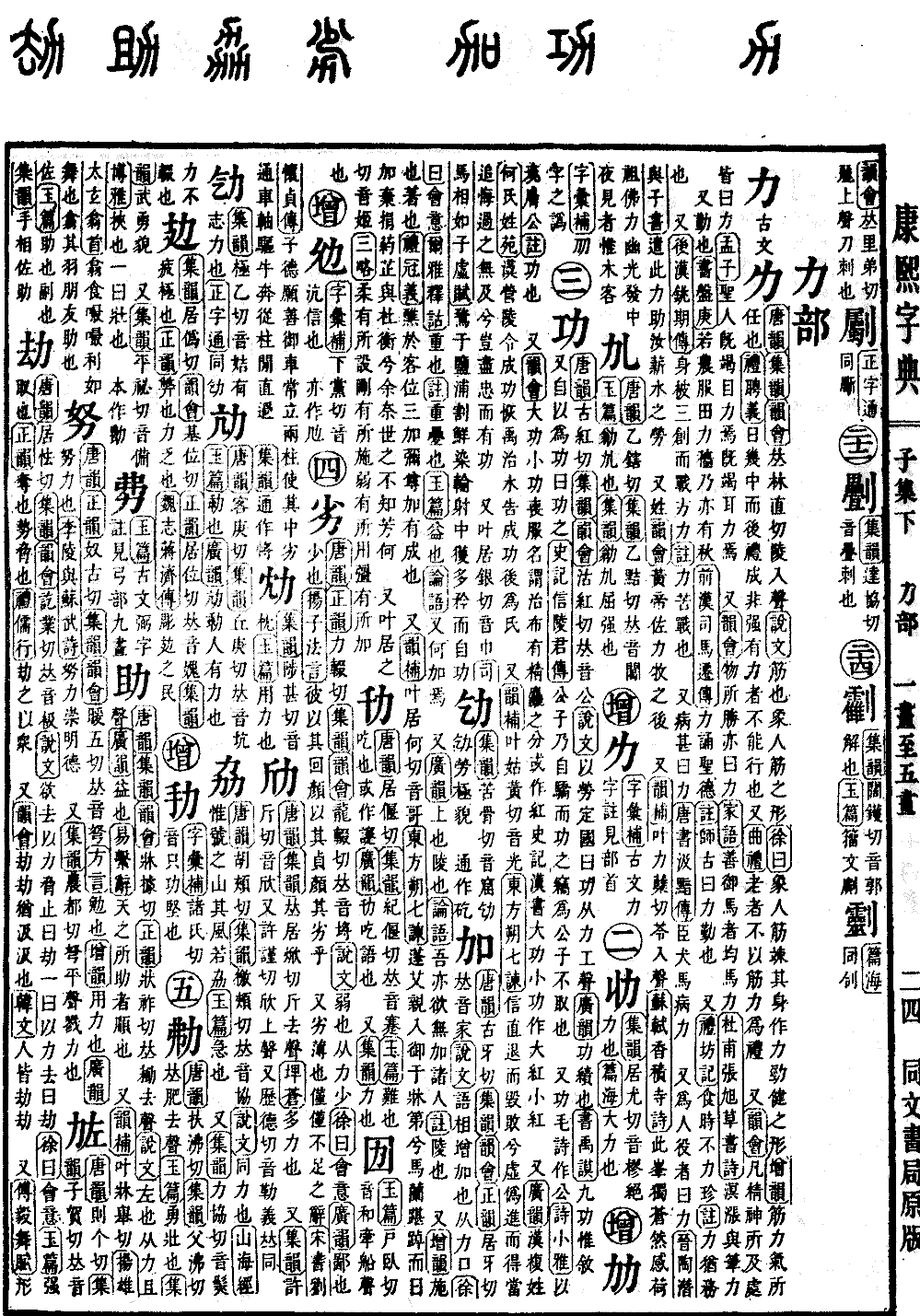
Zi Collection, Page Position: Lower
Radical: Strength (lì)
Strength (lì); Kangxi radical stroke count: 2; Page 146, entry 05
The ancient form of the character.
According to the Tang Rhyme (Tangyun), Collected Rhymes (Jiyun), and Rhyme Compendium (Yunhui), the pronunciation is lín zhí qiè, in the rù tone.
The Explanations of Characters (Shuowen Jiezi) states: "Sinew." It depicts the form of human sinew. Xu Kai's commentary states: "It depicts the sinews of a person contracting, their body exerting effort, in a strong and robust form."
The Augmented Rhymes (Zengyun) states: "Sinew is that which strength and energy enable."
From the Book of Rites (Liji), "Meaning of the Diplomatic Mission" chapter: "The ceremony was not completed until almost midday; only those with great strength and power could perform it."
Also from the Book of Rites, "Summary of Rules of Propriety" chapter: "The elderly do not perform rites that demand physical exertion."
Also from the Rhyme Compendium (Yunhui): "Wherever one's spirit reaches, it is called strength." From Mencius (Mengzi): "The sage fully exerted their power of sight, and fully exerted their power of hearing."
Also from the Rhyme Compendium: "That which an object overcomes is also called strength." From Family Sayings (Jiayu): "A good horseman distributes the horse's strength evenly." From Du Fu's "Poem on Zhang Xu's Cursive Script": "The surging tide and the power of the brush."
Also meaning diligence. From the Book of Documents (Shujing), "Pan Geng" chapter: "If farmers work their fields diligently in cultivation, then they will also have a harvest." From the Biography of Sima Qian in the Book of Han (Han Shu): "Diligently recited the sage's virtues." The commentary by Yan Shigu states: "Lì means diligence."
Also from the Book of Rites, "Record of the Dykes" chapter: "At mealtime, do not strive for delicacies." The commentary states: "Lì is equivalent to 'to strive for' or 'to pursue'."
Also from the Biography of Yao Qi in the Book of the Later Han (Hou Han Shu): "His body sustained three wounds, yet the battle was still fierce." The commentary states: "Lì means to fight fiercely."
Also, severe illness is called lì. From the Biography of Ji An in the Book of Tang (Tang Shu): "Your servant, a dog or horse, is gravely ill."
Also, one who serves as a laborer is called lì. From Tao Qian's (Tao Yuanming) "Letter to His Sons" (Tao Qian yu zishu): "Send this laborer to help you with the toil of fetching firewood and water."
Also a surname. From the Rhyme Compendium: "Descendants of Limu, an assistant to the Yellow Emperor."
Also from the Rhyme Supplement (Yunbu): The pronunciation is lì niè qiè, in the rù tone. From Su Shi's "Poem on Xiangji Temple": "This peak alone stands verdant, grateful for the ancestral Buddha's power. Its ethereal light shines forth in the middle of the night; only mountain spirits witness it."