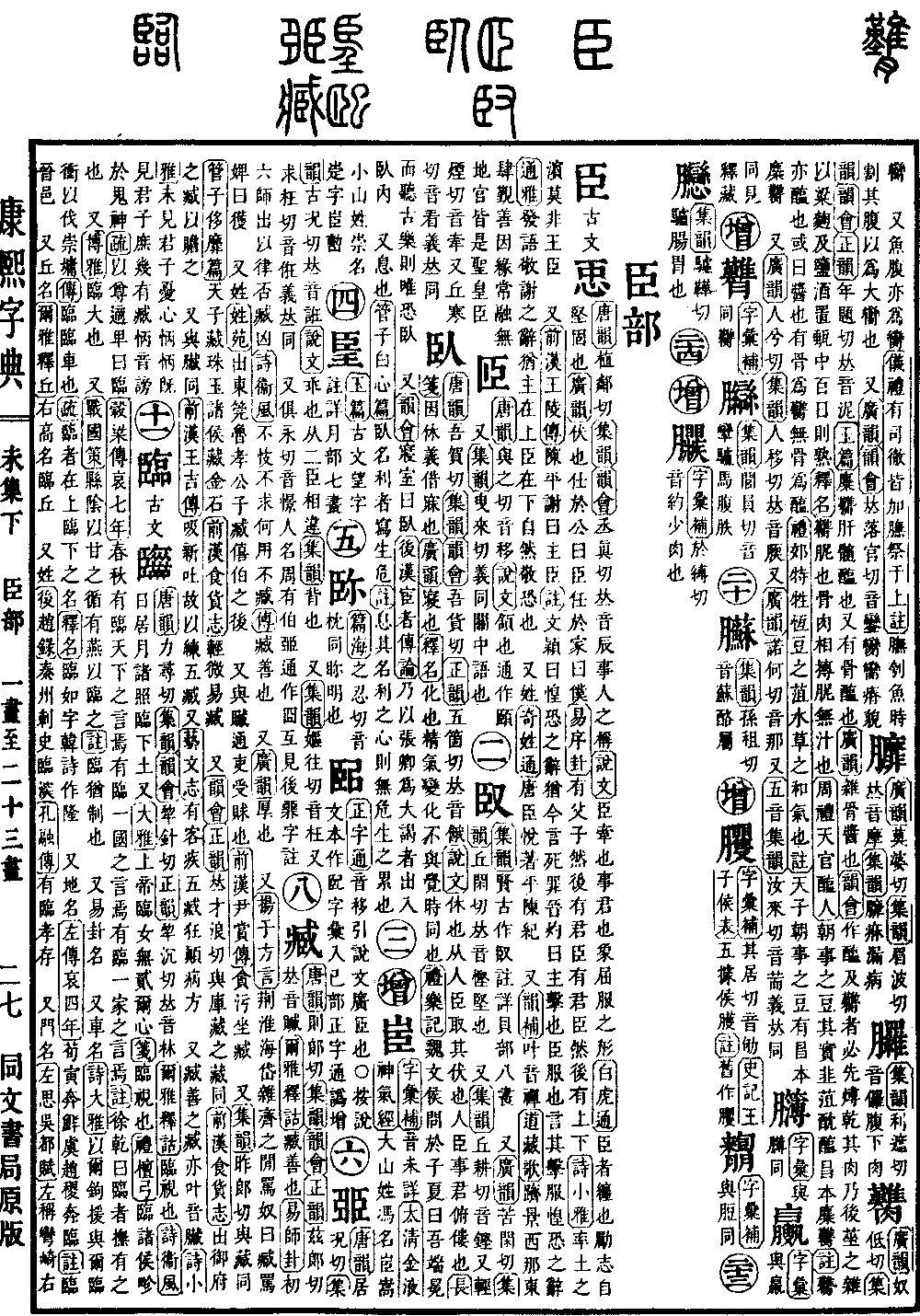
Wei Collection, Lower Volume
Radical: Minister (chén)
Page 999, Entry 13
Ancient form. Pronounced chén. A term for those who serve a ruler.
Shuowen Jiezi states: Chen means to restrain or to serve a ruler. The character shape resembles a posture of submission.
Baihu Tong states: Chen means to entwine, signifying the exertion of one's will to remain steadfast.
Guangyun states: Chen means to submit. One who holds an office in the public sector is called a minister; one who holds an office in a private household is called a servant.
Book of Changes (Yijing), Order of the Hexagrams states: Once there is the relationship between father and son, only then is there the relationship between ruler and minister; once there is the relationship between ruler and minister, only then are there social hierarchies.
Book of Odes (Shijing), Lesser Odes of the Kingdom states: Within the four seas, there is no one who is not a subject of the king.
Also, in the Biography of Wang Ling from the History of the Former Han (Hanshu), Chen Ping apologized, saying: Zhuchen. The commentary by Wen Ying states: This is an expression of trepidation, similar to saying "death penalty" in modern times. Jin Zhuo states: Zhu means to attack, and Chen means to submit. The meaning is to attack and force submission. This is an expression of trepidation.
Tongya states: This is a phrase expressing awe and apology, as if a ruler is above and a minister is below, naturally resulting in awe and trepidation.
Also, a surname. Qixingtong records that in the Tang dynasty there was Chen Yue, who authored the Chronicle of the Pacification of Chen (Ping Chen Ji).
Also, in rhymes, it rhymes with chan.
Daozang Ge states: Ascending to view the scenery in the west and east, completely encountering beautiful karmic affinities. Changrong and Wudi officials are all ministers of the sagely king.