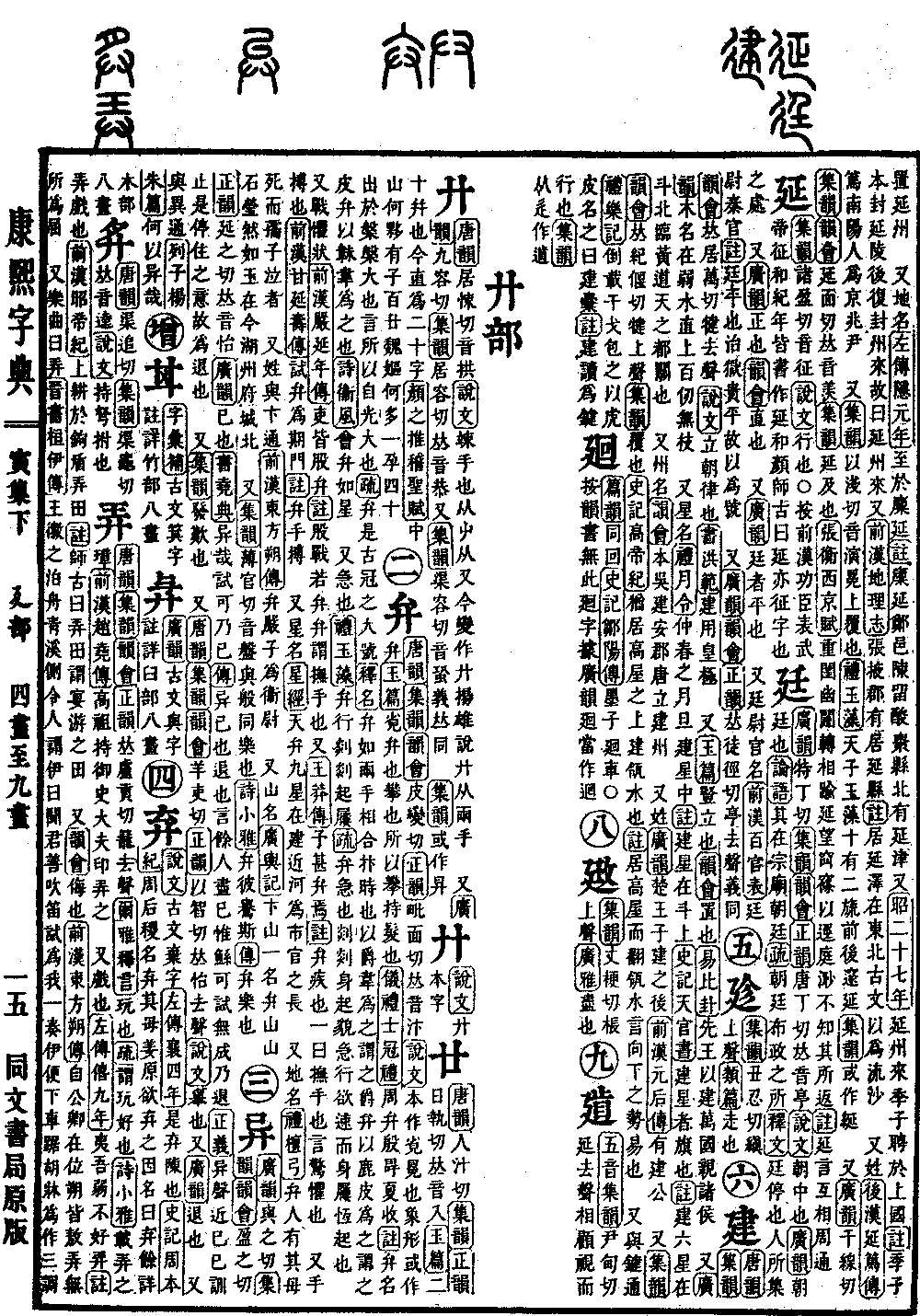
Yin Collection, Lower Volume
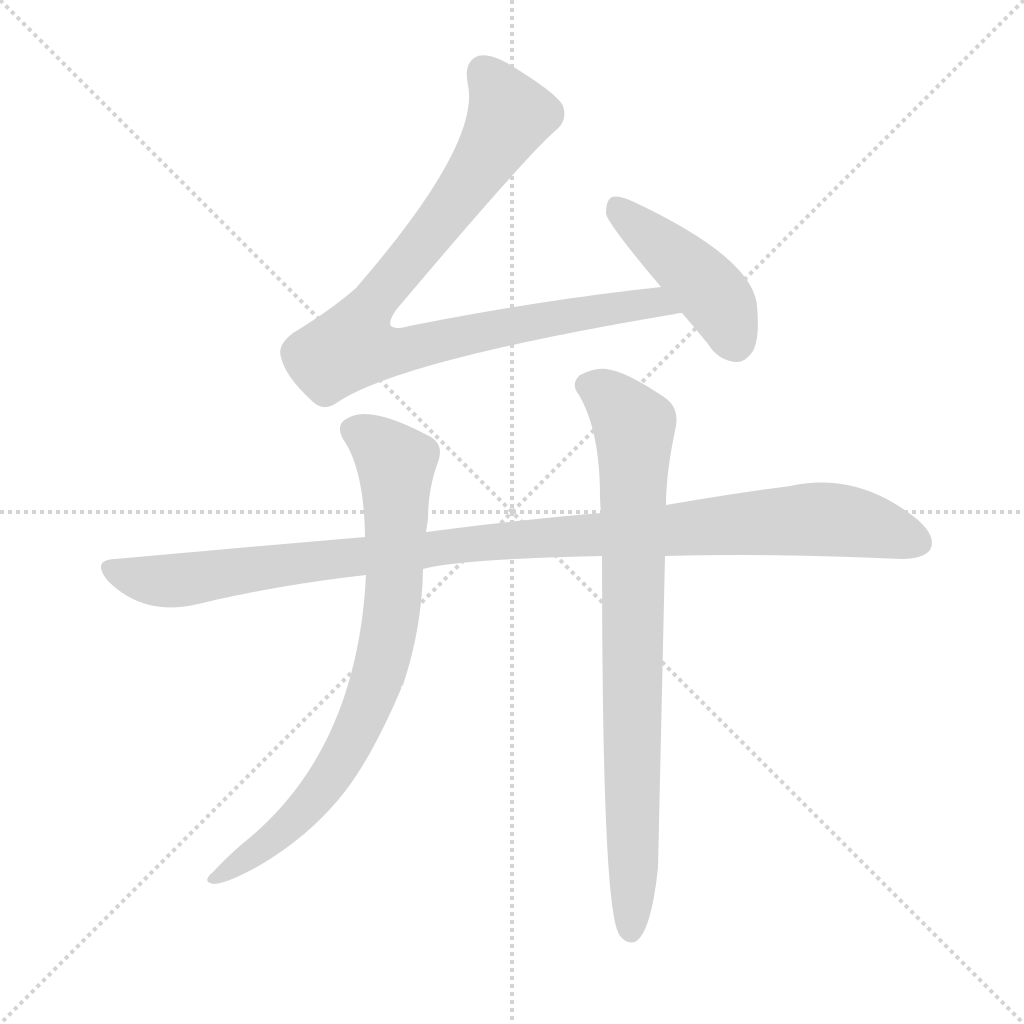
Radical: Twenty (gǒng)
Kangxi Strokes: 5
Page 353, Entry 11
Pronounced bian (falling tone)
Pronounced bian (falling tone)
Pronounced bian (falling tone)
Shuowen Jiezi (Explanation of Graphs and Analysis of Characters): Originally written as a different character. Refers to a ceremonial cap. It is a pictograph. Sometimes written in a variant form (biàn).
Yupian (Jade Chapters): The same as the primary character, also meaning to bind up the hair.
Book of Etiquette and Ceremonial (Yili), Section on Capping Rituals for Scholars: In the Zhou dynasty, it was called a bian; in the Yin dynasty, it was called a xu; in the Xia dynasty, it was called a shou.
Commentary: The name bian is derived from the word pan (meaning to be large). It signifies something worn to make one appear dignified and grand.
Sub-commentary: Bian is the collective term for ancient headgear.
Explanation of Names (Shiming): The term bian resembles the appearance of two hands coming together to clap. Caps made of sparrow-colored leather according to the season are called jue bian. Those made of deerskin are called pi bian. They are made from processed leather.
Book of Odes (Shijing), Odes of Wei: The jade stones decorating the pi bian glitter like stars.
Also conveys the meaning of haste.
Book of Rites (Liji), Section on Jade Decorations: Moving in haste with footsteps lifted quickly.
Sub-commentary: In this context, bian means haste. The phrase yan yan describes the body being lifted up. Walking hurriedly with a desire to be fast, the body and feet are always raised.
Also conveys the appearance of trembling or quaking.
History of the Former Han (Qian Hanshu), Biography of Yan Yannian: The officials all trembled in their legs.
Commentary: The thighs trembling like clapping hands. Bian refers to the act of clapping.
Also in the Biography of Wang Mang: I am extremely fearful.
Commentary: In this context, bian means rapid. Another interpretation suggests it refers to clapping, implying the sense of being terrified.
Also refers to unarmed combat.
History of the Former Han (Qian Hanshu), Biography of Gan Yanshou: Testing the ability in unarmed combat to serve as a guard of the Qimen.
Commentary: In this context, bian means to fight with bare hands.
Also the name of a star formation.
Classic of Stars (Xingjing): The Celestial Bian star consists of nine stars, located near the Di asterism close to the Milky Way; it oversees the officials who manage the markets.
Also a place name.
Book of Rites (Liji), Section on Tan Gong: A person from the place of Bian whose mother died, weeping like a small child.
Also a surname, interchangeable with the character bian.
History of the Former Han (Qian Hanshu), Biography of Dongfang Shuo: Bian Yanzi served as the Commandant of the Guard.
Also a mountain name.
Comprehensive Geography Records (Guangyuji): Bian Mountain, also known as Bian Mountain. The mountain stones are crystalline like jade. Located north of the current prefecture city of Huzhou.
Pronounced pan (level tone)
Equivalent to the character ban. Means joy or happiness.
Book of Odes (Shijing), Odes of Xia: How happy are those crows.
Commentary: Bian means happy.