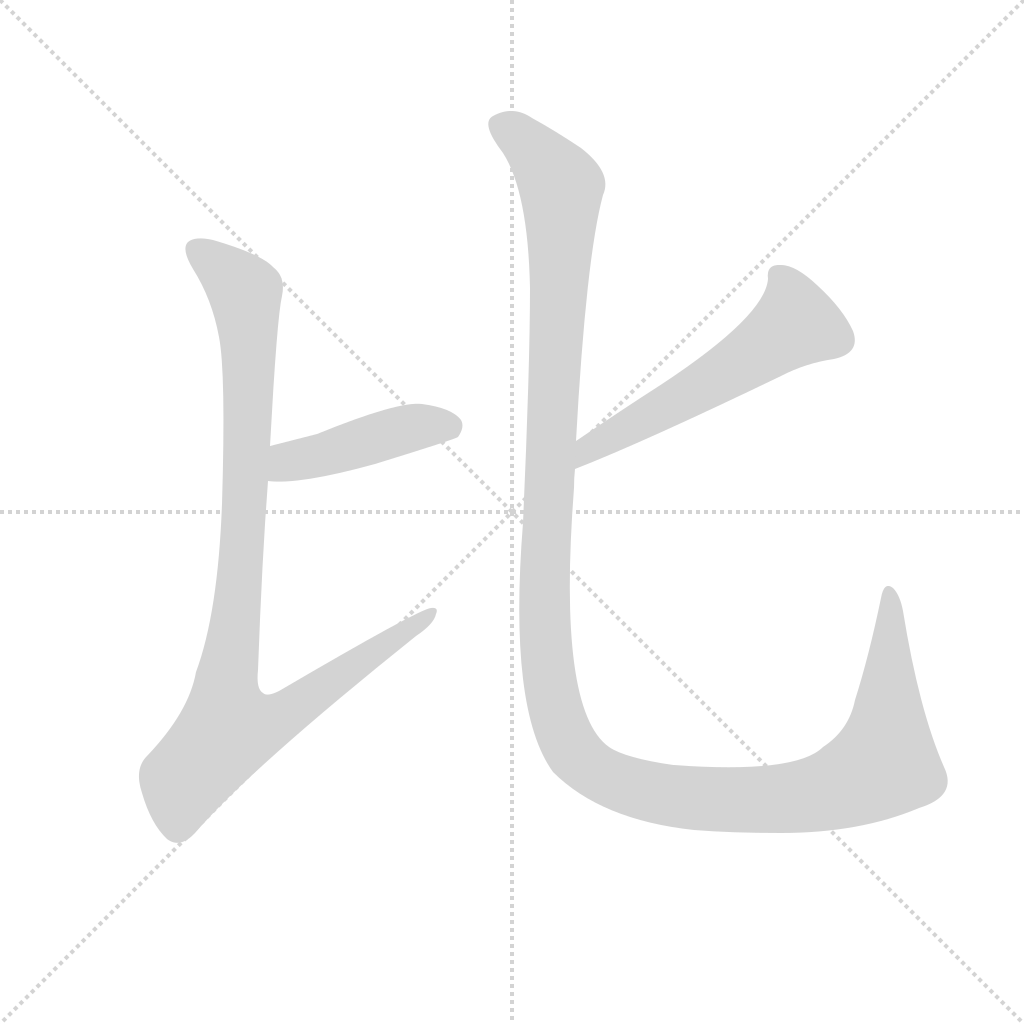
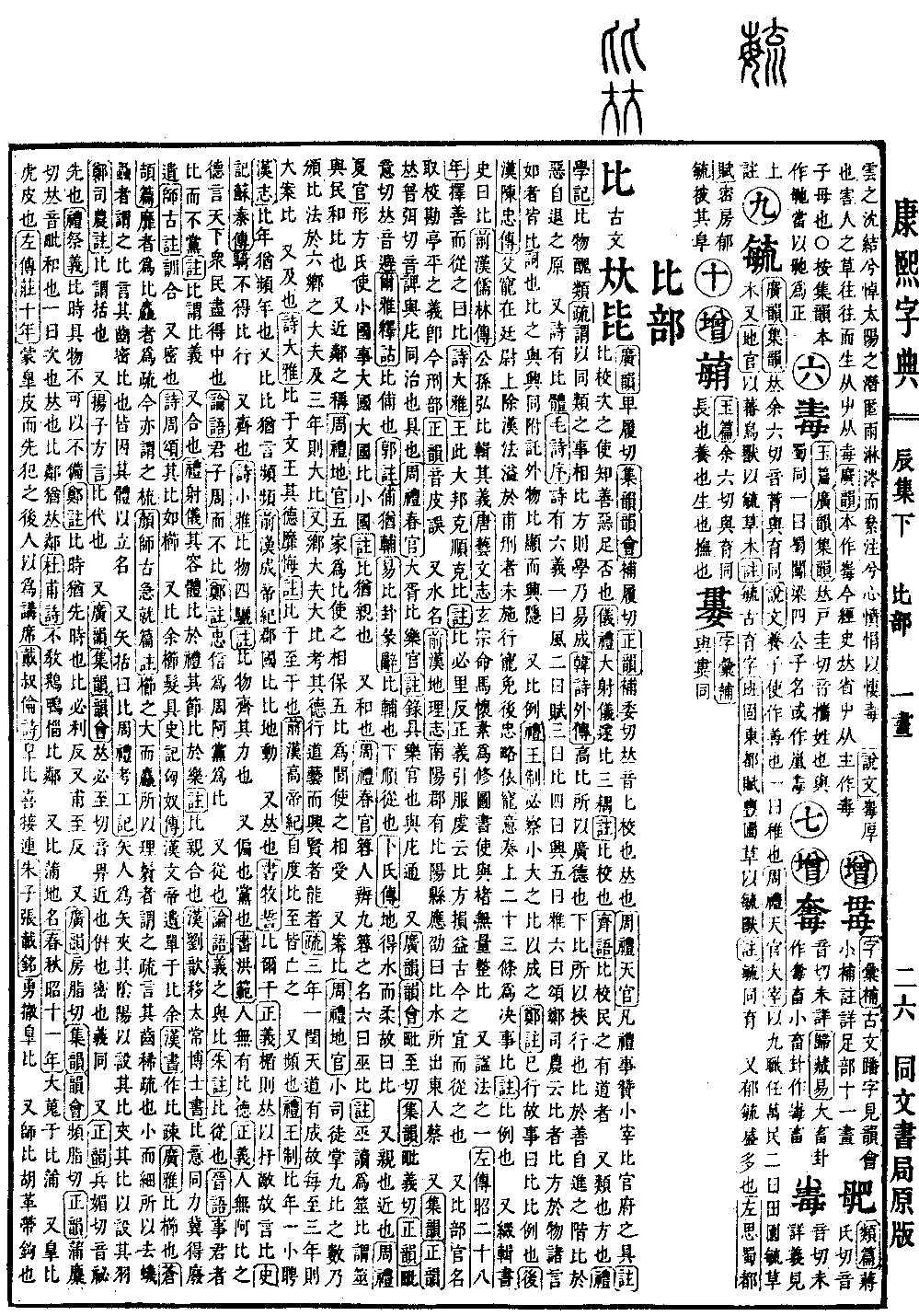
Chen Collection, Lower Volume. Radical: Compare (bǐ). Kangxi stroke count: 4. Page 590, Entry 09.
The ancient form is written as 夶.
According to the Guangyun, the pronunciation is lü (rising tone). According to the Jiyun and Yunhui, it is pronounced bu lü (rising tone). According to the Zhengyun, it is pronounced bu wei (rising tone). The pronunciation is the same as the character bi. It means to compare or to examine.
Book of Rites (Zhouli), Offices of Heaven: For all matters involving rituals, assist the Lesser Minister in comparing and examining whether the items prepared by the government offices are complete. Commentary: Bi means to check the order, allowing one to know if things are sufficient or of good or bad quality.
Ceremonial Rites (Yili), Great Archery Rites: Thereupon, compare the three pairs of archers. Commentary: Bi means to examine.
Discourses of Qi (Qiyu): Examine those among the populace who possess virtuous conduct.
It also refers to categories or analogies.
Book of Rites (Liji), Record of Learning (Xueji): Use things of the same category to compare and classify them. Commentary: This means that if one uses similar things to draw analogies, learning becomes easy to achieve.
Han's Family External Commentary (Hanshi Waizhuan): When compared with those who are noble, one can increase one's virtue. When compared with those who are base, one will harbor corrupt behavior. Comparing with goodness is a ladder for self-improvement. Comparing with wickedness is the root of self-regression.
It also refers to the bi (comparison) genre in the Book of Odes (Shijing).
Preface to the Book of Odes (Maoshi Xu): There are six expressions in the Odes: the first is wind, the second is exposition, the third is comparison, the fourth is stimulation, the fifth is refined, and the sixth is eulogy. Zheng Sinong stated: Comparison means using objects to draw analogies; those instances where terms such as like or as are used are all examples of the comparative genre. Comparison and stimulation both rely on external objects to entrust emotions, but comparison is explicit while stimulation is implicit.
It also refers to proportionality or precedents.
Book of Rites (Liji), Royal Regulations (Wangzhi): One must examine the scale of the matter to form a judgment. Commentary: Past events that have already been enacted are called bi. Bi means precedent.
History of the Later Han (Houhan Shu), Biography of Chen Zhong: His father, Chen Chong, while serving as the Minister of Justice, submitted a memorial to remove parts of the Han legal code that exceeded the punishments of the Marquis of Fu. Before it could be enacted, Chen Chong was dismissed. Later, Chen Zhong mostly followed his father's intent and submitted twenty-three articles to serve as precedents for judicial decisions. Commentary: Bi means precedent.
It also refers to editing and compiling books or historical records.
History of the Former Han (Qianhan Shu), Biographies of Confucian Scholars: Gongsun Hong edited and compiled its essential meanings.
Book of Tang (Tang Shu), Treatise on Arts and Literature: Emperor Xuanzong of Tang ordered Ma Huaisu to serve as the Commissioner for Compiling Books, and together with Chu Wuliang, they organized and arranged them.
It is also a type of posthumous title.
Zuo Tradition (Zuozhuan), Year 28 of Duke Zhao: Choosing the good and following them is called bi.
Book of Odes (Shijing), Greater Odes: The sovereign rules this great state, able to be harmonious and able to be close. Commentary: Pronounced bi li (rising tone). The justice section cites Fu Qian: To compare and deliberate on ancient and modern suitable practices and follow them.
It also refers to the Bureau of Comparison (Bi Bu), a government office. The name implies fairness in examination. It is the predecessor of the current Ministry of Justice. The Zhengyun claim that it is pronounced pi is incorrect.
It is also the name of a river.
History of the Former Han (Qianhan Shu), Treatise on Geography: Nanyang Commandery has Biyang County. Ying Shao stated: The Bi River flows from here and enters the Cai River to the east.
Also, according to Jiyun and Zhengyun, it is pronounced pu mi (rising tone), same as the character bi. It is synonymous with the character pi. It means to govern or to prepare.
Book of Rites (Zhouli), Offices of Spring: The Great Usher examines the music officials. Commentary: To record the qualified music officials. It is interchangeable with pi.
Also, according to Guangyun and Yunhui, it is pronounced pi zhi (falling tone); according to Jiyun, it is pronounced pi yi (falling tone); according to Zhengyun, it is pronounced pi yi (falling tone), same as the character bi.
Explanations of Terms (Erya), Interpretation of Ancient Words: Bi means to assist. Commentary: Fu means to assist.
Book of Changes (Zhouyi), Bi Hexagram, Commentary on the Judgments: Bi means to assist; those below follow those above. Bo Shi's Commentary: The earth obtains water and becomes soft and compliant, which is why it is called bi.
It also refers to being close or intimate.
Book of Rites (Zhouli), Offices of Summer: The Fangxing clan directs small states to serve large states, and large states draw close to small states. Commentary: Bi is like being intimate.
It also refers to harmony.
Book of Rites (Zhouli), Offices of Spring: The diviner distinguishes the names of the nine types of milfoil divination, the sixth of which is called wu bi. Commentary: Wu is read as shi (divination); bi means the divination and the people are in harmony and intimate.
It also refers to immediate neighbors.
Book of Rites (Zhouli), Offices of Earth: Five households constitute one bi, making them mutually responsible for one another. Five bi constitute one lü, making them mutually reliant.
It also refers to auditing household registers.
Book of Rites (Zhouli), Offices of Earth: The Lesser Minister of the Multitude manages the count of the nine bi, then issues auditing laws to the grand officers of the six townships. After three years, a major audit is conducted. Furthermore: The township official examines the virtue and skills of the people during the major audit to promote the worthy. Justice: Every three years is a leap, the path of heaven completes its cycle, so every three years a major audit is held.
It also refers to arriving or reaching.
Book of Odes (Shijing), Greater Odes: When it reached King Wen, his virtue had no flaws. Commentary: Bi yu means to reach the point of.
History of the Former Han (Qianhan Shu), Annals of Gaozu: He estimated that by the time he arrived, the people would have all run away.
It also refers to frequency.
Book of Rites (Liji), Royal Regulations (Wangzhi): Once a year there is a small inquiry. History of the Han (Hanshi), Treatise on Food and Money: Bi nian means successive years.
Also, bi bi is used to describe frequency.
History of the Former Han (Qianhan Shu), Annals of Chengdi: Earthquakes occurred frequently in the commanderies and kingdoms.
It also refers to arrangement.
Book of History (Shangshu), Oath at Mu: Arrange your shields. Justice: Shields are used to defend against enemies, so it is called bi.
Records of the Grand Historian (Shiji), Biography of Su Qin: The cavalry could not be arranged in rows.
It also refers to being equal or identical.
Book of Odes (Shijing), Lesser Odes: Four black horses of equal strength. Commentary: Bi wu means to make their strengths equal.
It also refers to favoritism or forming cliques.
Book of History (Shangshu), Great Plan: Men have no partial virtue. Justice: That men have no flattering or partial virtue means that the common people of the world all accord with the path of the middle and the upright.
Analects of Confucius: The superior man gathers others but does not form cliques. Zheng Commentary: Loyalty and trustworthiness are called zhou, while flattery and clique-forming are called bi.
It also refers to following or pursuing.
Analects of Confucius: To follow righteousness. Zhu Commentary: Bi means to follow.
Discourses of the States (Guoyu), Jin Discourses: Those who serve a ruler follow righteousness and do not form cliques for selfish gain. Commentary: Bi refers to following righteousness.
It also refers to conforming or matching.
Book of Rites (Liji), Meaning of Archery: His demeanor conforms to ritual, and his rhythm conforms to music. Commentary: Bi means to be intimate and conform.
Han Dynasty, Liu Xin, Memorial to the Grand Scholars: Our intentions matched, our forces coordinated, hoping to obtain the abandoned and neglected classics. Shigu Commentary: Explained as to join.
It also refers to being tight or dense.
Book of Odes (Shijing), Zhou Eulogies: They are arranged tightly like the teeth of a comb.
Also, bi yu is a tool for grooming hair.
Records of the Grand Historian (Shiji), Biography of the Xiongnu: Emperor Wen of Han sent the Chanyu a bi yu. The History of the Han writes it as bi shu. Guangya: Bi is a comb. Cangjie Pian: Fine-toothed is called bi, coarse is called shu. It is now called a comb. Yan Shigu, Notes on Jijiupian: A comb that is large and coarse, used to comb the hair at the temples, is called shu, meaning its teeth are sparse. A small and fine one, used to remove lice, is called bi, meaning its teeth are dense. Both are named according to their shape.
It also refers to the nock of an arrow where the string is attached.
Book of Rites (Zhouli), Artificers' Record: The arrow-maker produces arrows, setting the arrow nock based on the yin and yang sides of the shaft, and attaches the feathers to the sides of the nock. Zheng Sinong Commentary: Bi refers to the arrow nock.
Also, Yangzi's Dialect: Bi means to replace.
Also, according to Guangyun, Jiyun, and Yunhui, it is pronounced bi (falling tone), same as the character bi. It means to be close, aligned, or dense. The meaning is the same as above.
Also, according to Zhengyun, it is pronounced bing mei (falling tone), same as the character mi. It means to prepare in advance.
Book of Rites (Liji), Meaning of Sacrifice: Prepare sacrificial items in advance; they cannot be anything less than complete. Commentary: Bi shi is like saying prior time. Bi is read as bi li (falling tone), or fu zhi (falling tone).
Also, according to Guangyun, it is pronounced fang zhi (falling tone); according to Jiyun and Yunhui, it is pronounced pin zhi (falling tone); according to Zhengyun, it is pronounced pu mi (falling tone), same as the character pi. It means harmony. One opinion says it refers to order or alignment. Bi lin is like saying neighbor.
Du Fu's Poetry: Do not let the geese and ducks disturb the neighbors.
Also, Bi Pu is a place name.
Spring and Autumn Annals (Chunqiu), Year 11 of Duke Zhao: A grand military review was held at Bipu.
Also, gao bi refers to a tiger skin.
Zuo Tradition (Zuozhuan), Year 10 of Duke Zhuang: Covering oneself with a tiger skin to lead an attack. Later generations used gao bi to refer to a lecture seat.
Dai Shulun's poetry: Joyfully ascending the lecture seat one after another.
Zhu Xi, Zhang Zai Inscription: Courageously remove the lecture seat (meaning to stop lecturing).
Also, shi bi refers to the belt hook of the Hu people.
Strategies of the Warring States (Zhan Guo Ce): Hu attire matched with a golden shi bi. Commonly written as pi or pi.
Also, according to Tangyun, it is pronounced pi bi (falling tone); according to Jiyun and Yunhui, it is pronounced bu bi (falling tone); according to Zhengyun, it is pronounced bu mi (falling tone), same as the character bi. It means to arrange in sequence.
Zengyun: Bi bi means many or in succession.
Zhang Jiuling, Lychee Rhapsody: The skin is arranged as densely as dragon scales.
Gu Kuang, Holding the Axe: The rafters are so dense, arranged like fish scales or comb teeth. All are read as bi.
Also, Zhuangzi, Discourse on Making All Things Equal: The bamboo flute is (an instrument made of) arranged bamboo pipes. Li Gui reads it this way.
Explanations of Characters (Shuowen Jiezi): Two people following one another is called cong; the reverse of cong is bi.
Verification: Zuo Tradition, Year 10 of Duke Zhuang: Covering oneself with a gao pi and being the first to attack. Carefully following the original text, gao pi is corrected to gao bi.