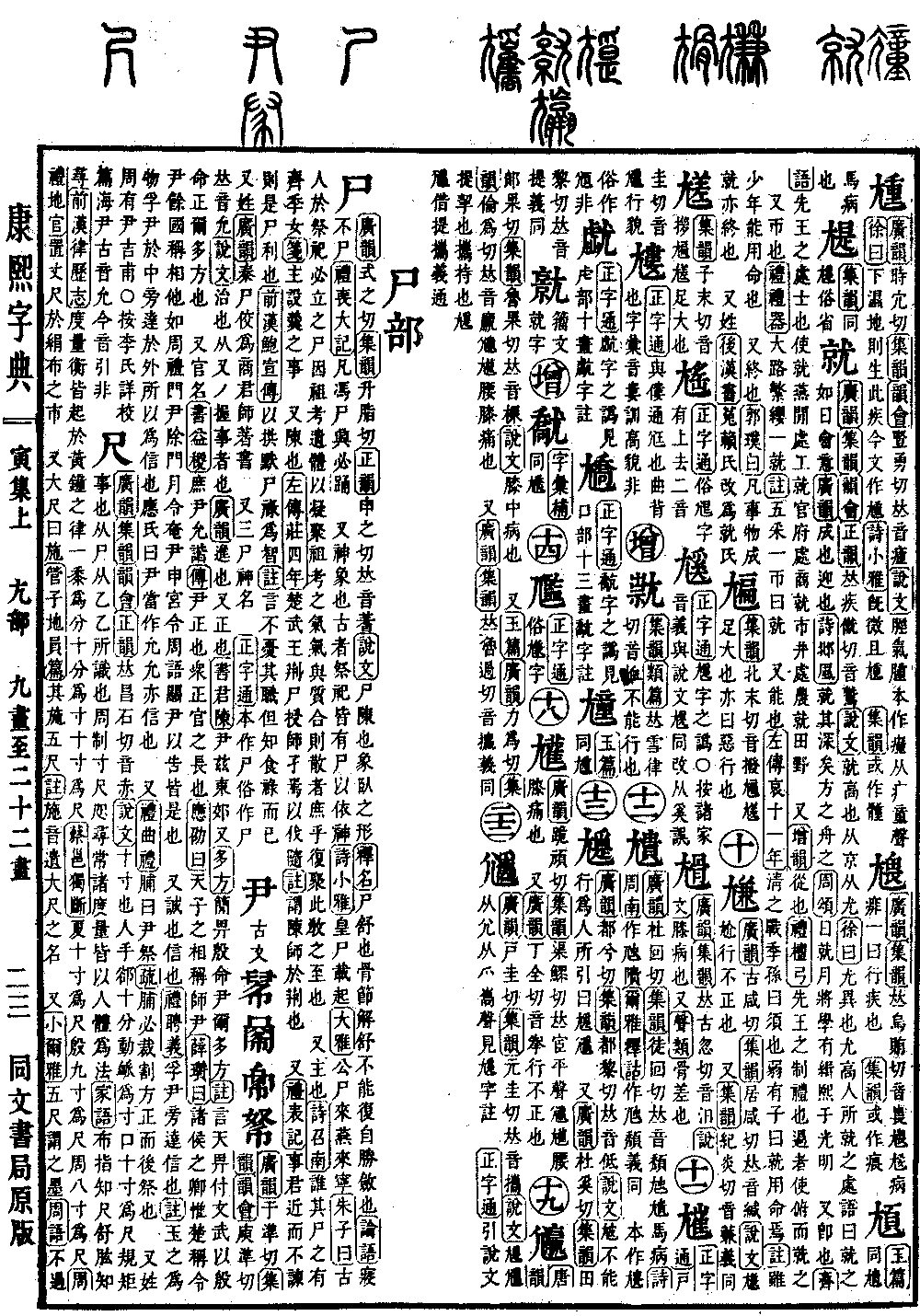
Yin Collection, Upper Volume
Radical: Corpse (shī)
Kangxi Strokes: 9
Page 299, Entry 26
Pronounced shi. Pronounced shi. Pronounced shen. The pronunciation is the same as the word for yarrow (shī).
Explanations from the Origin of Chinese Characters (Shuowen Jiezi): The word for corpse refers to the human body. It resembles the shape of a person lying down.
Explanations of Names (Shiming): The word for corpse means to stretch out. The joints and bones are stretched and relaxed, unable to retract or gather themselves again.
Analects (Lunyu): When sleeping, one should not lie straight and rigid like a corpse.
Book of Rites (Liji), Great Record of Mourning (Sangdaji): Whenever supporting a corpse, one must stomp their feet and leap upon rising to demonstrate grief.
Also refers to a spirit tablet or an idol. In ancient sacrificial rites, a person was always appointed to act as a living representative to embody the spirit of the deceased.
Book of Odes (Shijing), Minor Odes of the Kingdom (Xiaoya): The representative acting as the former king stands up.
Book of Odes (Shijing), Greater Odes of the Kingdom (Daya): The representative acting as the former duke comes to feast and receive offerings in peace.
Zhu Xi comments: In ancient times, when performing sacrifices, a representative was always required. By utilizing the bloodline left behind by ancestors, the spirit and essence of the ancestor were gathered. When spirit and form are combined, the scattered soul of the ancestor may be brought together once more. This is an extremely important method of moral education.
Also refers to managing or presiding over.
Book of Odes (Shijing), Odes of Shao (Shaonan): Who shall preside over this matter? It is that dignified young woman.
Zheng Xuan annotations: Presiding over the arrangement of sacrificial soup and ritual affairs.
Also refers to displaying or deploying.
Zuo Tradition (Zuo Zhuan), Fourth Year of Duke Zhuang: King Wu of Chu displayed his troops within the borders of Chu, granting them halberds to attack the state of Sui.
Du Yu annotations: This means to display weapons to the troops within the borders of Chu.
Also, Book of Rites (Liji), Record on Subject Matter (Biaoji): Serving a ruler, being close but not remonstrating, is like a corpse receiving sacrificial offerings while seeking personal gain, meaning to hold a salary without performing duties.
Book of Han (Hanshu), Biography of Bao Xuan: Regarding remaining silent and idly drawing a salary as wisdom.
Yan Shigu annotations: This means not to worry about one's duties, but only to know how to eat and collect a salary for nothing.
Also serves as a surname.
Guangyun: Shi Jiao of the State of Qin was a teacher of Shang Yang and the author of books.
Also refers to the Three Corpses (sānshī), which are names of deities in Daoist religion.
Zhengzitong: Originally written as an alternative form, commonly written as the current form.
Textual Research: Book of Rites (Liji), Record on Subject Matter (Biaoji): Serving a ruler, being close but not remonstrating, is to hold a salary like a corpse. Following the original text, the extra character is deleted.