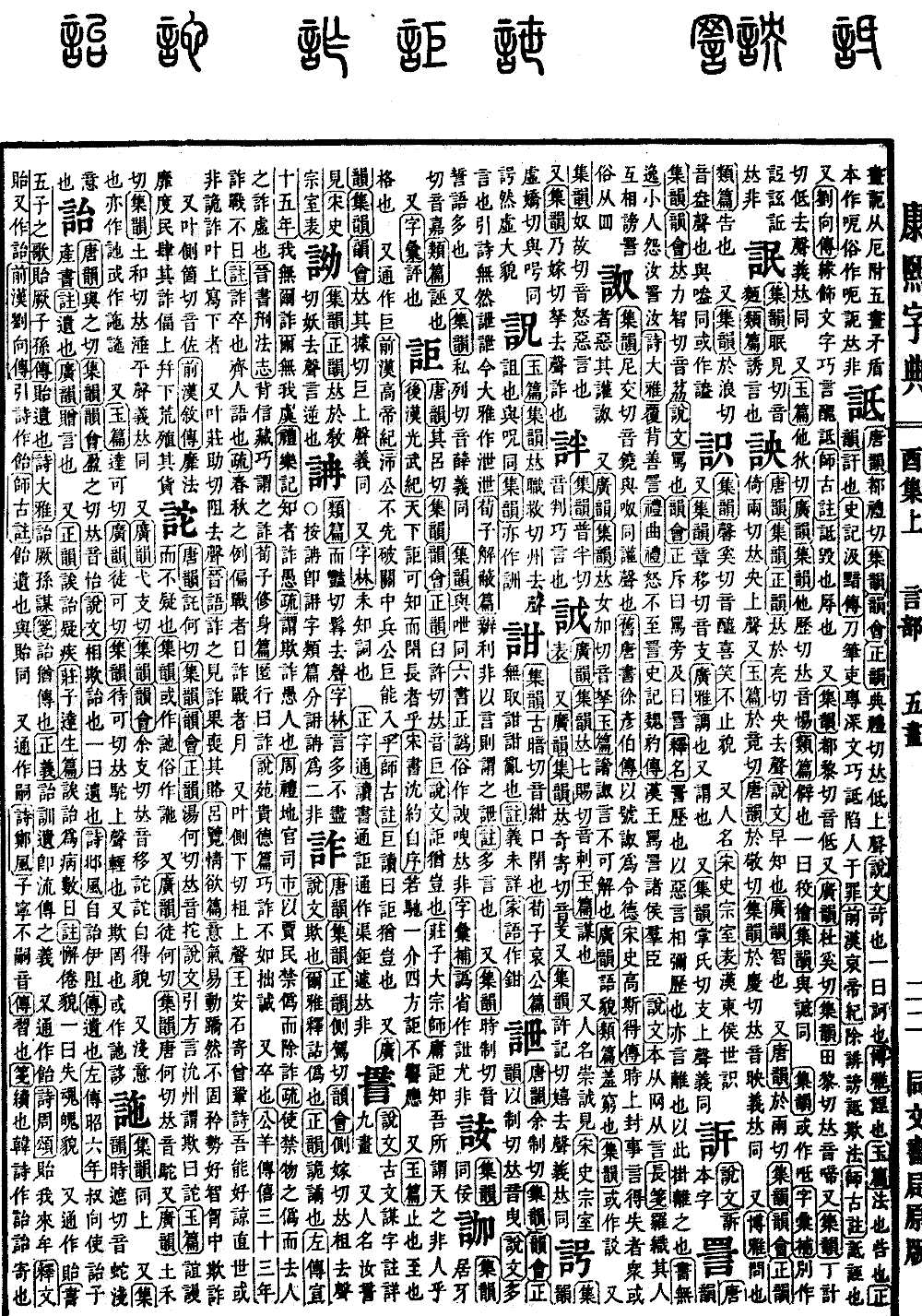
You Collection, Upper Volume
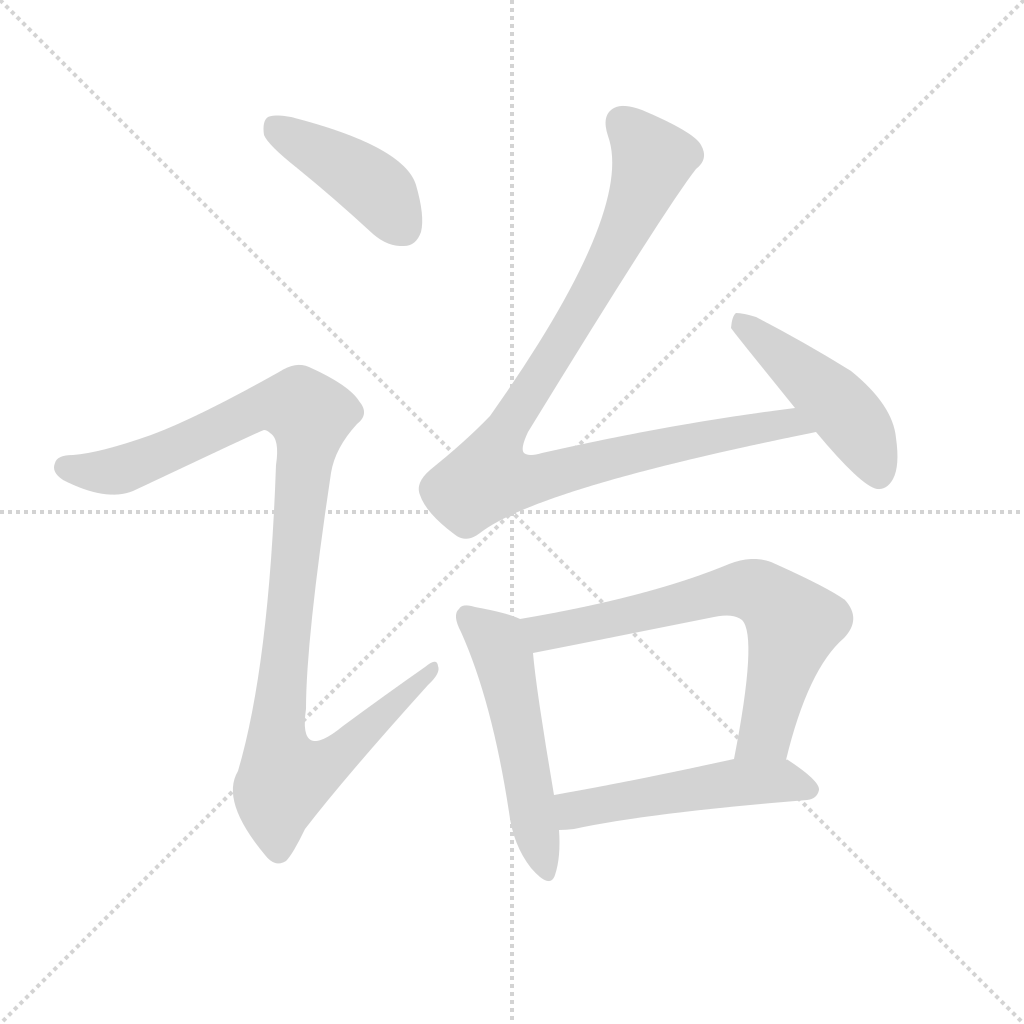
Radical: Speech (yán)
Yi
Kangxi Stroke Count: 12
Page 1154, Entry 01
Pronounced yi.
In the Shuo Wen Jie Zi (Shuowen), it means to deceive one another. Another definition is to bestow or leave behind.
Book of Odes (Shijing), Beifeng: To bring obstacles upon oneself.
Commentary: It means to leave behind.
Zuo Commentary (Zuo Zhuan), Sixth Year of Duke Zhao: Shuxiang sent a letter to Zichan.
Annotation: It means to leave behind.
Guang Yun: To give words as a gift.
Also Zheng Yun: Aiti, meaning a state of lethargy or illness.
Zhuangzi, Dasheng Chapter: Aiti caused illness for several days.
Annotation: The appearance of being sluggish or weary. Another definition is the appearance of having lost one's spirit.
Also interchangeably written as yi.
Book of Documents (Shangshu), Song of the Five Sons: To bequeath it to descendants.
Commentary: Yi means to leave behind.
Book of Odes (Shijing), Daya: To bequeath plans to descendants.
Annotation: Yi is like to pass on.
Correct Interpretation: Yi is defined as leaving behind, which refers to the meaning of passing down through generations.
Also interchangeably written as yi.
Book of Odes (Shijing), Zhousong: Bestowed upon me wheat and barley.
Explication of Texts: Yi, also written as yi.
History of the Former Han Dynasty (Qian Hanshu), Biography of Liu Xiang: Quotes the Book of Odes as yi.
Shigu Annotation: Yi means to leave behind. It is the same as yi.
Also interchangeably written as si.
Book of Odes (Shijing), Zhengfeng: Would you not continue to send word?
Commentary: Xi means to practice.
Annotation: Xu means to continue. The Han version of the Odes uses yi. Yi means to send; to not send any inquiries.
Also pronounced yi (falling tone).
Lei Pian: Also means to leave behind.
Yun Hui: To give as a gift.
Zuo Commentary (Zuo Zhuan), Sixteenth Year of Duke Wen: For those aged seventy and above, there are none who do not receive gifts.
Sub-commentary: Both kuit and yi refer to giving things to people. It is interchangeable with yi, and has both level and falling tones.
Also pronounced tai.
The appearance of being sluggish or weary. Cites the Zhuangzi reference to aiti. Read by Li Gui.
Also pronounced tai (falling tone). Same meaning as above. Also means to deceive.
Also pronounced tai (rising tone).
Lei Pian: In the Jiangnan region, calling someone a deceiver is called yi.
Zeng Yun: Qiyi means to swindle or deceive.
Liezi, Huangdi Chapter: To be disrespectful and deceitful.
Xu Gan, Kaowei Chapter: Flesh and blood deceiving one another, friends swindling each other.
Also interchangeably written as dai.
Guliang Commentary (Guliang Zhuan), First Year of Duke Xi: Hating the deception of the公子 (gōngzǐ).
Annotation: Qidai means to deceive.
Records of the Grand Historian (Shiji), Annals of Xiang Yu: Xiang Yu lost his way; the farmer deceived him by saying, turn left, and thus he fell into a great swamp.
Shigu Annotation: Dai means to deceive.
Lei Pian: Sometimes written as a variant form.