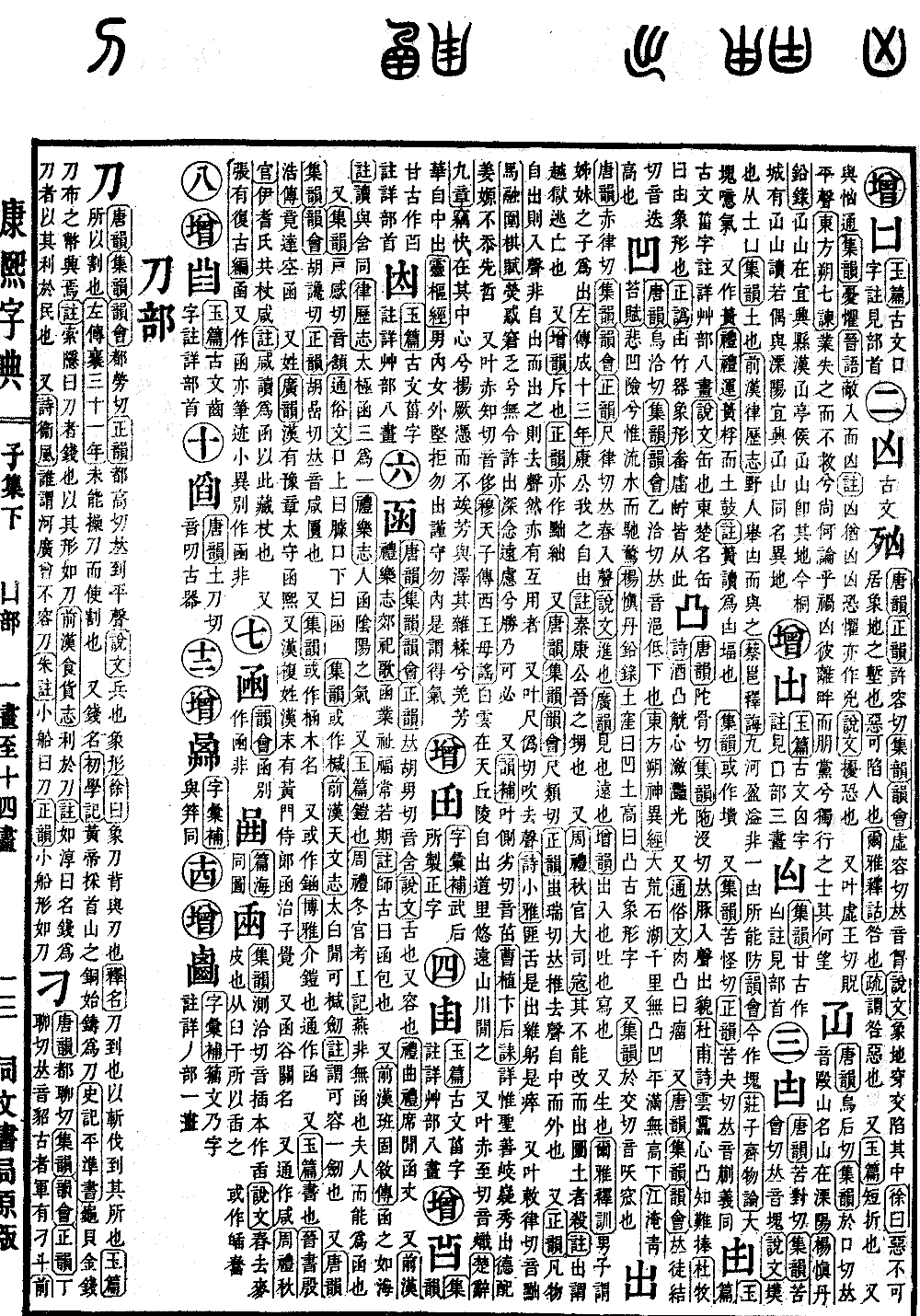
Zi Collection, Page Position: Lower. Radical: Knife (dāo). Character: Knife (dāo). Kangxi Dictionary stroke count: 2. Page number: Page 135, position 24. Tang Rhymes (Tangyun), Collected Rhymes (Jiyun), and Rhyme Assembly (Yunhui) record the pronunciation as a phonetic combination of the sounds dū and láo. Correct Rhymes (Zhengyun) records it as a combination of dū and gāo. It is pronounced the same as the level tone of the word dào. Explaining Graphs and Analyzing Characters (Shuowen Jiezi) defines it as a weapon. The character is a pictograph. Xu Kai states that the character form resembles the shape of the back and the edge of a blade. Explanation of Names (Shiming) says that knife (dāo) means to arrive (dào), referring to a tool used for hacking and cutting to arrive at one's goal. Jade Chapters (Yupian) defines it as an instrument used for cutting. Commentary of Zuo (Zuo Zhuan), in the entry for the thirty-first year of Duke Xiang, mentions letting someone perform cutting before they have even learned how to use a knife. It also refers to a type of currency. Records for Initial Studies (Chuxueji) states that the Yellow Emperor mined copper from Mount Shou and was the first to cast knife coins. Records of the Grand Historian (Shiji), in the Book on Balanced Standards (Pingzhunshu), notes that tortoise shells, cowries, metal coins, knife coins, and cloth coins began to circulate. The Seeking the Obscure (Suoyin) commentary explains that the term knife refers to money because its shape resembles a knife. Book of the Former Han (Qian Hanshu), in the Treatise on Food and Money (Shihuozhi), mentions the benefits of knife coins. Ru Chun's commentary states that money is called a knife because it is beneficial to the common people. Furthermore, in the Book of Odes (Shijing), within the Odes of Wei (Weifeng) section, it is asked who says the Yellow River is wide when it cannot even accommodate a single dāo. Zhu Xi's commentary explains that a small boat is called a dāo. Correct Rhymes notes that the shape of such a small boat resembles a knife.