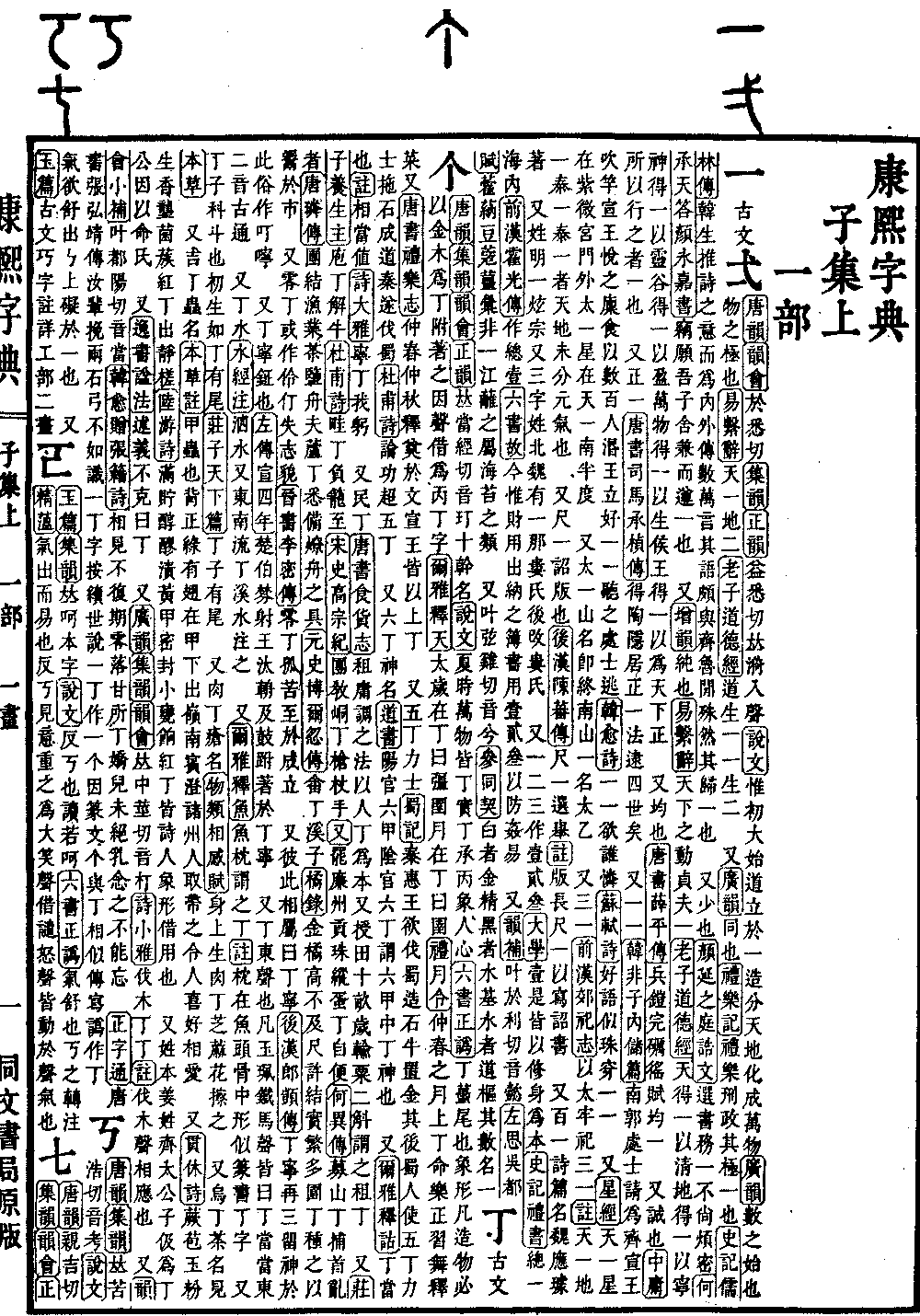
Zi Collection, Page Position: Upper
Radical: One (yī)
Character: One (yī)
Kangxi Dictionary Stroke Count: 1
Page 75, Column 1
The ancient form was written as yī. The Tang Rhymes (Tangyun) and Rhyme Collection (Yunhui) note the pronunciation as yū xī qiè. The Collected Rhymes (Jiyun) and Correct Rhymes (Zhengyun) note the pronunciation as yì xī qiè. It is pronounced like the entering tone of the character pronounced yī. Explaining Graphs and Analyzing Characters (Shuowen Jiezi) explains: At the beginning of the universe, the Great Dao was established upon "one." From this, Heaven and Earth were divided, and the myriad things were transformed and generated. Expanded Rhymes (Guangyun) says: It is the beginning of numbers and the ultimate end of things. The Book of Changes (Yijing), Appended Phrases (Xici) says: Heaven is one, Earth is two. Laozi, Classic of the Way and Virtue (Daodejing) says: The Way produced one, and one produced two. Furthermore, Expanded Rhymes explains it as having the meaning of "identical" or "the same." The Book of Rites (Liji), Record of Music (Yueji) says: Ritual, music, punishment, and government—their ultimate goals are the same. The Records of the Grand Historian (Shiji), Biographies of Confucian Scholars (Rulin Zhuan) records: Master Han investigated the meaning of the Book of Odes (Shijing) and wrote the Inner and Outer Commentaries in tens of thousands of words; his interpretations differed considerably from the scholars of the Qi and Lu regions, but the fundamental purpose was consistent. It is also explained as "few" or "scant." Yan Yanzhi's Admonitions to the Household (Tinggao Wen) says: In selecting books, one must prioritize the essential and not seek the voluminous and detailed. He Chengtian's Letter in Reply to Yan Yongjia (Da Yan Yongjia Shu) says: I privately hope you will discard the miscellaneous and adhere solely to the essential. Furthermore, Supplemented Rhymes (Zengyun) explains it as "pure" or "undivided." The Book of Changes, Appended Phrases says: All movements under Heaven return to the pure and singular. Laozi, Classic of the Way and Virtue says: Heaven attained the One and became clear; Earth attained the One and became tranquil; the spirits attained the One and became divine; the valleys attained the One and became full; the myriad things attained the One and lived; lords and kings attained the One and became the standard for the world. It is also explained as "equal" or "uniform." The Old Book of Tang (Tangshu), Biography of Xue Ping (Xue Ping Zhuan) records: Weapons and armor were intact and sharp; corvée labor and taxes were equalized and uniform. It is also explained as "sincere and single-minded." The Doctrine of the Mean (Zhongyong) says: The means by which the Way is practiced is through being single-minded. There is also the term zhèngyī, meaning "Orthodox One." The Old Book of Tang, Biography of Sima Chengzhen (Sima Chengzhen Zhuan) records: He received the zhèngyī method passed down from Tao Hongjing, which had been transmitted for four generations. There is also the term yīyī, meaning "one by one." The Han Feizi, Inner Congeries of Sayings (Neichu Shuo) records: The scholar Nanguo requested to play the yu flute for King Xuan of Qi. The King was pleased and supported hundreds of flute players with grain from the official granaries. When King Min ascended the throne, he preferred to listen to them perform individually one by one, so the scholar Nanguo fled. A poem by Han Yu says: One by one, who pities them? A poem by Su Shi says: Witty words are like pearls, strung together one by one. Furthermore, the Classic of Stars (Xingjing) records: The Tianyi star is outside the gate of the Purple Forbidden Enclosure. The Taiyi star is located half a degree south of the Tianyi star. There is also Mount Taiyi, which is Mount Zhongnan, also known as Mount Taiyi using the variant form pronounced yǐ. There is also the term sānyī, meaning the "Three Ones." The Book of the Former Han (Qian Hanshu), Treatise on Sacrifices (Jiaosi Zhi) records: The Three Ones were worshipped with the Great Sacrifice (tàiláo). The commentary says: The Three Ones refer to the Heavenly One, the Earthly One, and the Supreme One (Tàiyī). The Supreme One is the original qi before Heaven and Earth were divided. There is also the term chǐyī, meaning "one foot and one inch," which refers to imperial edicts. The Book of the Later Han (Hou Hanshu), Biography of Chen Fan (Chen Fan Zhuan) records: Officials were selected using the chǐyī edicts. The commentary says: The edict boards were one foot and one inch long, used for writing imperial decrees. There is also the "Hundred and One" (Bǎiyī) poems, which is the title of a poetic work by Ying Qu of the Wei state. It is also used as a surname; in the Ming dynasty, there was a man named Yi Xuanzong. There is also a three-character compound surname: in the Northern Wei, there was the Yinalou clan, which later changed to the Lou clan. Furthermore, the complex forms of the numbers one, two, and three are written as yī, èr, and sān. The Great Learning (Daxue) says: All take the cultivation of the self as the root. In the Records of the Grand Historian, Book of Rites (Lishu), the phrase "unifying all within the seas" is written with the standard character for one, while in the Book of the Former Han, Biography of Huo Guang (Huo Guang Zhuan), it is written with the complex form yī. The Causes of the Six Scripts (Liushu Gu) says: Nowadays, only in ledgers and documents for financial receipts and expenditures are the complex forms yī, èr, and sān used to prevent fraudulent alterations by wicked people. Furthermore, the Rhyme Supplement (Yunbu) provides a rhyming pronunciation, read as yū lì qiè, sounding like the character pronounced yì. Zuo Si's Rhapsody on the Capital of Wu (Wudu Fu) says: Agastache and cardamom, ginger and various fragrant herbs are more than one kind. There are also types like river grass and sea moss. There is another rhyming pronunciation, read as xián jī qiè, sounding like the character pronounced xī. The Kinship of the Three (Cantong Qi) says: White is the essence of metal, black is the root of water. Water is the pivot of the Way, and its numerical name is "one."