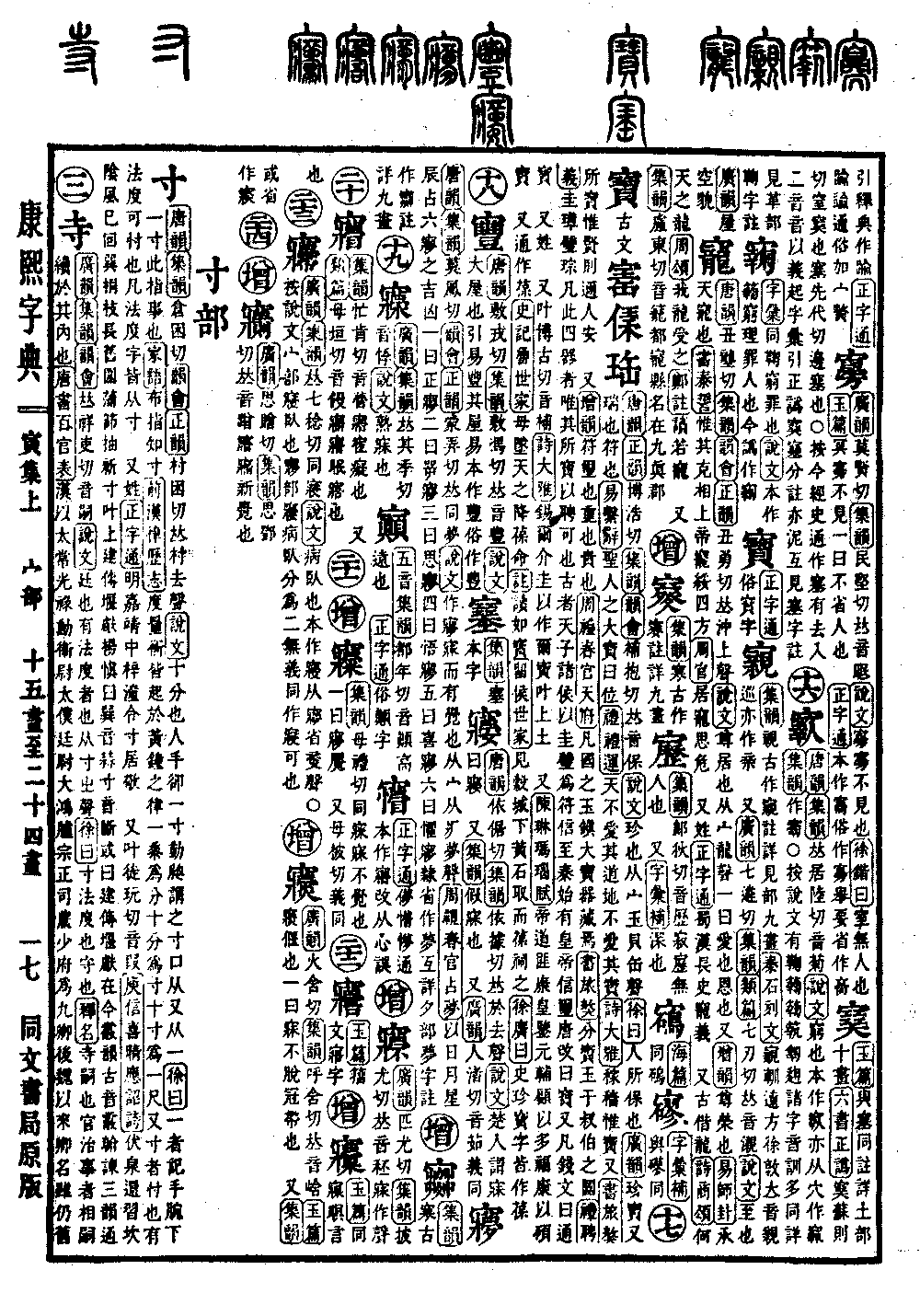
Yin Collection, Upper Volume
Radical: Inch (cùn)
Kangxi Strokes: 3
Page 293, Entry 32
Pronounced cùn (falling tone)
According to the Explaining Graphs and Analyzing Characters (Shuowen Jiezi), it denotes one-tenth of a foot. It refers to the place on the wrist where the pulse can be felt, located one inch behind the palm of the hand. The character is composed of the radical for right hand and the horizontal line, which indicates the location one inch below the wrist. This is a self-explanatory character.
According to the Family Sayings of Confucius (Kongzi Jiayu), by extending the fingers one can determine a length of one inch.
According to the History of the Former Han (Qian Hanshu), section on Regulations and Calendar, the systems of measurement and weight all originate from the musical pitch of the Yellow Bell. The width of one millet grain is one fen; ten fen make one cun; ten cun make one chi.
Cun also means to deliberate, indicating that there is a standard or law by which to measure thoughts. All characters representing laws or standards are derived from the radical for inch.
It is also used as a surname. According to the Zhengzitong, there was a magistrate of Zitong County named Cun Jujing during the Jiajing era of the Ming dynasty.
It is also pronounced duàn (falling tone). In the poem Rejoicing in the Clearing Weather by Yu Xin, it rhymes with the sound of the character xùn. The bamboo branch grows from its old circumference, while the reed joint sprouts a new inch. Some note that this rhyme follows the sound of the character xiàn. Yang Shen stated that xùn rhymes with suàn, and cùn rhymes with duàn; some suggest that the characters xiàn and xiàn belong to the same rhyme category in modern times, while in ancient phonology, the rhyme groups of xiàn, hàn, and jiàn were interchangeable.
Supplementary Note: In the Pianhai Leibian, it is recorded as a vulgar form of the character for wait or class.