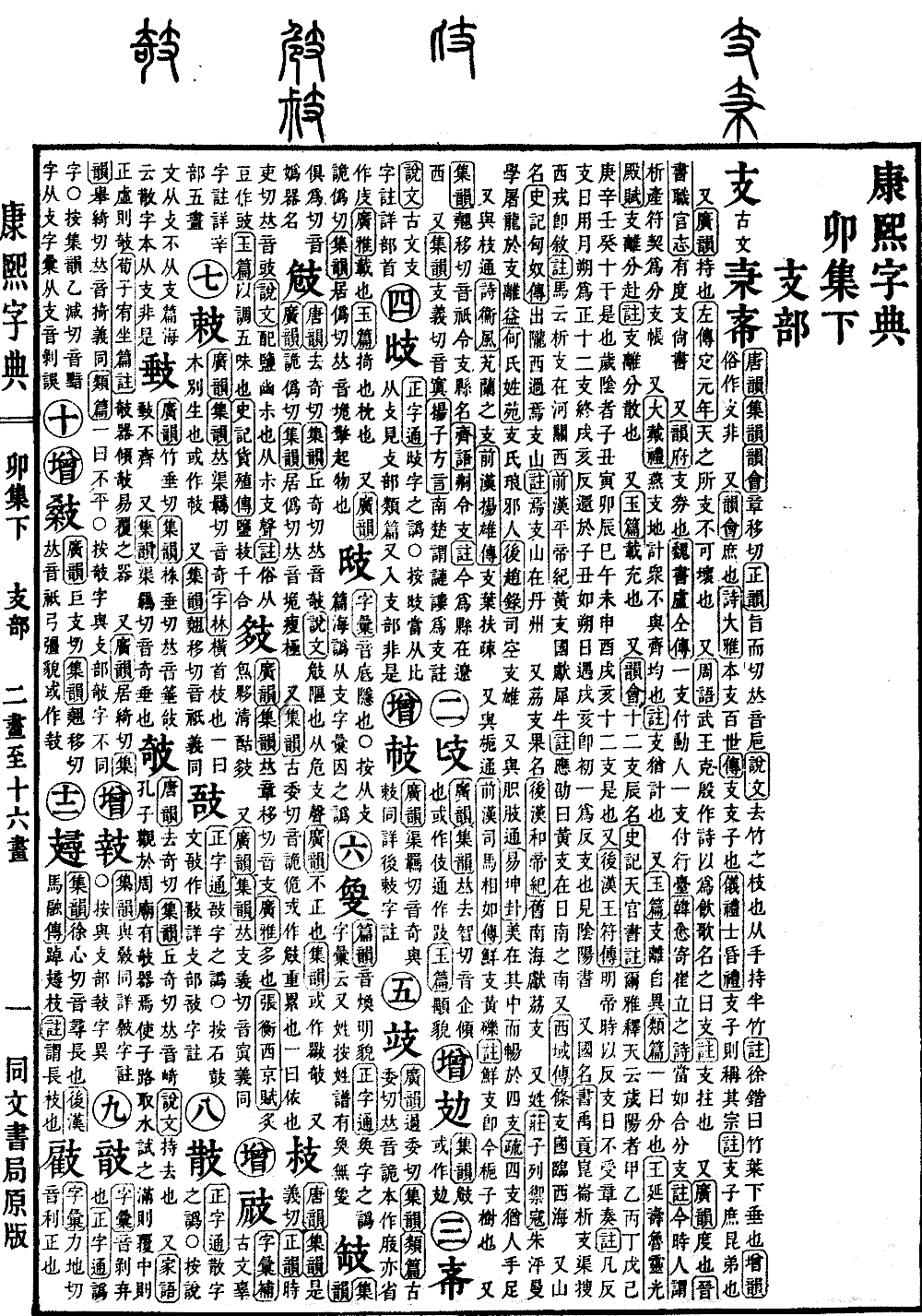
Mao Collection, Lower Volume
Radical: Branch (zhī)
Kangxi Strokes: 4
Page 467, Entry 01
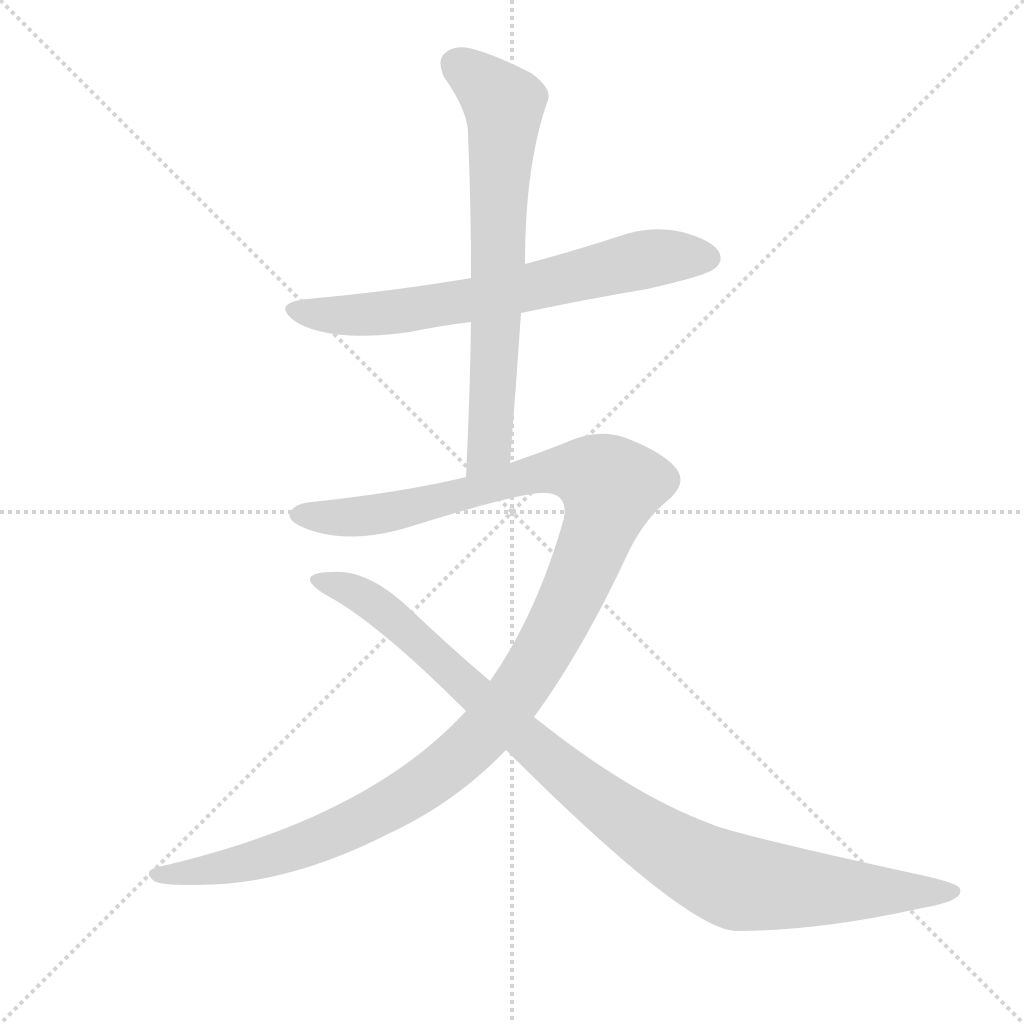
Ancient character. Pronounced zhi.
According to the Shuowen Jiezi (Explanation of Graphs and Analysis of Characters), it denotes the removal of a branch from bamboo. Composed of the radical for hand, holding half of a bamboo stalk. The annotation by Xu Kai states it represents bamboo leaves hanging downward. The Zengyun (Additions to the Rhyme Dictionary) notes that the common form using the radical for strike is incorrect.
Also, meaning to be of the secondary line. In the Book of Odes (Shijing), it is said that the secondary branches continue for a hundred generations. The commentary explains this refers to secondary sons. In the Book of Etiquette and Ceremonial (Yili), it is stated that a secondary son shall address his ancestral head. The commentary explains secondary son refers to those born of a concubine or a junior wife.
Also, meaning to support. In the Zuo Tradition (Zuozhuan), it refers to that which the heavens intended to destroy and could not be supported.
Also, in the Discourses of the States (Guoyu), after King Wu of Zhou conquered the Shang dynasty, he composed a poem to be sung while drinking, naming it Zhi. The commentary explains Zhi means to support.
Also, meaning to measure or calculate. The History of the Southern Dynasties (Jinshu) mentions an Office of Measurement and Expenditure.
Also, a term for evidence or a promissory note. In the History of the Wei (Weishu), a record states that one portion was issued to those with merit, and one portion to the regional office. In a poem by Han Yu, it suggests that one should behave as if distributing property. The commentary notes that people today refer to contracts dividing property as branch accounts.
Also, in the Classic of Filial Piety for Women (Dadai Liji), it states that the state of Yan calculated its land and population, and did not treat them as equal to those of the state of Qi. The commentary notes Zhi here is equivalent to calculating.
Also, the term zhili, meaning unusual or distinct. Another interpretation is to separate. In the Rhapsody on the Lingguang Hall (Lingguangdian Fu), it describes items scattered and rushing in all directions. The commentary explains the appearance of being scattered.
Also, to bear or to be full.
Also, the twelve earthly branches, which are names for hours or years. In the Records of the Grand Historian (Shiji), the annotation to the Treatise on Celestial Offices cites the Erya (Approaching Elegance) dictionary: the solar years are the ten heavenly stems, and the lunar years are the twelve earthly branches.
Also, in the History of the Later Han (Houhanshu), during the reign of Emperor Ming of Han, on fanzhi days, memorials from subjects were not accepted. The commentary explains that fanzhi days are determined by the earthly branch of the first day of the lunar month; the twelve branches cycle from xu and hai, and return to zi and chou. If the first day falls on xu or hai, it is a fanzhi day. Details are found in books on yin and yang.
Also, names of states. In the Tribute of Yu (Yu Gong), it is mentioned that the Kunlun, Xizhi, and Qusou, all western tribes, had submitted. The commentary by Ma Rong states that Xizhi is west of the He Pass. The History of the Former Han (Hanshu) records that the state of Huangzhi presented a rhinoceros. The commentary by Ying Shao states that Huangzhi is south of Rinan Commandery.
Also, in the Treatise on the Western Regions, the state of Tiaozhi is noted as bordering the Western Sea.
Also, mountain names. In the Records of the Grand Historian (Shiji), it is written that departing from Longxi, one passes Yanzhi Mountain. The commentary states Yanzhi Mountain is in Danzhou.
Also, litchi, a fruit name. The History of the Later Han records that in the past, the southern regions presented litchi.
Also, a surname. In the Zhuangzi, it is mentioned that Zhu Pingman studied the art of dragon-slaying under Zhili Yi. The Heshi Xingyuan (Ho Family Surnames) states the Zhi clan is from Langya. The Records of the Later Zhao state there was a Minister of Works named Zhi Xiong.
Also, interchangeable with the character for limbs. In the I Ching (Book of Changes), it is said that beauty is contained within, and it reaches the four limbs. The commentary explains the four limbs are like the hands and feet of a person.
Also, interchangeable with the character for tree branch. In the Book of Odes (Shijing), it refers to the branches of the fragrant herbs. In the History of the Former Han (Hanshu), it refers to lush branches and leaves.
Also, interchangeable with the character for gardenia. In the History of the Former Han, it mentions xianzhi and yellow gravel. The commentary states xianzhi is the modern gardenia.
Also, pronounced zhi. Lingzhi is the name of a district. In the Discourses of Qi (Qiyu), it refers to attacking Lingzhi. The commentary notes this is currently a district in Liaoxi Commandery.
Also, pronounced zhi. In the Fangyan (Regional Speech), the people of Southern Chu refer to wordy or convoluted speech as zhizhu.