Zi Collection, Page Position: Upper
Radical: One (yī)
Pi
Kangxi Stroke Count: 5
Page 77, Row 10
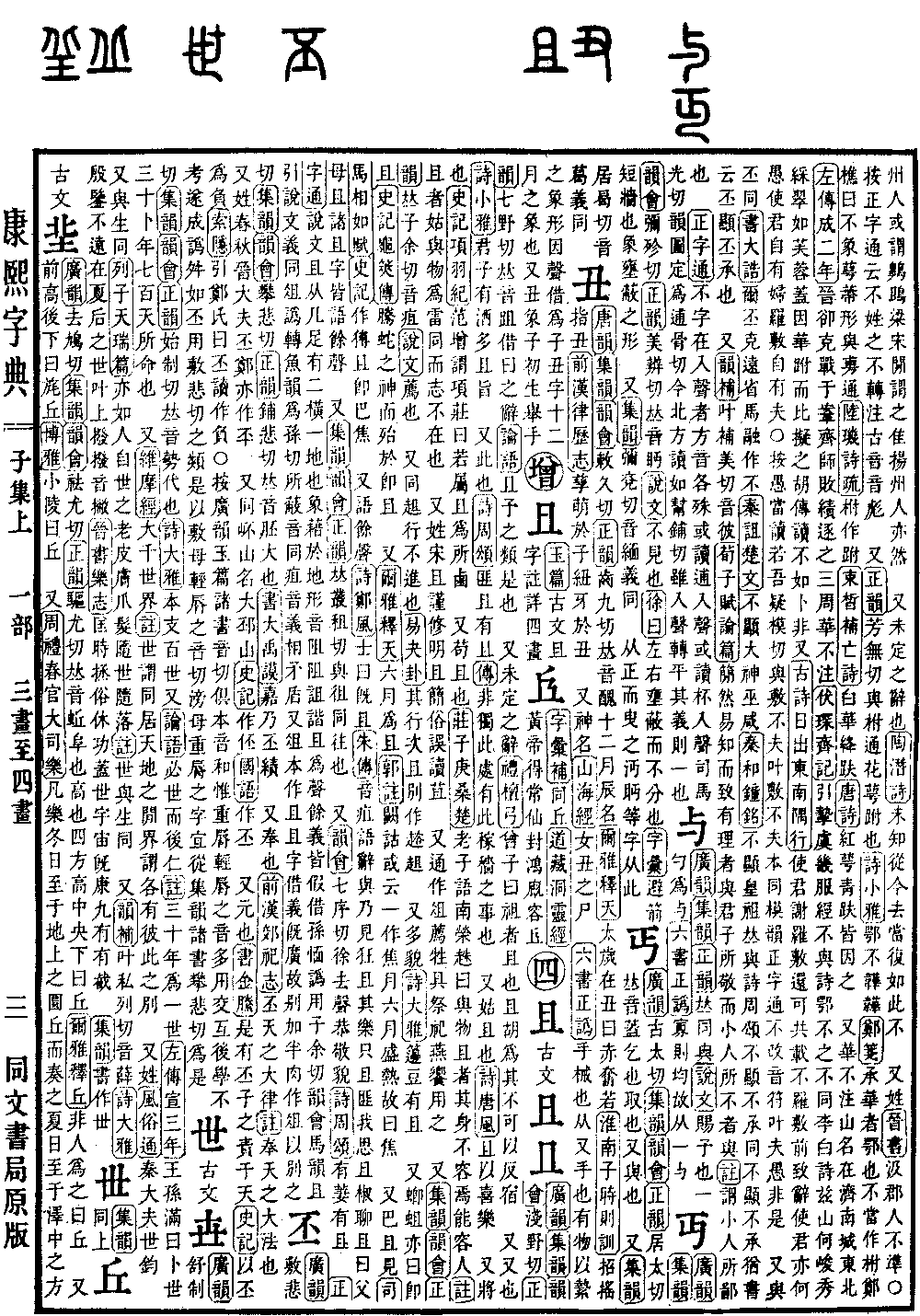
In the Broad Rhymes (Guangyun), the pronunciation is given by the fanqie of fū and bēi. In the Collected Rhymes (Jiyun) and the Rhyme Assembly (Yunhui), it is given by the fanqie of pān and bēi. In the Correct Rhymes (Zhengyun), it is given by the fanqie of pū and bēi. It is pronounced the same as pēi. It means large. In the Counsels of Great Yu (Da Yu Mo) section of the Book of Documents (Shujing), it says: I praise your great achievements. It also means to receive or uphold. In the Treatise on Sacrifices (Jiaosi Zhi) in the History of the Former Han (Qian Hanshu), it says: Upholding the great laws of Heaven. The commentary explains this as carrying out the great laws of Heaven. It is also a surname, such as Pi Zheng, a high official of the State of Jin during the Spring and Autumn period. It is also written in a variant form. It is also the same as the character pí, referring to a mountain name, specifically Great Pi Mountain. In the Records of the Grand Historian (Shiji), it is written as pī, while in the Discourses of the States (Guoyu), it is written as pī. It also means original or first. In the Metal-Bound Coffer (Jin Teng) section of the Book of Documents (Shujing), it says: This is the responsibility of the eldest son toward Heaven. The Records of the Grand Historian (Shiji) writes pi as fù. The Suoyin commentary cites the scholar Zheng, stating that pi is read as fù. According to the pronunciations in the Broad Rhymes and the Jade Chapters (Yupian), the entries were originally based on the principles of sound harmony, but heavy labial sounds and light labial sounds were often confused. Later scholars failed to investigate this thoroughly, leading to errors. For example, using a fanqie like fū and bēi for pi uses a light labial initial fū to represent a heavy labial initial pāng. One should follow the fanqie of pān and bēi found in the Collected Rhymes. The character pí was originally composed of the radicals for mountain (shān) and not (bù).