Zi Collection, Page Position: Lower
Radical: Open Box (kǎn)
Kangxi radical strokes: 5
Page 135, Entry 07
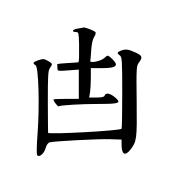
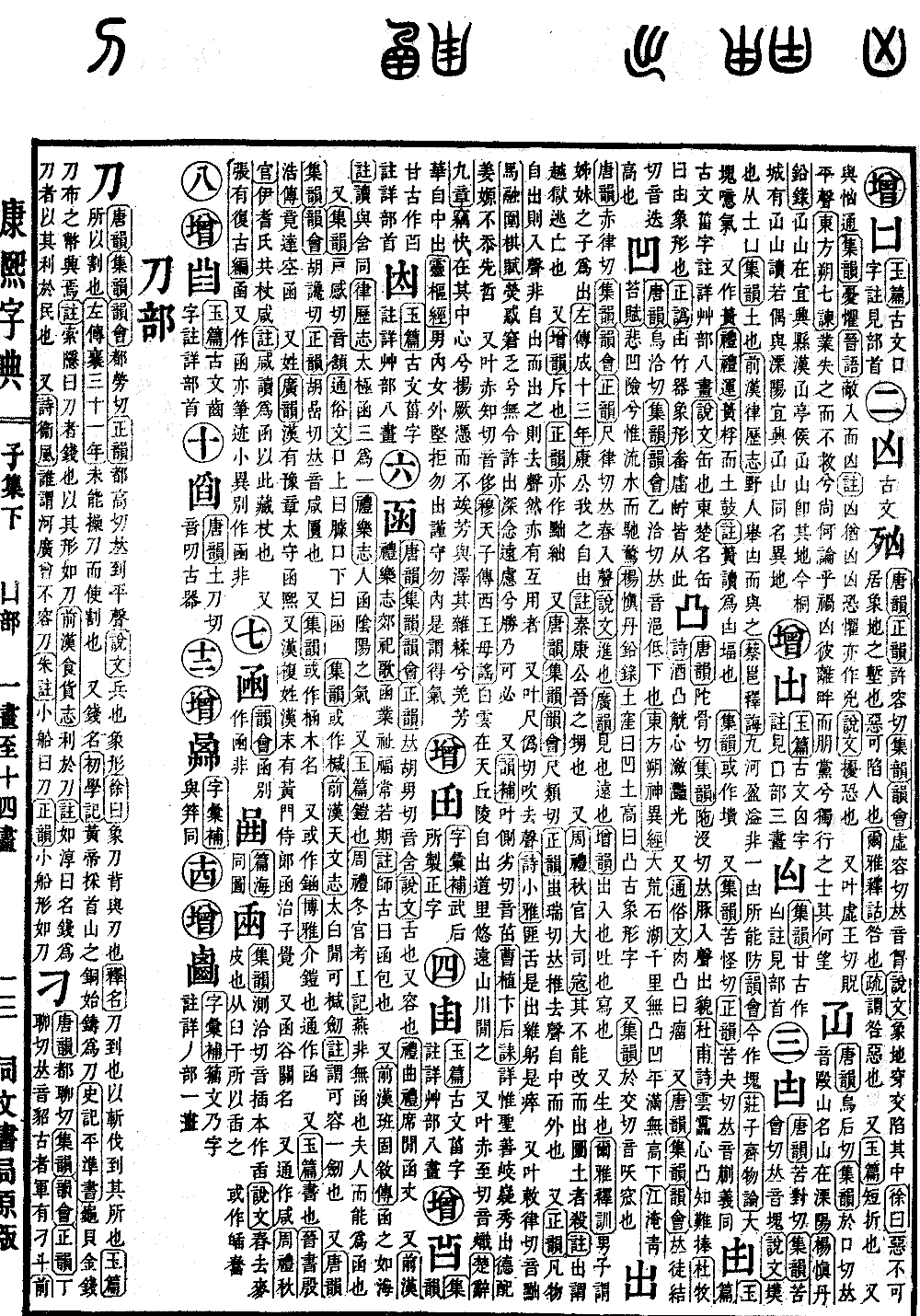
From Tangyun (tángyùn): "kǔ duì qiè". From Jiyun (jíyùn): "kǔ huì qiè". Pronounced "kuài". From Shuowen (shuōwén): "A clod of earth." Formed from Earth (tǔ) and Open Box (kǎn). From Jiyun (jíyùn): "Earth." The Book of Han (Hànshū), Treatise on Calendars and Astronomy (Lǜlìzhì) states: "The common people picked up a clod of earth and gave it." Cai Yong's (Cài Yōng) Explication of Doubts (Shìhuì) states: "The Nine Rivers overflowed, and it was not a single clod that could prevent it." From Yunhui (yùnhuì): "Now written as 塊." Zhuangzi (zhuāngzǐ), On the Equality of Things (Qíwùlùn) states: "The Great Clod exhales." Also written as 蕢. The Book of Rites (Lǐjì), Evolution of Rites (Lǐyùn) states: "They played on rafts made of reeds and drums made of earth." The commentary says: "蕢 is read as 凷, meaning a clod of earth." From Jiyun (jíyùn): "Sometimes also written as 墤."
Also, from Jiyun (jíyùn): "kǔ guài qiè". From Zhengyun (zhèngyùn): "kǔ guài qiè". Pronounced "kuǎi". The meaning is the same.