Zi Collection, Page Position: Upper
Radical: One (yī)
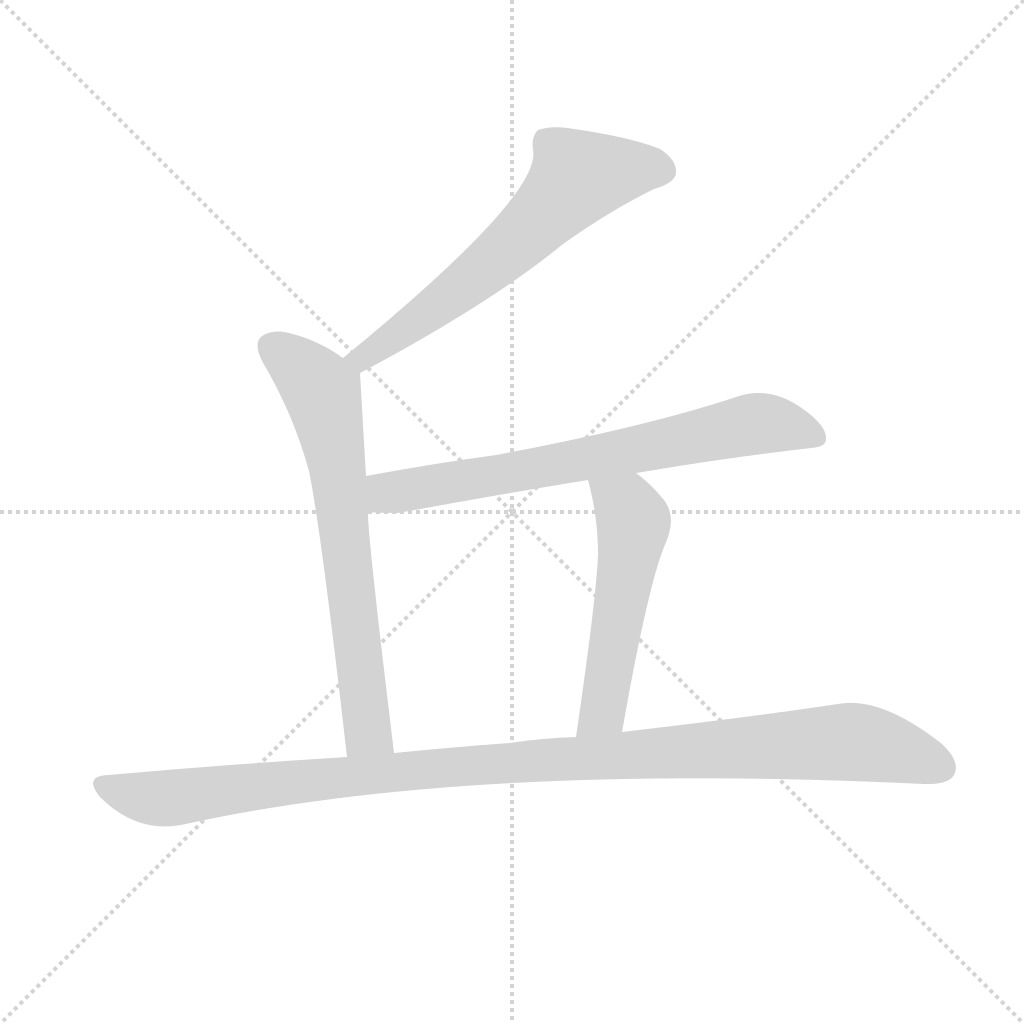
Qiu
Kangxi Stroke Count: 5
Page 77, Number 14
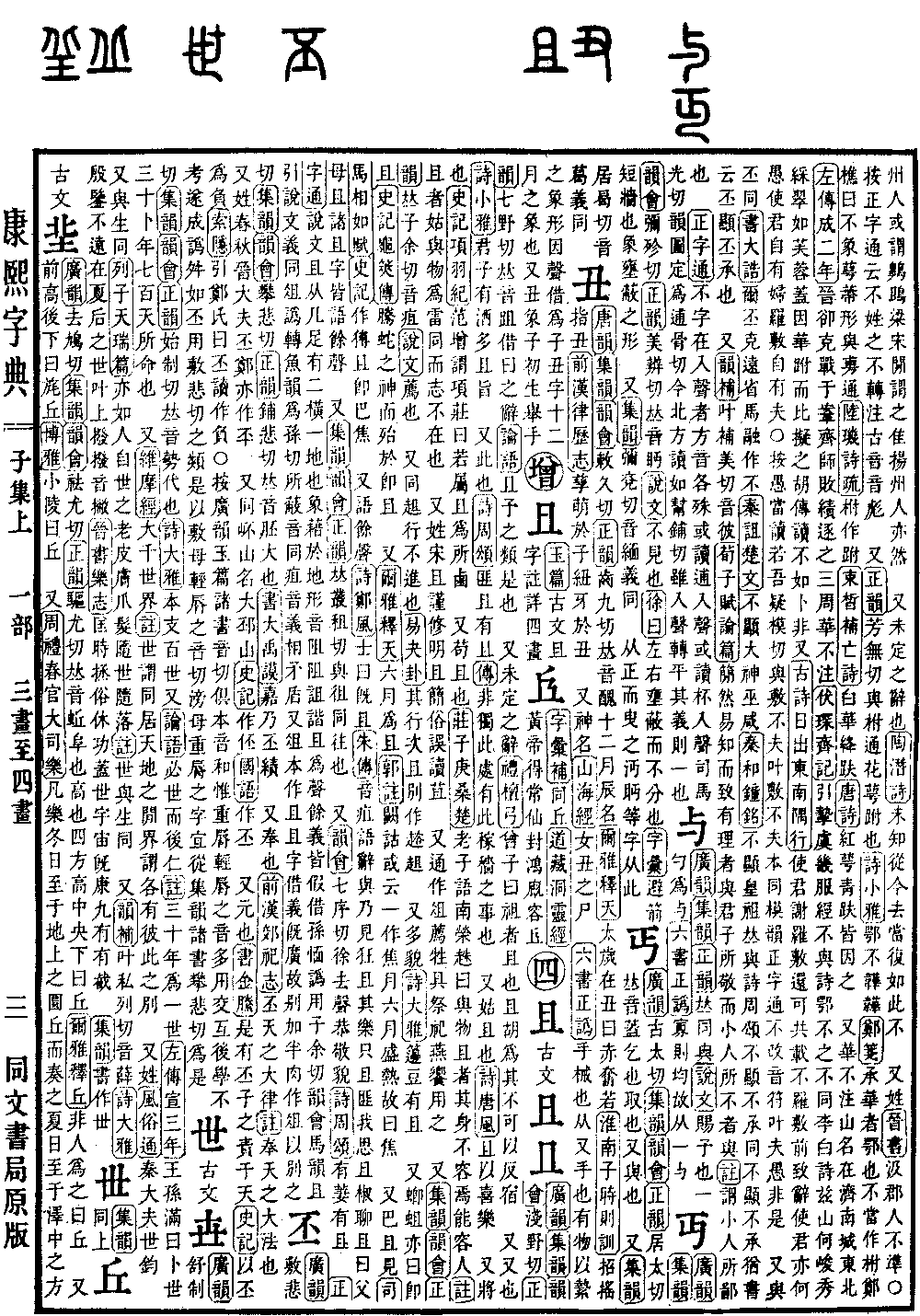
Ancient form. According to the Broad Rhymes (Guangyun), the Collected Rhymes (Jiyun), the Rhyme Assembly (Yunhui), and the Correct Rhymes (Zhengyun), it is pronounced with the initial of qù and the final of jiū, or qū and yóu, or qū and yóu, sounding like qiū.
A mound; high ground. A place that is high on four sides and low in the center is called a qiu. That which is not man-made is called a qiu — Erya.
Also, a place that is high in front and low in back is called a mao-qiu. A small hill is called a qiu — Boya.
Also, in the Rites of Zhou (Zhouli), in the section of the Grand Master of Music, it is stated that during the winter solstice, music is played on the Round Mound (Yuanqiu) on the ground. During the summer solstice, music is played on the Square Mound (Fangqiu) in the marsh. Commentary: High earth is called a qiu. Because high things are used to serve Heaven, the ritual is performed on the ground. Because low things are used to serve Earth, the ritual is performed in the marsh.
Also a place name. Diqiu was originally the ruins of the emperor Zhuanxu, located in present-day Puyang County, Chanzhou. Also Yingqiu, Shangqiu, Chuqiu, Lingqiu, Kuiqiu, Xianqiu, and Huqiu are all place names.
Also the Three Hills (Sanqiu). Passing through the desolate wilds of Shaohao, I ask about the Three Hills from Goumang — Rhapsody on Contemplating the Mystery (Sixuan Fu) by Zhang Heng. Note: Penglai, Fangzhang, and Fanghu are the three places where immortals dwell.
Also, in the Book of Han (Qian Han Shu), in the Treatise on Law, it is stated that four wells make a town (yi), and four towns make a qiu. A qiu consists of sixteen wells.
Also, in the Spring and Autumn Annals (Chunqiu), in the first year of Duke Cheng, the qiu armor was established. Commentary by Hu: This refers to increasing the troops; if each qiu provides one armored soldier, then within one dian (a larger administrative unit), there would be a total of one hundred soldiers.
Also means to gather. The records of the Nine Provinces are called the Nine Qiu. This means that all the contents of the Nine Provinces are gathered in this book — Preface to the Book of Documents (Shangshu) by Kong Anguo.
Also Chongqiu, the name of a lost poem from the Book of Odes (Shijing). It signifies that all things reach their ultimate height and greatness.
Also means large. In the Book of Han, in the Biography of Prince Yuan of Chu, it is mentioned that when Emperor Gaozu was of humble status, he once visited his elder sister-in-law (qiu-sao) for a meal. Note: A term for the eldest sister-in-law.
Also means empty. Residing in an empty pavilion — Book of Han, Biography of Xifu Gong.
Also qiu-li. Shaozhi asked Taigong Diao: What is meant by the talk of the qiu-li? He replied: Qiu-li refers to combining ten surnames and a hundred names to form customs — Zhuangzi.
Also bhikkhu (biqiu). In the Book of Wei (Wei Shu), in the Treatise on Buddhism and Taoism, it is stated that Sangmen (Shramana) means to rest the mind, and biqiu (bhikkhu) means to beg for food.
Also a surname. Also compound surnames such as Zuoqiu, Longqiu, Xianqiu, Yuqiu, Liangqiu, Muqiu, Taoqiu, Fuqiu, Maiqiu, Shuiqiu, and Wuqiu.
Also, in the Rhyme Supplement (Yunbu), it rhymes as qī. Accompanying you across the Qi River, as far as Dunqiu — Book of Odes. It rhymes with the following word qī. In the Minor Odes (Xiaoya), the path through the willow garden winds toward the hill (mu-qiu). It rhymes with the following word zhī. In the Zuo Commentary (Zuo Zhuan), fifteenth year of Duke Xi, Shi Su divined it saying: It is not favorable for the army to march; they will be defeated at Zongqiu. It rhymes with the preceding words jī and qí.
Also rhymes as kāo. The dark bird bids farewell and returns, flying toward the spiritual hill (Lingqiu). Looking at the valley so lush and verdant, where bears and grizzly bears roar — Verses of Chu (Chuci).
Also rhymes as qū. Passing through the spiritual realm of immortality, following the Cinnabar Hill (Danqiu) of the winged men. Seeing the common people in such abundance, I linger and hesitate — Rhapsody on the Great Wilds (Dahuang Fu) by Chen Lin. In ancient times, the sounds of qiu and qu were interchangeable. Yan Shigu stated: In ancient speech, the two characters qiu and qu had no distinction in sound, but they are read differently now. See also the entry for qu under the Radical: Box (fāng).
The Collected Rhymes states it was originally written in a variant form pronounced qiū, and also written in another variant form.