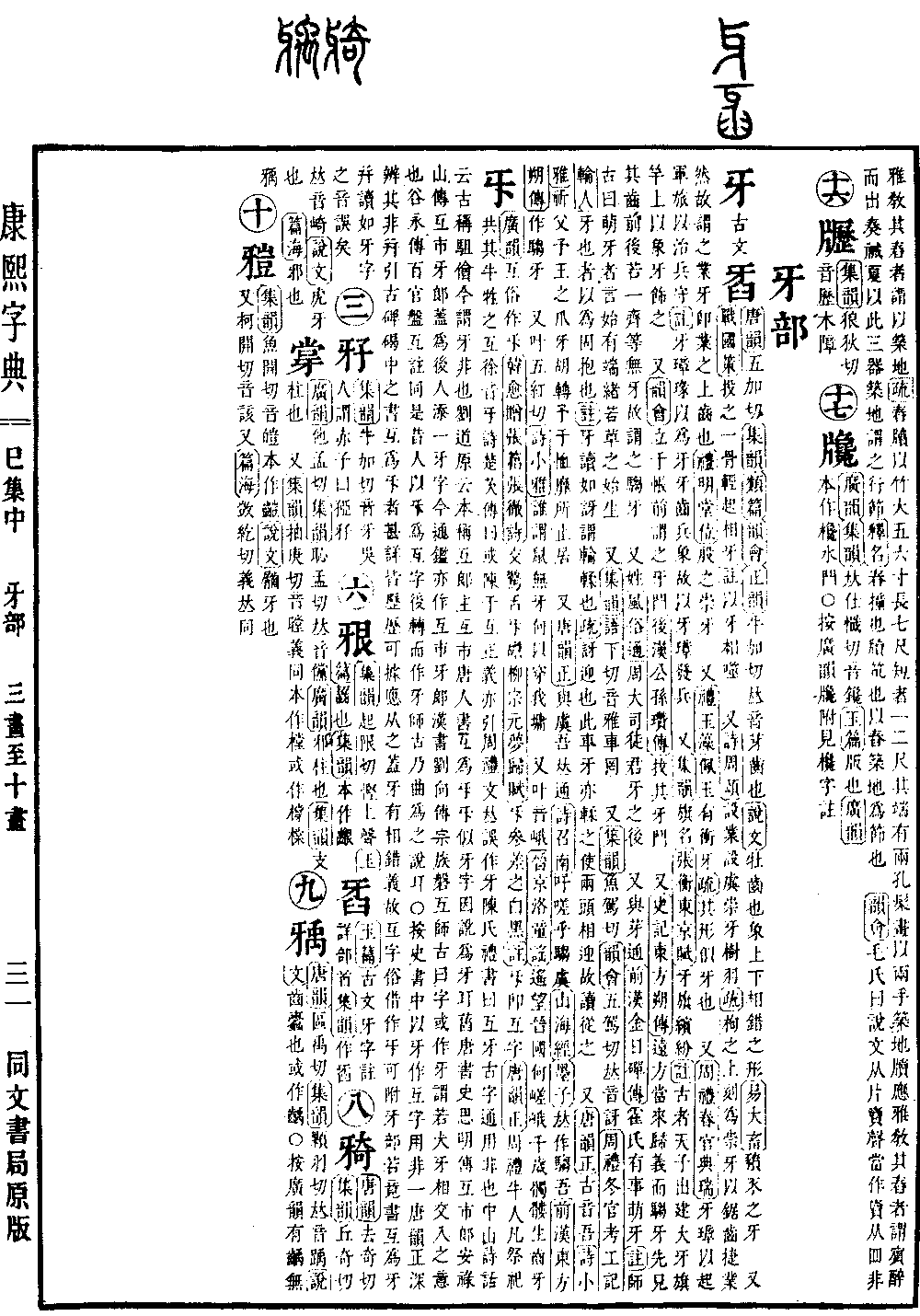
Si Collection, Middle Volume
Radical: Tooth (yá)
Kangxi Strokes: 4
Page 695, Entry 03
Ancient form. Tang Rhymes (Tangyun) states pronunciation is ya; Collected Rhymes (Jiyun), Categories of Characters (Leipian), Rhymes and Meetings (Yunhui), and Orthodox Rhymes (Zhengyun) state pronunciation is ya. The pronunciation is the same as that for sprout. Refers to teeth. Explaining Characters and Writing (Shuowen Jiezi) defines it as the teeth of a male animal. The character shape resembles the interlocking of upper and lower teeth. Book of Changes (Yijing), Hexagram Great Taming (Daxu Gua), mentions the teeth of a castrated pig. Also, Stratagems of the Warring States (Zhanguoce): Throwing a bone will easily cause animals to fight each other with their teeth. Commentary: Refers to biting one another with teeth.
Also, Book of Odes (Shijing), Zhou Eulogies (Zhousong): Refers to the wooden frames and crossbeams used to hang bells and chimes, with sawtooth-shaped, towering, tooth-like decorations carved onto the crossbeams, inserted with feathers. Commentary: Carving towering, tooth-like decorations onto the crossbeams where bells and chimes are hung. Because the sawtooth patterns are arranged neatly and have prominent shapes, it is called ye-ya, which is the tooth-shaped part at the upper end of the crossbeam. Book of Rites (Liji), Bright Hall Positions (Mingtangwei), records that this towering tooth-shaped decoration existed as early as the Yin dynasty.
Also, Book of Rites (Liji), Jade Ornaments (Yuzao): There is a jade ornament among the worn jade pieces called chong-ya. Commentary: Its shape resembles a tooth.
Also, Rites of Zhou (Zhouli), Spring Officials (Chunguan), Statutes of Auspicious Tokens (Dianrui): Used a tooth-token (yazhang) to mobilize troops, for military management and defense. Commentary: A tooth-token is a jade piece carved with tooth-like patterns; the teeth symbolize weapons, hence it is used to dispatch troops.
Also, Collected Rhymes (Jiyun): The name of a type of banner. Zhang Heng, Rhapsody on the Eastern Capital (Dongjing Fu): The tooth-banners are numerous. Commentary: In ancient times, when the Emperor traveled, a large tooth-banner was erected, with the flagpole decorated with ivory.
Also, Rhymes and Meetings (Yunhui): The banner erected in front of a military tent is called a tooth-gate (yamen). History of the Later Han (Hou Hanshu), Biography of Gongsun Zan: Attacked and captured his tooth-gate.
Also, Records of the Grand Historian (Shiji), Biography of Dongfang Shuo: When people from afar are about to submit to the imperial court, the auspicious omen known as the zou-ya is seen first; its teeth are uniform front to back, neat and without irregularity, which is why it is called zou-ya.
Also a surname. Customs and Traditions (Fengsutong) records it as descending from Jun Ya, a Grand Minister of the Zhou dynasty.
Also interchangeable with the character for sprout. History of the Former Han (Qian Hanshu), Biography of Jin Ridi: The Huo family had the beginnings (mengya) of a situation. Commentary: Shiguan says: Mengya refers to when a situation has just shown slight signs, similar to grass just beginning to sprout.
Also, Collected Rhymes (Jiyun): Pronounced ya. Refers to the outer rim of a wheel.
Also, Collected Rhymes (Jiyun): Pronounced ya; Rhymes and Meetings (Yunhui): Pronounced ya. Rites of Zhou (Zhouli), Winter Officials (Dongguan), Records of Artificers (Kaogongji), Wheel-Maker (Lunren): A ya is a component used to make the wheel firm and hold it together. Commentary: Pronounced ya. Refers to the outer frame of a wheel. Commentary: Ya implies greeting. This outer frame of the wheel is also curved, connecting the two ends, so the pronunciation follows this meaning.
Also, Tang Rhymes Orthodox (Tangyun Zheng): In ancient times pronounced wu. Book of Odes (Shijing), Lesser Odes (Xiaoya): O Qi Fu, I am the claws and teeth of the ruler. Why did you place me in a land of sorrow with no place to rest?
Also, Tang Rhymes Orthodox (Tangyun Zheng): Interchangeable with yu and wu. Book of Odes (Shijing), Odes of Zhao (Zhaonan): Alas for the zou-yu. Classic of Mountains and Seas (Shanhaijing) and Mozi write it as zou-wu. History of the Former Han (Qian Hanshu), Biography of Dongfang Shuo, writes it as zou-ya.
Also, rhyme-merged pronunciation as wu. Book of Odes (Shijing), Lesser Odes (Xiaoya): Who says the rat has no teeth, what does it use to pierce my wall?
Also, rhyme-merged pronunciation as e. Jin Dynasty Luoyang nursery rhyme: Looking from afar at the Jin state, how towering it is, a thousand-year-old skeleton has grown teeth.