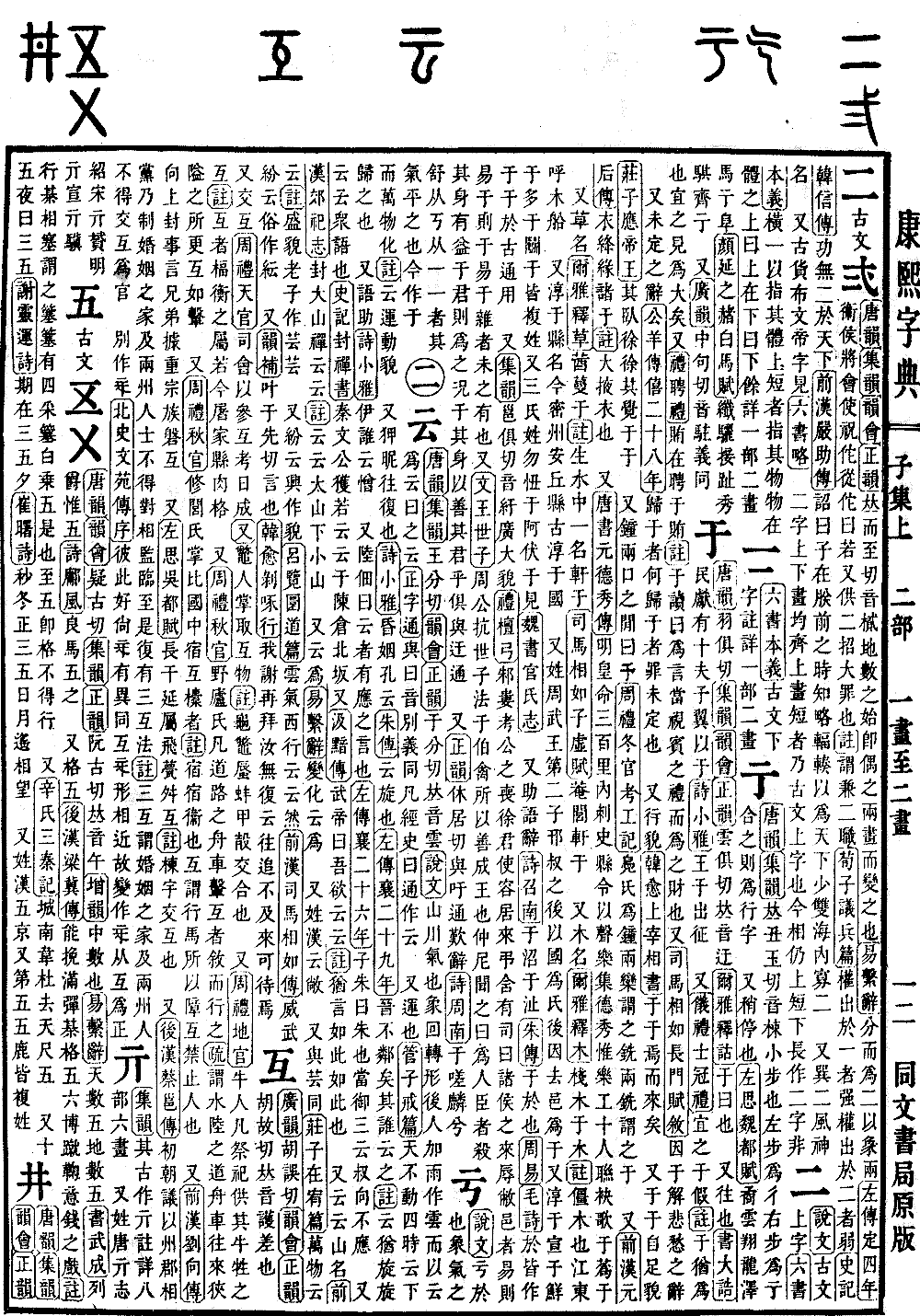
Zi Collection, Page Position: Upper
Radical: Two (èr)
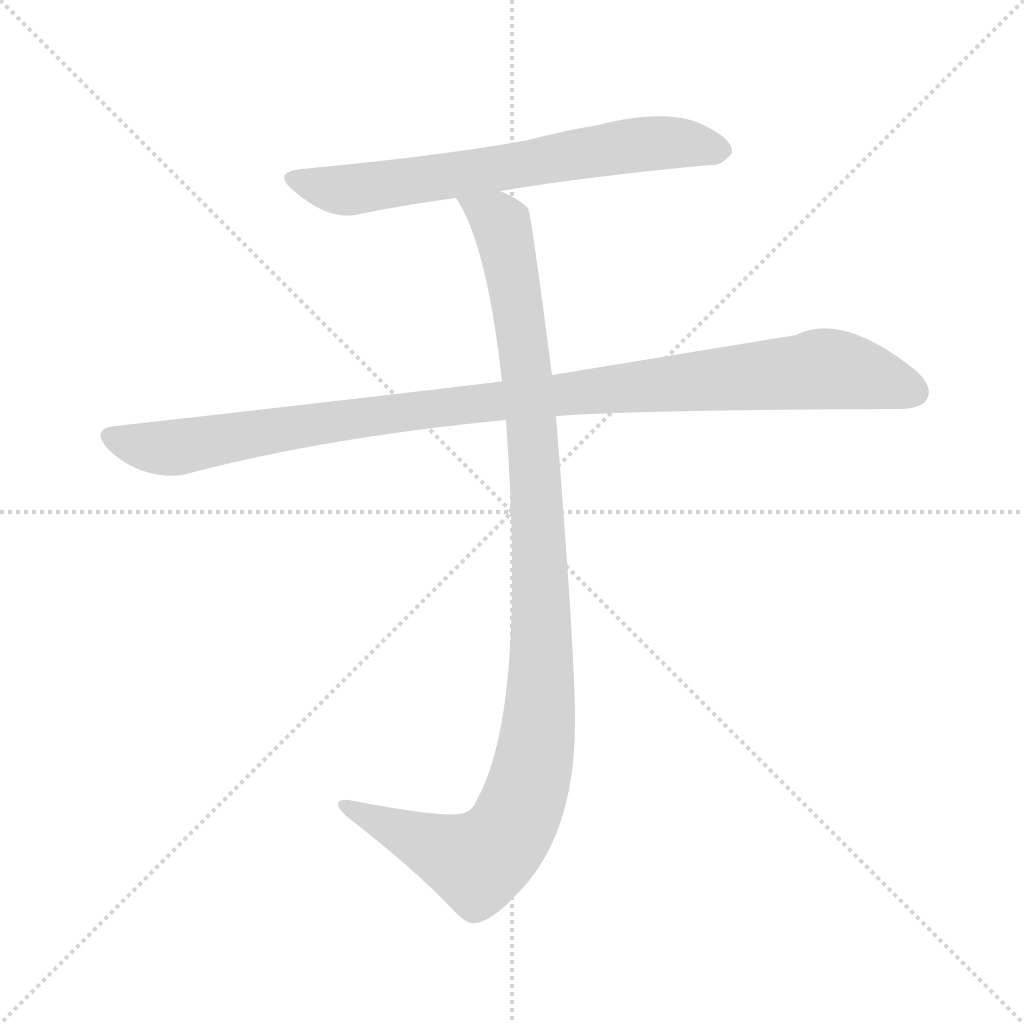
yú
Kangxi Stroke Count: 3
Page 86, Number 06
Tang Phonology: phonetic combination of yǔ and jū. Collected Rhymes, Rhyme Assembly, and Correct Rhymes: phonetic combination of yún and jū, pronounced like yū.
Erya, Explaining Words (Shigu): yú means yuē (to say). It also means wǎng (to go).
Book of Documents (Shangshu): Among the worthy people there are ten men; I will assist them in going forward.
Book of Odes (Shijing): The King goes forth on an expedition.
Also, from the Book of Etiquette and Ceremonial (Yili): It is appropriate for it to be great. Note: yú is equivalent to wéi (to be). It means "suitable to appear grand."
Also, from the Rites of Visits (Pinli): The gifts lie in the ceremonial presentation of gifts. Note: yú is read as wéi. It means one should prepare corresponding goods according to the guest's protocol.
Also, from Sima Xiangru, Preface to the Rhapsody of the Tall Gate (Changmen Fu Xu): Consequently, he composed words to dispel sorrow.
Also used to indicate uncertainty. Gongyang Commentary (Gongyang Zhuan): What does "returning to yú" mean? "Returning to yú" indicates that the crime has not yet been determined.
Also describes the manner of walking. Han Yu, Letter to the Chancellor (Shang Zaixiang Shu): Coming in a leisurely and unhurried manner.
Also "yú yú," describing a self-satisfied appearance. Zhuangzi, The Response to Emperors and Kings (Ying Diwang): When he sleeps, he is calm and slow; when he wakes, he is leisurely and carefree.
Also, the space between the two corners of a bell is called yú. Rites of Zhou (Zhouli), Record of Trades (Kaogong Ji): The Fu clan makes bells; the two protruding sides are called xiǎn, and the space between the xiǎn is called yú.
Also, from the History of the Former Han (Qian Hanshu): Wearing a red-trimmed zhū yú. Note: Refers to a garment with large sleeves.
Also, from the Old Book of Tang (Tangshu): Emperor Minghuang ordered governors and magistrates within three hundred li to gather with musicians; Yuan Dexiu brought only ten musicians, who held hands and sang "Yú Wěi Yú."
Also a name for a plant. Erya, Explaining Plants (Shicao): Qiàn, the creeping yú. Note: It grows in water. Also called xuān yú. Sima Xiangru, Rhapsody of Sir Vacuous (Zixu Fu): Ān lǘ and xuān yú.
Also a name for a tree. Erya, Explaining Trees (Shimu): Zhàn mù, the yú tree. Note: Refers to a dead, fallen tree. In the Jiangdong region, it is called mù gè.
Also "Chúnyú," a county name. Present-day Anqiu County in Mizhou was the ancient state of Chunyu.
Also a surname. Descendants of Yú Shū, the second son of King Wu of Zhou, took the state name as their surname, later dropping the "city" radical to become the surname Yú.
Also "Chúnyú," "Xuānyú," "Xiānyú," "Duōyú," and "Yú" are all compound surnames.
There are also three-character surnames, such as "Wùniǔyú" and "Āfúyú," found in the History of Wei (Weishu), Record of Official Clans (Guanshi Zhi).
Also used as a grammatical particle. Book of Odes: In the ponds, on the islets. Commentary by Zhu Xi: yú is equivalent to the particle yú. In the Book of Changes (Zhouyi) and the Mao edition of the Odes, the particle was written as yú. The two forms were used interchangeably in ancient times.
Also, from Collected Rhymes: phonetic combination of yōng and jū, pronounced like yū. Describes a grand appearance. Book of Rites (Liji): At the funeral of Duke Kao of Zhulou, the ruler of Xu sent Rong Ju to offer condolences and burial jade. The official said: When lords deign to visit our humble city, those who follow the simple rites do so simply, and those who follow the grand rites do so grandly; there has never been a mixture of simple and grand.
Also, from the Prince of King Wen (Wenwang Shizi) chapter: Confucius said: The Duke of Zhou applied the laws of the heir apparent to Bo Qin in order to better King Cheng. I have heard it said: If a minister's sacrificing himself benefits his lord, he will do it; how much more so would he refine himself to improve his lord? All these instances are interchangeable with yū.
Also, from Correct Rhymes: phonetic combination of xiū and jū, interchangeable with xū. An interjection of lament. Book of Odes: Alas, the unicorn!
Textual Verification: Regarding the Book of Etiquette and Ceremonial, "The gifts lie in the ceremonial presentation of gifts." According to the style of this dictionary, the Book of Rites is usually called "Li," but as this quote comes from the Book of Etiquette and Ceremonial, the word "Li" is deleted. In the Rites of Zhou, Record of Trades, "The Fu clan makes bells; the two protruding sides are called xiǎn, and the space between the xiǎn is called yú." The phrase "two xiǎn" has been corrected to "the space between the xiǎn" according to the original text. In Erya, Explaining Trees, "Zhàn mù, the yú tree," the note says "dead tree." In Jiangdong, it is called mù gè. The original note "mù chuán" is corrected to "mù gè." In the Prince of King Wen chapter, "The Duke of Zhou applied the laws of the heir apparent to Bo Qin in order to better King Cheng. Confucius heard this and said: If a minister's sacrificing himself benefits his lord, he will do it; how much more so would he refine himself to improve his lord?" Both are interchangeable with yū. Note that from "The Duke of Zhou" to "improve his lord" are the words of Confucius. The word "Confucius" was incorrectly added before "heard"; thus, "Confucius said" is added before "The Duke of Zhou" and "Confucius" is deleted before "heard." The two instances of yú in "applied the laws to" and "benefits his lord" are corrected to the alternative character yú according to the original text.