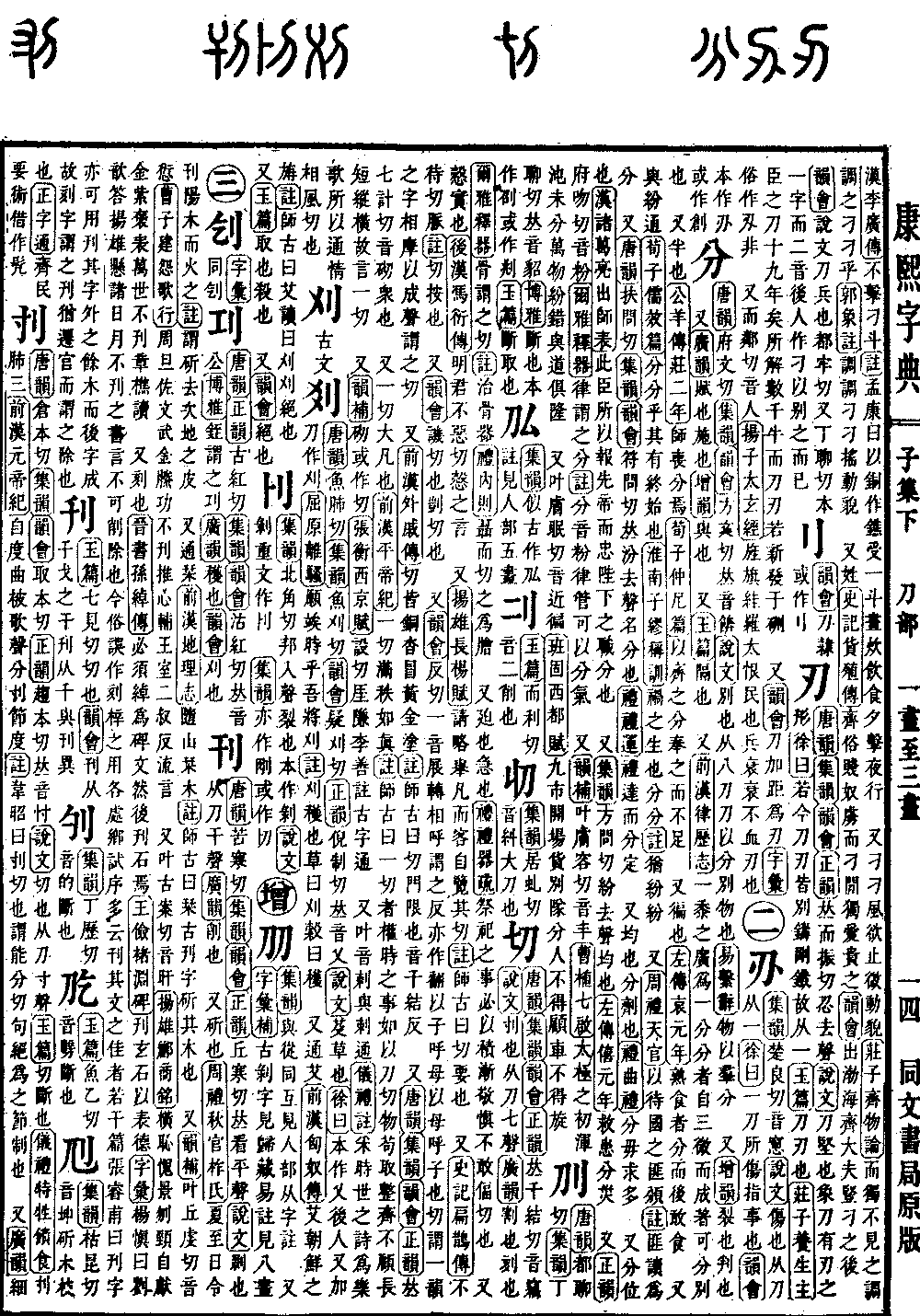
Zi Collection, Page Position: Lower
Radical: Knife (dāo)
Kangxi Dictionary Stroke Count: 5
Page Number: Page 136, Line 21
According to the Tang Rhymes (Tangyun), the pronunciation is indicated by the fanqie phonetic system as cāng and běn. In the Collected Rhymes (Jiyun) and the Rhyme Assembly (Yunhui), it is indicated as qǔ and běn. In the Correct Rhymes (Zhengyun), it is indicated as qū and běn. It is pronounced the same as cǔn.
The Explaining Graphs and Analyzing Characters (Shuowen Jiezi) defines this as to cut. The character form is derived from the radical Knife (dāo), with Inch (cùn) as the phonetic component.
The Jade Chapters (Yupian) defines this as to cut apart.
The Book of Etiquette and Ceremonial (Yili), in the chapter The Single Victim Sacrifice, records: Cut the lung into three pieces.
The Book of the Former Han (Qian Hanshu), in the Annals of Emperor Yuan, records: He composed tunes himself, set lyrics to music, and divided the cuts and measures. A commentary states that Wei Zhao believed cǔn means to cut, referring to the ability to analyze and divide the rhythm of sentences and pauses to exercise control.
The Expanded Rhymes (Guangyun) defines this as to cut finely.
The Augmented Rhymes (Zengyun) defines this as to slice or to sever.
The Collected Rhymes also provides an alternative fanqie pronunciation of cǐ and yǎn, which is pronounced the same as qiǎn, and carries the same meaning.