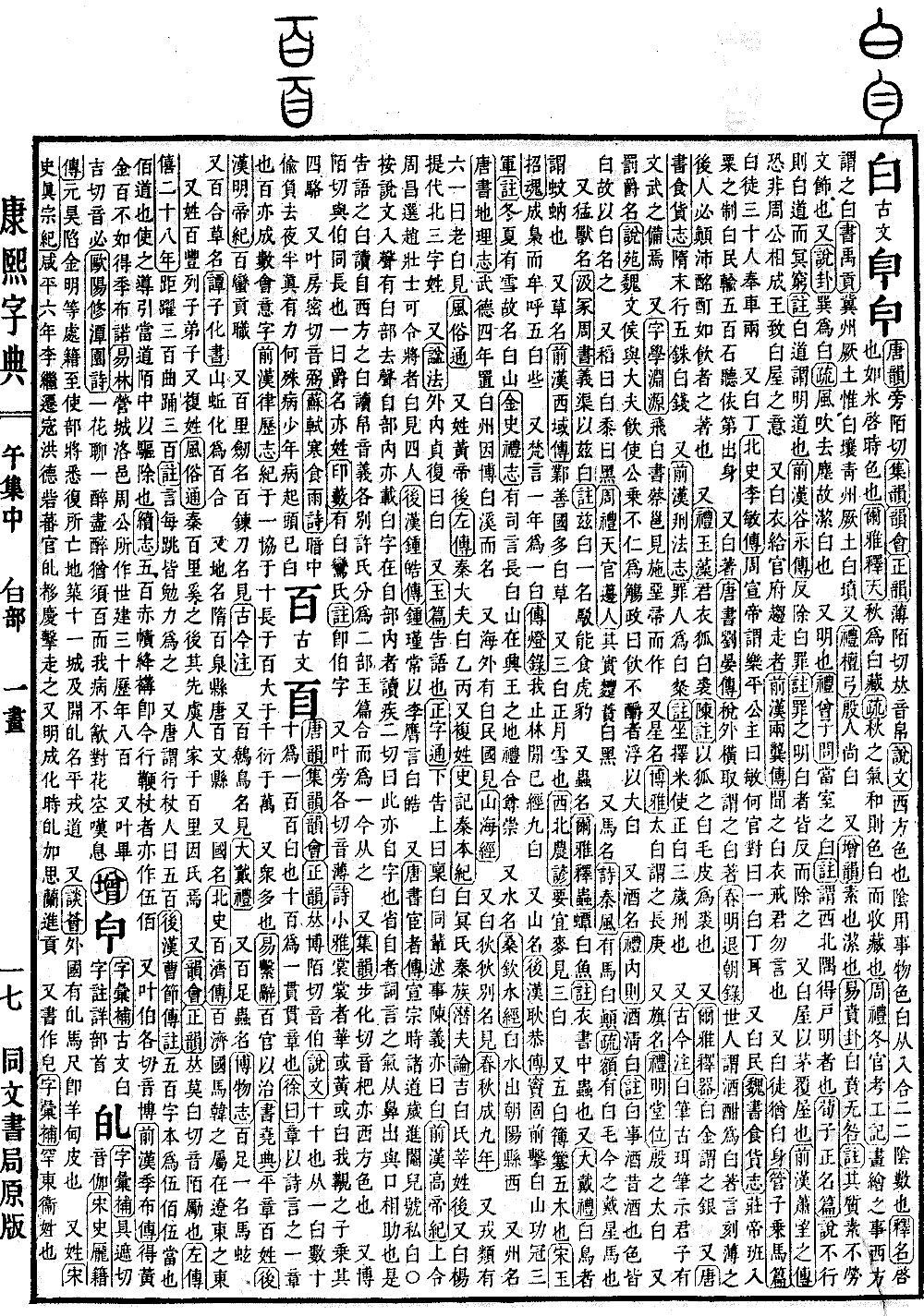
Wu Collection, Middle Volume. Radical: White (bái). Kangxi Stroke Count: 5. Page 785, Entry 01.
Ancient text. According to Tangyun (Tang rhyme dictionary), pronounced bo (entering tone). According to Jiyun (Collection of Rhymes), Yunhui (Dictionary of Rhymes), and Zhengyun (Correct Rhymes), pronounced bo (entering tone).
According to Shuowen Jiezi (Explanation of Graphs and Analysis of Characters), it is the color of the West. It governs the yin energy, and is the color of objects. The character structure is formed by combining entering (rù) and two (èr); two is a yin number.
According to Shiming (Explanation of Names), it means to open. It is like the color of water when it first begins to freeze.
According to Erya, Shitian (Approaching Elegance, Explaining Heaven), the autumn season is called white storage (bái cáng).
Commentary: The climate in autumn is harmonious, and the colors are white, meaning all things are being stored away.
According to Book of Rites (Zhou Li), Winter Official, Record of Artificers (Kǎogōngjì), in painting, the West is called white.
According to Book of Documents (Shujing), Tribute of Yu (Yǔgòng), in Jizhou, the soil there is white and loose. In Qingzhou, the soil there is white and fertile.
Also, according to Book of Rites (Liji), Tan Gong (Temple Gong), the people of the Yin dynasty revered the color white.
Also, according to Zengyun (Augmented Rhymes), it means plain. It also means pure and clean.
According to Book of Changes (Yijing), Bì Hexagram, to use white as an ornament is not a mistake.
Commentary: Its texture is simple and plain; it does not require ornate decoration.
Also, according to Shuo Gua (Discussion of the Trigrams), the Xun trigram symbolizes white.
Commentary: The wind blows away the dust, therefore it is white and clean.
Also, it means bright.
According to Book of Rites (Liji), Zengzi Asked (Zēngzǐ Wèn), the bright place in a room.
Commentary: This refers to the place in the northwest corner where there are windows to receive light.
According to Xunzi, Rectifying Names (Zhèngmíng), when a theory cannot be practiced, one should clarify the principle and then retire.
Commentary: The white path (bái dào) means to clarify the principles.
According to History of the Former Han (Qiánhànshū), Biography of Gu Yong, on the contrary, one is exempted from a clear crime.
Commentary: Those whose crimes are clear are exempted.
Also, white house (bái wū), a house with a roof covered in thatch.
According to History of the Former Han (Qiánhànshū), Biography of Xiao Wangzhi, I fear this is not the intention of the Duke of Zhou when he assisted King Cheng in treating poor scholars with courtesy.
Also, white-clothed (bái yī), refers to people who run errands and serve the government.
According to History of the Former Han (Qiánhànshū), Biography of the Two Gongs, listen to the petty officials of the government, and heed their warning not to speak.
Also, white-follower (bái tú), similar to someone with no official status or rank.
According to Guanzi, Chengma Chapter, thirty white-followers served two carriages.
Also, white-commoner (bái dīng).
According to History of the Northern Dynasties (Běishǐ), Biography of Li Min, Emperor Xuan of Zhou asked Princess Leping what rank Li Min held. She replied: He is merely a commoner (bái dīng).
Also, white-people (bái mín).
According to History of the Northern Dynasties (Wèishū), Treatise on Food and Money, Emperor Zhuang issued a system for granting official rank in exchange for grain, allowing commoners who contributed five hundred shi of grain to obtain status according to regulations.
Also, white-tax (bái zhe).
According to History of the Tang (Tángshū), Biography of Liu Yan, extortionate taxes collected outside of the regular taxes were called white-tax (bái zhe).
According to Chunming Tuichao Lu (Record of Retiring from Court in Chunming), the world calls being drunk white-tax (bái zhe). This implies that after being cruel, one will certainly fall into poverty and confusion, behaving like a drunkard.
Also, according to Book of Rites (Liji), Yuzao (Jade Beads), the ruler wears fur of white fox.
Commentary: A fur garment made from white fox fur.
Also, according to Erya, Shiqi (Approaching Elegance, Explaining Implements), white gold is called silver.
Also, according to History of the Tang (Tángshū), Treatise on Food and Money, in the final years of the Sui dynasty, five-zhu white coins were in circulation.
Also, according to History of the Former Han (Qiánhànshū), Treatise on Criminal Law, criminals performed the labor of white-husked (bái càn).
Commentary: Being punished to pick rice to make it purely white, serving three years of labor.
Also, according to Gujin Zhu (Commentary on Past and Present), white brush (bái bǐ), in ancient times, inserted at the side of the crown, indicating that the gentleman is prepared in both civil and military matters.
Also, according to Zixue Yuanyuan (Source of Character Study), Flying White (fēibái) calligraphy, created by Cai Yong after seeing a broom dipped in white clay brushing a wall.
Also, name of a star.
According to Boya (Broad Elegance), the star Tai Bai is called the star Chang Geng.
Also, name of a flag.
According to Book of Rites (Liji), Mingtang Wei (Position in the Hall of Light), the great white flag of the Yin dynasty.
Also, name of a wine cup used for penalties.
According to Shuoyuan (Garden of Stories), King Wen of Wei was drinking with his ministers and let Gongcheng Buren serve as the wine official, saying: Those who do not finish their wine will be punished with a large cup of wine.
Also, name of a wine.
According to Book of Rites (Liji), Neize (Inner Rules), wine includes clear wine (qīngjiǔ) and white wine (báijiǔ).
Commentary: White wine refers to shi wine and xi wine. Their colors are all white, so they are named with white.
Also, glutinous rice is called white, and broomcorn millet is called black.
According to Book of Rites (Zhou Li), Heavenly Official, Bian Ren (Distributor of Offerings), its fruits include hemp seeds, white rice, and black millet.
Also, name of a horse.
According to Book of Odes (Shijing), Qin Wind (Qín Fēng), there is a horse with a white forehead.
Commentary: Having white hair on the forehead, this is what is now called a star-marked horse.
Also, name of a ferocious beast.
According to Jizhong Zhoushu (Lost Book of Zhou), the Yiqu state presented a zibai.
Commentary: Zibai, also called bo, can eat tigers and leopards.
Also, name of an insect.
According to Erya, Shichong (Approaching Elegance, Explaining Insects), the silverfish is also called white fish (bái yú).
Commentary: A moth that eats clothes and books.
Also, according to Dadai Liji (Record of Rites by Dai the Elder), white bird (bái niǎo) refers to mosquitoes and gnats.
Also, name of a grass.
According to History of the Former Han (Qiánhànshū), Treatise on the Western Regions, the Shanshan state has a lot of white grass (bái cǎo).
Also, the three whites, referring to the snow of the first lunar month.
According to Northwest Agricultural Proverbs: To be suitable for wheat, one must see three snowfalls.
Also, the five whites, a pattern of the five-wood game used in gambling.
According to Song Yu, Zhao Hun (Summoning the Soul): The owl game becomes a winner, shouting for the five whites.
Also, Sanskrit calls one year one white.
According to Chuandeng Lu (Record of Transmitting the Lamp): I lived in the mountains and forests for nine white.
Also, name of a mountain.
According to History of the Later Han (Hòuhànshū), Biography of Geng Gong, Dou Gu previously attacked White Mountain (Bái Shān), his merit being the greatest of the three armies.
Commentary: It has snow in both winter and summer, hence the name White Mountain.
According to History of Jin (Jīnshǐ), Treatise on Rites, the official in charge said that Mount Changbai is where the royal enterprise arose, and according to ritual, it should be honored.
Also, name of a water.
According to Sang Qin, Shui Jing (Classic of Waterways), White Water (Bái Shuǐ) originates from the west of Zhaoyang County.
Also, name of a prefecture.
According to History of the Tang (Tángshū), Treatise on Geography, White Prefecture (Bái Zhōu) was established in the fourth year of the Wude reign, named after the Bobai Creek.
Also, overseas there is the Kingdom of White People (Bái Mín Guó). See Classic of Mountains and Seas (Shānhǎijīng).
Also, White Di (Bái Dí), another name for the Di people. See Spring and Autumn Annals (Chūnqiū), 9th Year of Duke Cheng.
Also, there are six types of Rong tribes, one is called Old White (Lǎo Bái). See Fengsu Tong (Comprehensive Meaning of Customs).
Also, a surname. Descendant of the Yellow Emperor.
According to Zuo Commentary (Zuǒzhuàn), the Qin official Bai Yibing.
Also, a double surname.
According to Records of the Grand Historian (Shǐjì), Annals of Qin, the Bai-Ming clan, the ancestral clan of Qin.
According to Qianfu Lun (Discourse of the Hidden Man), the Ji-Bai clan, descendants of the Shen surname.
Also, Bai-Yang-Ti is a three-character surname in the area north of the Dai.
Also, according to Posthumous Title Law (Shìfǎ), being internally and externally firm, pure, and returning to one's original nature is called white.
Also, according to Yupian (Jade Chapter), it means to tell.
According to Zhengzitong (Compendium of Correct Characters), reporting from a subordinate to a superior is called bing-bai. Stating facts between peers is also called bai.
According to History of the Former Han (Qiánhànshū), Annals of Emperor Gaozu, the Emperor ordered Zhou Chang to select brave men from Zhao who could serve as generals, to report and introduce four people.
According to History of the Later Han (Hòuhànshū), Biography of Zhong Hao, Zhong Jin often reported the words of Li Ying to Zhong Hao.
Also, according to History of the Tang (Tángshū), Biography of Eunuchs, during the reign of Emperor Xuanzong of Tang, various regions presented castrated boys every year, called private white (sī bái).
Note: In the Shuowen Jiezi, the entering tone has a white section, and the departing tone section also records the white character. In the zi section, it is pronounced ji (entering tone), and it is said that this is also the character zi. Omitting the writing of zi, the breath of speech comes out from the nose and assists with the mouth. Therefore, bai meaning to tell is pronounced zi, and bai meaning the color of the West is pronounced bo, the sounds and meanings are different. Xu Shen divided them into two radicals. Yupian merged them into one, and this is now followed.
Also, according to Jiyun (Collection of Rhymes), pronounced ba. It is also the color of the West.
Also, pronounced bo. Same as bo (elder). Means elder. One view says it is a title. Also a surname.
According to Yinshu (Collection of Seals), there is the Bai Luan clan.
Commentary: This is the character bo.
Also, rhymes with bo (entering tone).
According to Book of Odes (Shijing), Xiaoya (Lesser Odes), the flowers are bright and blooming, some yellow some white. I met that person, driving four black-maned white horses.
Also, rhymes with bi (entering tone).
According to Su Shi, Cold Food Rain Poem: Secretly taken away in the darkness, having real strength in the middle of the night. How is it different from that sick young boy, after recovering from the illness, the hair is already white.
Ancient character for zi. Pronounced ji.
Textual verification: According to Book of Rites (Liji), Mingtang Wei, the great white (dà bái) of the Yin. I have corrected the original text "tai bai" to "da bai" according to the original classic.