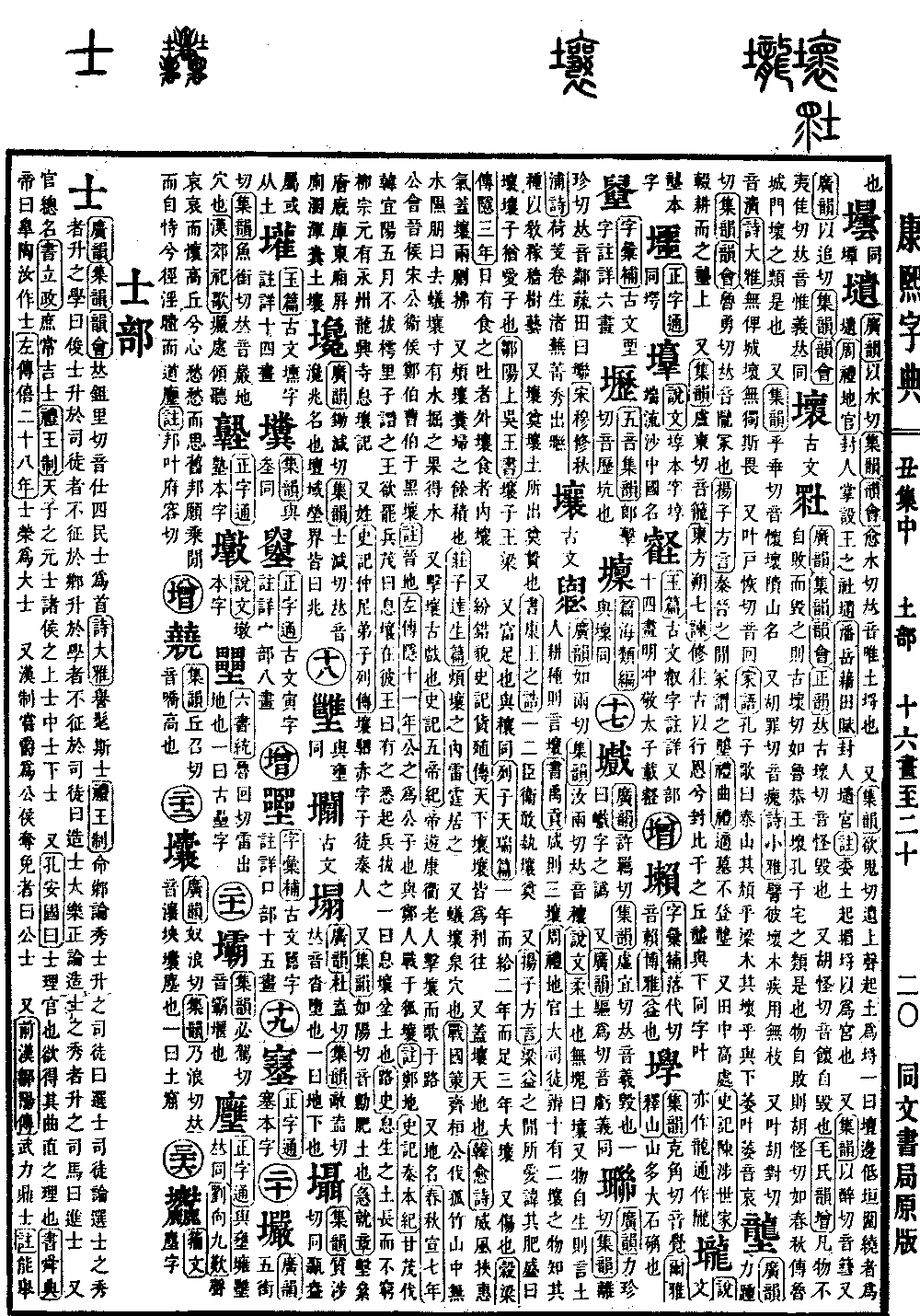
Chou Collection, Upper Volume
Radical: Scholar (shì)
Kangxi Strokes: 3
Page 242, Entry 38
Pronounced shì. Among the four social classes, the scholar occupies the first position.
Book of Odes (Shijing): Praised and flourishing is this scholar.
Book of Rites (Liji): Orders are given to the local districts to discuss the outstanding scholars and promote them to the Minister of Instruction, which is called the select scholar. The Minister of Instruction discusses the most outstanding of the select scholars and promotes them to the school, which is called the gifted scholar. Those promoted to the Minister of Instruction are not conscripted by the local district; those promoted to the school are not conscripted by the Minister of Instruction, which is called the nurtured scholar. The Great Music Master discusses the most outstanding of the nurtured scholars and promotes them to the Minister of War, which is called the advanced scholar.
Also a general term for officials.
Book of Documents (Shangshu): All the commoners are good scholars.
Book of Rites (Liji): The Son of Heaven has his primary scholar; the feudal lords have their upper scholars, middle scholars, and lower scholars.
Kong Anguo stated: A scholar is a legal official, one who desires to obtain the principles of truth and falsehood.
Book of Documents (Shangshu): The Emperor said, Gaoyao, you shall act as the legal official.
Zuo Commentary (Zuozhuan), 28th Year of Duke Xi: Shi Rong served as a grand legal official.
In the Han dynasty system, those who once held the titles of duke or marquis but were demoted were called public scholars.
Former Han History (Qian Hanshu), Biography of Zou Yang: Men of martial strength and tripod-lifting ability. Commentary: Those who are capable of lifting a tripod.
Former Han History (Qian Hanshu), Biography of Li Xun: Promoting celestial scholars. Commentary: Those who are capable of knowing the way of heaven.
Later Han History (Hou Hanshu), Biography of Li Ye: Wang Mang appointed Ye as a wine official. Commentary: At that time, the government sold wine, so a wine official position was established.
Also refers to attendants.
Comprehensive Mirror (Tongjian): Tang dynasty figures such as Du Ruhui and eighteen other scholars were referred to at the time as those who ascended Yingzhou.
Also refers to soldiers.
Zuo Commentary (Zuozhuan), Commentary on Qiajia: One chariot, three armored soldiers, and seventy-two infantrymen.
Family Sayings (Jia Yu): When Confucius went to Song, the people of Kuang surrounded him with armored soldiers.
A general term for men.
Book of Odes (Shijing): Depending upon their men.
For women who possess the conduct of a scholar, they are called female scholars.
Book of Odes (Shijing): Bestow upon us female scholars.
Guanzi, Pasturing the People section: There is the scholar classic. Commentary: Scholar means affairs. Classic means constant.
In Buddhist texts, those among the followers of the Buddha who are diligent in their practice are called virtuous scholars or supreme scholars.
In folk tradition, carved statues of deities are called wooden recluses.
Han Yu’s Poems: Once I inscribed the name wooden recluse, there were endless people seeking blessings.
Classic of Mountains and Seas (Shanhaijing): In the great wilderness in the west, there is a country named Shushi.
Scholar districts.
Later Han History (Hou Hanshu), Biography of Zheng: In the past, Qi established scholar districts. Commentary: Guan Zhong, acting as chancellor to Duke Huan, divided the state into twenty-one districts; six were districts of artisans and merchants, and fifteen were scholar districts.
A county name, Yongshi County, belonging to Tianshui Commandery, found in Later Han History (Hou Hanshu), Record of the Western Qiang.
A surname. Descendants of Tang Yao, following the lineage of Shi Wei, adopted Shi as their surname, found in The Comprehensive Genealogy (Tongpu).
A double surname: Shi-sun Rui of the Han dynasty, a man from Fufeng.
Used interchangeably with affairs.
Book of Documents (Shangshu): Appearing for affairs in Zhou. Commentary: All coming to attend to their labor.
Book of Odes (Shijing): Do not perform the affairs of holding silence. Commentary: From now on, one does not need to perform the affairs of holding silence.
Also rhymes with yu.
Book of Odes (Shijing): Brilliant and bright, the King commands the minister. Rhymes with fu below. Fu is pronounced fu.
Shuowen Jiezi: Scholar means affairs. Numbers begin at one and end at ten; composed of the characters for one and ten.
Collection of Rhymes (Jiyun): Originally written as another character. Also used interchangeably with official.