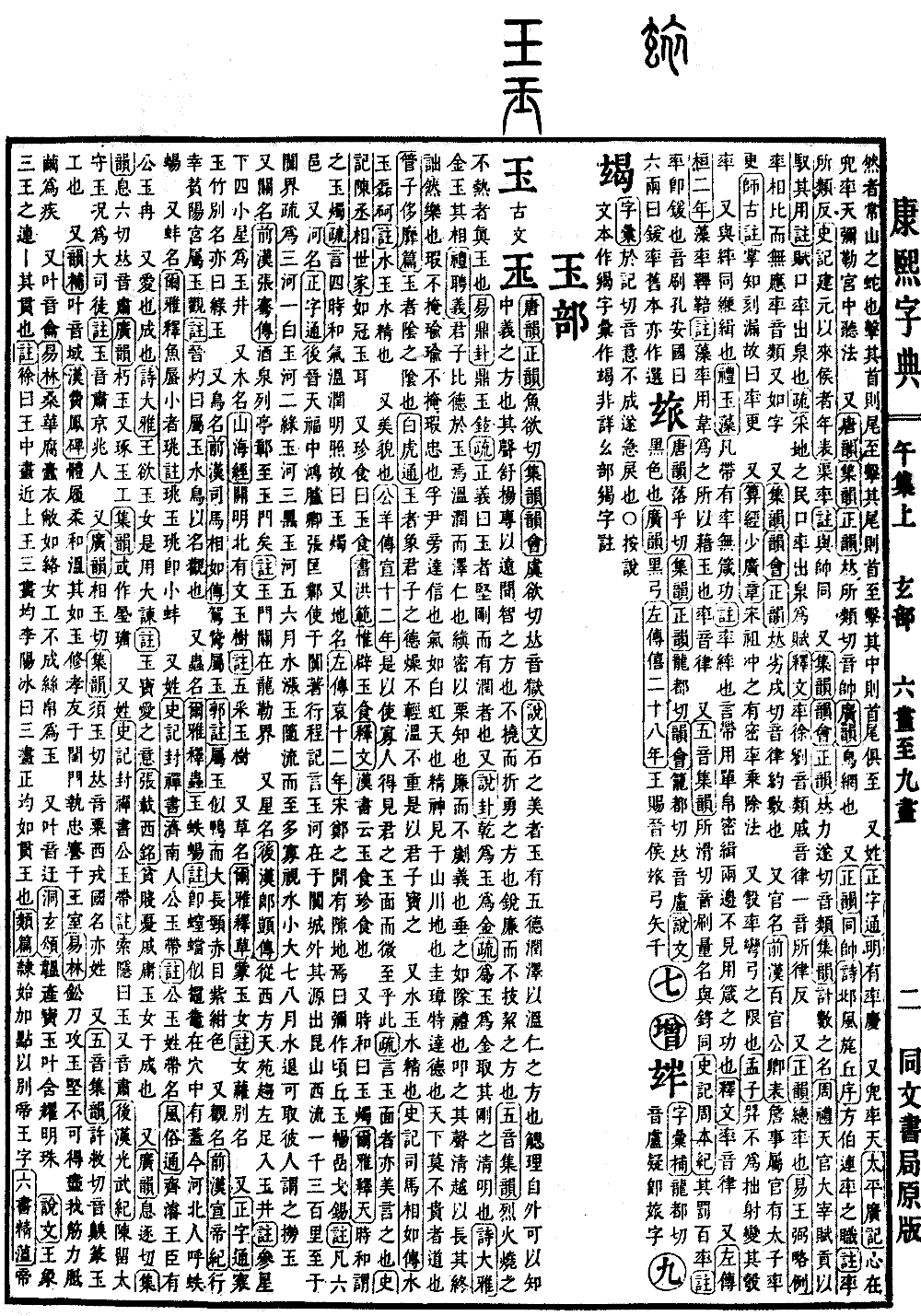
Wu Collection, Upper Volume
Radical: Jade (yù)
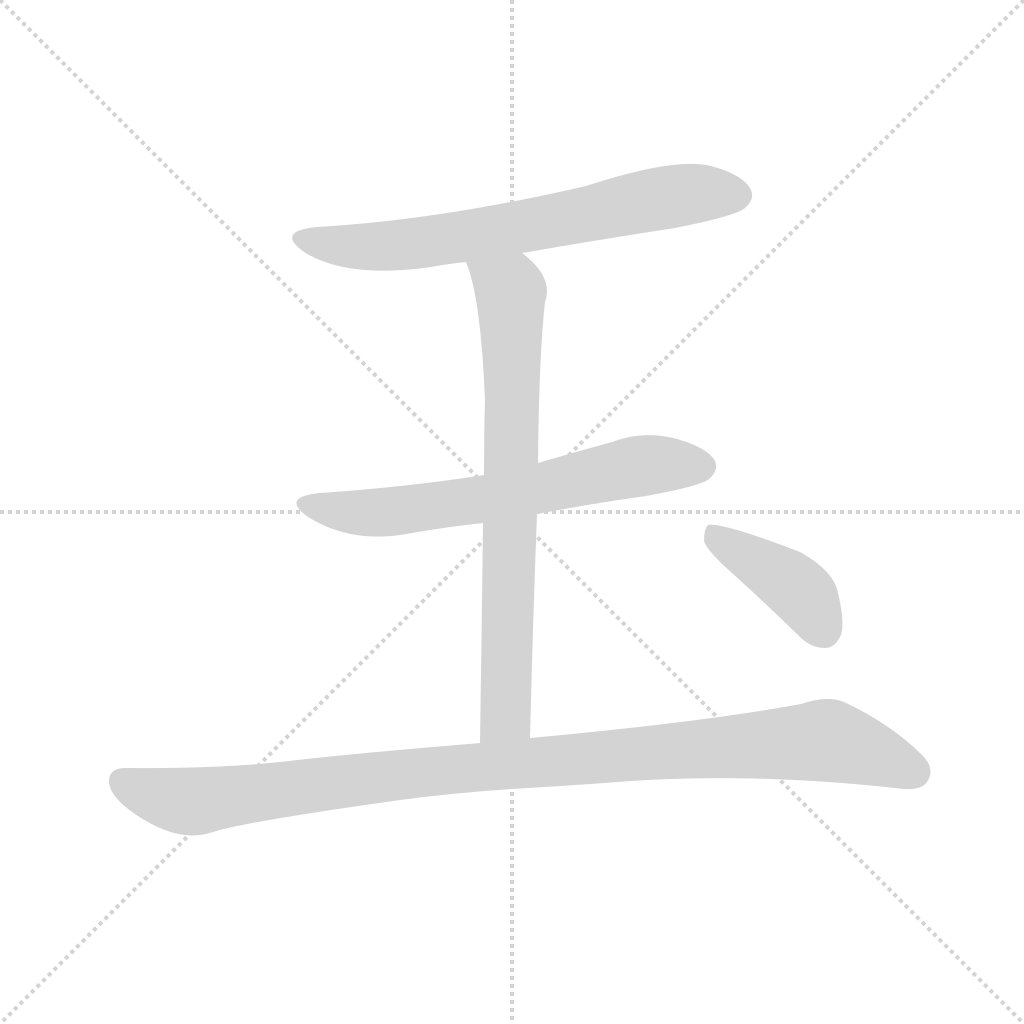
Jade; Kangxi strokes: 5; Page 726, Entry 04
Ancient script: According to the Tangyun and Zhengyun, pronounced yu (falling-rising tone); according to the Jiyun and Yunhui, pronounced yu (rising tone), sounding the same as prison (yù). The Shuowen Jiezi explains it as: a beautiful stone. Jade possesses five virtues: being warm, moist, and lustrous, representing benevolence; its markings being visible from the outside to reveal the inner structure, representing righteousness; its sound being expansive and melodious, carrying far, representing wisdom; being broken rather than bent, representing courage; its edges being sharp but not causing harm, representing integrity. The Wuyin Jiyun records: that which remains cool when burned by intense fire is genuine jade. The Book of Changes (Yijing), Ding Hexagram mentions, the jade handle of the tripod. The Commentary (Shu) explains: jade is a substance that is hard and firm yet warm and moist. Furthermore, the Shuo Gua states: the Qian hexagram symbolizes jade and gold. The Commentary explains: symbolizing jade and gold is to emphasize their hard and clear qualities. The Book of Odes (Shijing), Daya states: their appearance is like gold and jade. The Book of Rites (Liji), Pin Yi states: the noble man compares jade to moral virtue. Its warmth and luster resemble benevolence; its dense and firm texture resembles wisdom; its edges that do not cut resemble righteousness; when hanging, it drops like a weight, resembling propriety; when struck, its sound is clear, melodious, and lingering, ending abruptly like music; flaws do not hide the luster, and the luster does not hide the flaws, resembling loyalty; its colors and textures permeate from within to the outside, resembling sincerity; its temperament is like a white rainbow piercing the sun, resembling the heavens; its spirit is manifested in mountains and rivers, resembling the earth; being as direct and accessible as the jade tablet and jade disc, it resembles the Tao. The Guanzi, Chimi Chapter states: jade is the yin within the yin. The Baihu Tong states: jade symbolizes the virtue of a noble man; when dry, it does not appear light; when moist, it does not appear heavy; therefore, the noble man treasures it. It also refers to water-jade, which is crystal. The Records of the Grand Historian (Shiji), Biography of Sima Xiangru mentions water-jade piling up. The Annotation says: water-jade is crystal. It also refers to a beautiful face. The Gongyang Zhuan, 12th year of Duke Xuan states: thus it allowed me to see your jade face, arriving at such a level. The Commentary explains: saying jade face is a term of praise. The Records of the Grand Historian (Shiji), Biography of Chancellor Chen states: it was merely a beautiful piece of jade used to decorate a hat. It also refers to precious food, called jade-food. The Book of Documents (Shangshu), Hongfan states: only the monarch can enjoy jade-food. The Shiven says: the Han Shu states: jade-food is precious and beautiful food. It also refers to the harmonious climate of the four seasons, called jade-candle. The Erya, Shitian states: the harmony of the four seasons is called jade-candle. The Commentary explains: it means the climate of the four seasons is harmonious, warm, and brightly shining, hence it is called jade-candle. It is also a place name. The Zuo Zhuan, 12th year of Duke Ai records: between the states of Song and Zheng there were several places named: Mizuo, Qingqiu, Yuchang, Yan, Ge, and Xi. The Annotation says: these are six cities in total. It is also a river name. The Zhengzitong records: during the Tianfu reign of the Later Jin dynasty, the Honglu official Zhang Kuangye was sent as an envoy to Khotan and wrote a travel journal. He stated that the Jade River is outside the city of Khotan; its source originates in the Kunlun Mountains, flowing west for thirteen hundred li, reaching the border of Khotan, where it splits into three rivers: first, the White Jade River; second, the Green Jade River; and third, the Black Jade River. In the fifth and sixth months, the river swells, and jade stones flow with the water, in quantities depending on the strength of the current. In the seventh and eighth months, after the water recedes, they can be gathered; the local people call this gathering jade. It is also a pass name. The History of the Former Han (Qian Hanshu), Biography of Zhang Qian states: from Jiuquan, fortifications were built extending as far as Yumen Pass. The Annotation says: Yumen Pass is located within the territory of Longle County. It is also a star name. The History of the Later Han (Hou Hanshu), Biography of Lang Yi states: rushing from the Western Tianyuan star sector, the left foot entered the Yujing star. The Annotation says: below the Shen constellation there are four small stars called Yujing. It is also a tree name. The Classic of Mountains and Seas (Shanhaijing) states: north of the Kai-Ming beast is the Wenyu tree. The Annotation says: it is a five-colored jade tree. It is also a grass name. The Erya, Shicao states: Meng is the jade-woman. The Annotation says: it is an alternative name for the dodder plant. The Zhengzitong records: cold jade is an alternative name for bamboo. It is also called green jade. It is also a bird name. The History of the Former Han (Qian Hanshu), Biography of Sima Xiangru mentions: the geese and the jade-bird. Guo Pu’s Annotation says: the jade-bird resembles a duck but is larger, with a long neck, red eyes, and a purplish-black color. It is also a palace name. The History of the Former Han (Qian Hanshu), Annals of Emperor Xuan records: toured the Yuyu Pavilion of the Fuyang Palace. The Annotation says: Jin Zhuo stated: Yuyu is a type of water bird used to name a pavilion. It is also a name for a type of clam. The Erya, Shiyu, in the note on the small Shen-clam being the Yao-clam, states: Yao is the jade-Yao-clam, which is a small clam. It is also a surname. The Records of the Grand Historian (Shiji), Fengshan Shu records: Gongyu Dai of Jinan. The Annotation says: Gongyu is the surname, Dai is the given name. The Fengsu Tong records: King Min of Qi had a minister named Gongyu Ran. It also has the meanings of to cherish and to achieve. The Book of Odes (Shijing), Daya states: the king wishes to cherish you all, therefore he makes this strong exhortation. The Annotation says: Yu means to cherish and to treasure. Zhang Zai’s Ximing states: poverty, lowliness, and sorrow may perhaps prompt you to achieve something. Also, according to the Guangyun, pronounced su (falling-rising tone). According to Jiyun, pronounced su (entering tone), sounding the same as su. The Guangyun explains it as: decayed jade. It also refers to a craftsman who carves jade. The Jiyun records: sometimes written in a variant form. It is also a surname. The Records of the Grand Historian (Shiji), Fengshan Shu, in the Annotation on Gongyu Dai, the Suoyin says: Yu is also pronounced su. The History of the Later Han (Hou Hanshu), Annals of Emperor Guangwu records: the Administrator of Liu, Yu Kuang, was appointed as Grand Minister of Works. The Annotation says: Yu is pronounced su, and he was a native of Jingzhao. Also, according to the Guangyun, pronounced su (falling-rising tone). According to the Jiyun, pronounced su (entering tone), sounding the same as millet (su). This is the name of a state of the Western Rong. It is also a surname. Also, according to the Wuyin Jiyun, pronounced xiu (falling-rising tone), sounding the same as smell (xiù). Refers to a craftsman who engraves jade. Also, according to the Yunbu, it rhymes with the sound of yu. The inscription on the stele of Fei Feng of the Han dynasty states: her manners and gait were gentle and compliant, as mild as beautiful jade; within the family she practiced filial piety and brotherly love; within the royal court she upheld loyalty and righteousness. The Yilin says: using a lead knife to carve jade, the hardness makes it impossible to succeed. I exhaust my strength, and my hands and feet become calloused and painful. Also rhymes with the sound of yue. The Yilin says: the mulberry leaves bloom but are eaten by worms, the clothes are as worn as coarse cloth. The woman failed at weaving, yet the silk became beautiful jade. Also rhymes with the sound of yu. The Dunsong says: concealing precious jade, containing shining pearls. The Shuowen Jiezi states: the character for king resembles three horizontal lines intersected by a vertical line. The Annotation says: Xu Xuan stated: in the character for king, the middle horizontal line is closer to the top; in the character for jade, the three horizontal lines are evenly spaced. Li Yangbing stated: the three horizontal lines are even and straight, like connected jade pieces. The Leipian states: in clerical script, a dot was added to distinguish it from the king of the empire. The Liushu Jingyun states: the king of the empire uses one vertical line to connect the three horizontal lines as its meaning. The three horizontal lines represent heaven, earth, and mankind. The middle horizontal line is closer to the top, signifying that the monarch models himself after heaven. For the jade of precious stones, the three horizontal lines are evenly spaced, like the shape of connected jade pieces. Common writers, not knowing that the middle horizontal line in the king character is closer to the top, added a dot to the side to distinguish it.