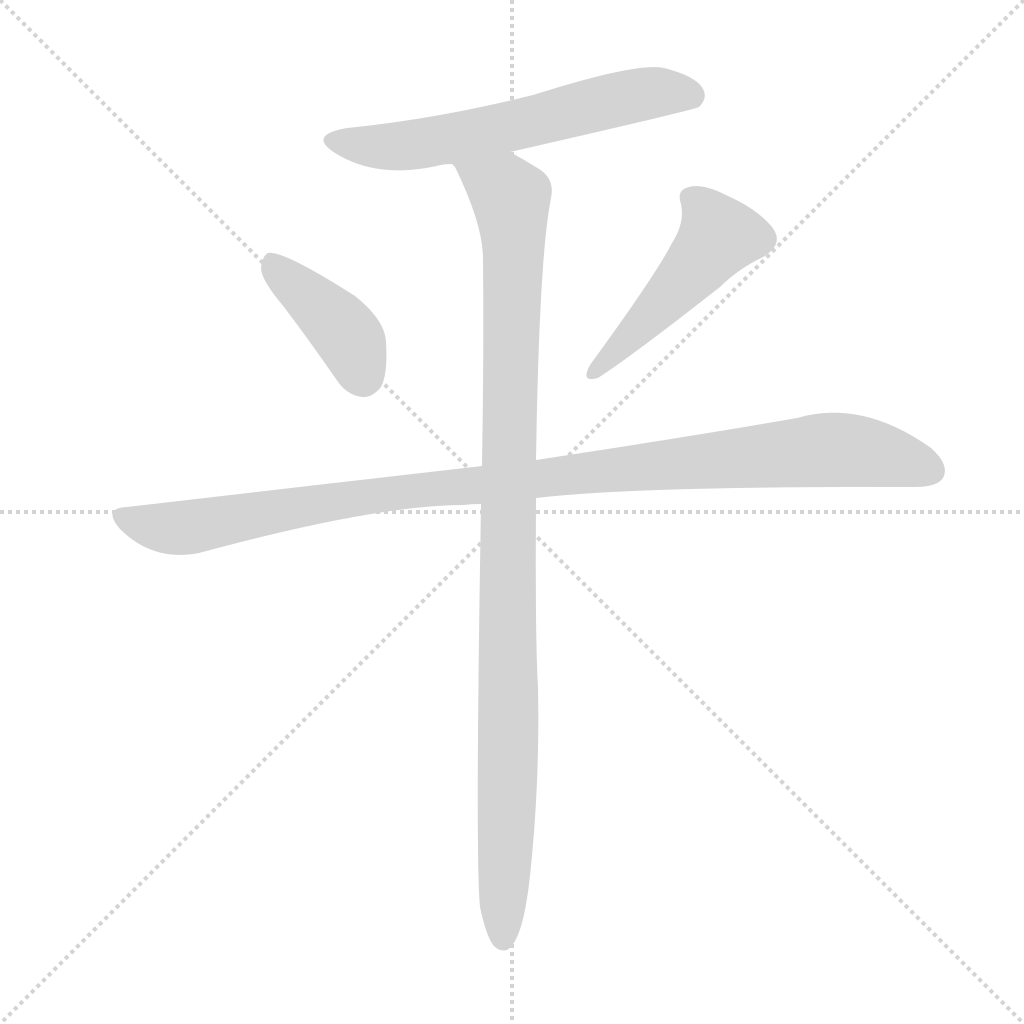
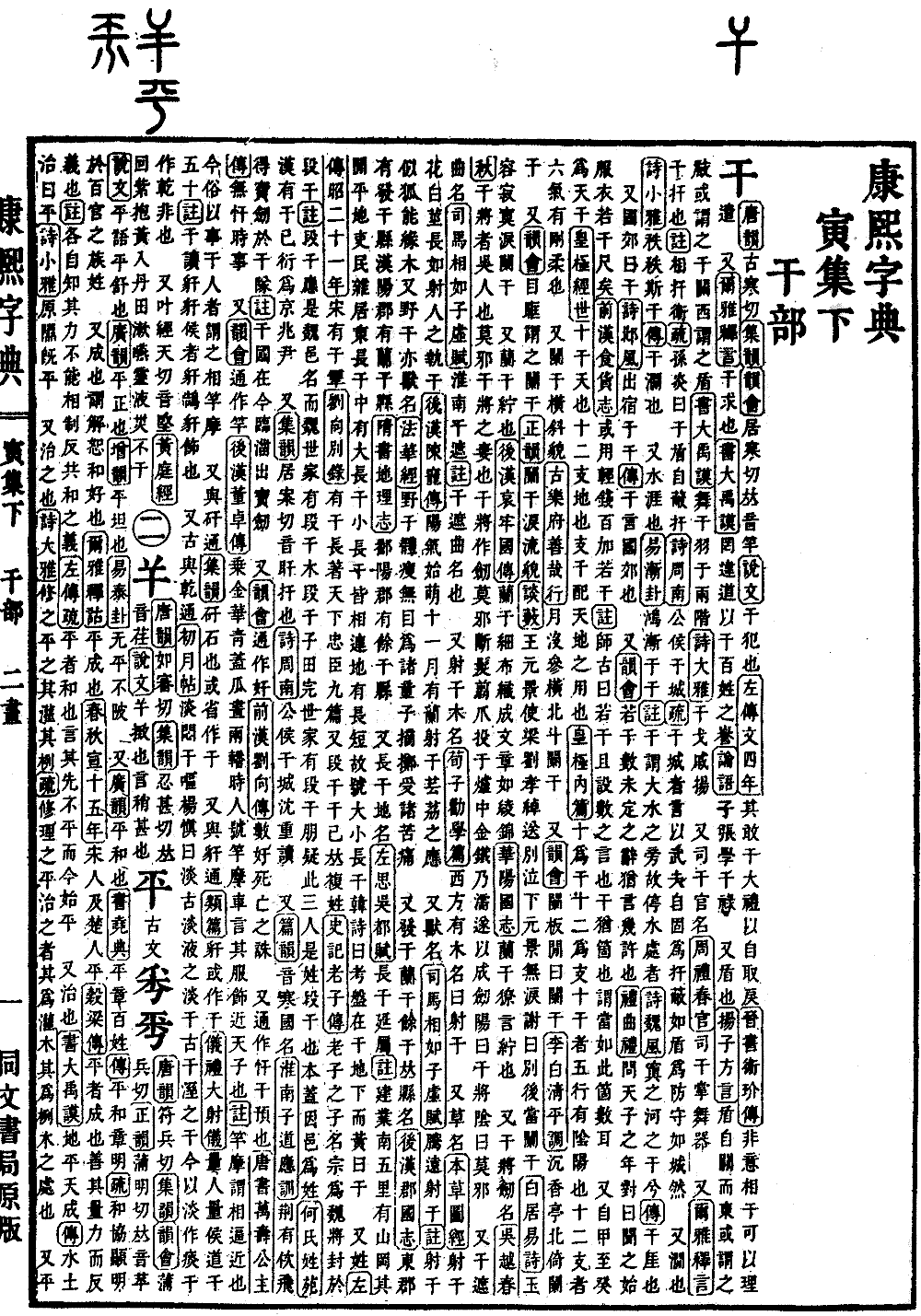
Yin Collection, Lower Volume
Radical: Dry (gān)
Page 339, Entry 03
Ancient form. Pronounced ping.
Shuowen Jiezi (Explanation of Characters and Analysis of Compound Characters): Ping means language that is calm and relaxed.
Guangyun (Broad Rhymes): Ping means upright or correct.
Zengyun (Expanded Rhymes): Ping means flat or level.
Book of Changes (Yijing), Tai Hexagram: There is no level ground that does not have a slope.
Also, Guangyun: Ping means harmony.
Book of Documents (Shangshu), Canon of Yao: Harmoniously clarify the hundred clans. Commentary: Harmony and clarification. Sub-commentary: To harmonize and coordinate, making manifest the clans of the hundred officials.
Also, to reach an agreement. This refers to settling disputes and reconciling.
Erya (Approaching Elegance), Interpretation of Words: Ping means to reach an agreement.
Spring and Autumn Annals (Chunqiu), Duke Xuan, 15th Year: The people of Song and the people of Chu reached an agreement.
Guliang Zhuan (Guliang’s Commentary): To reach an agreement means to settle. It praises their ability to gauge their own strength and return to a sense of justice. Commentary: Each knew their own strength, unable to overcome the other, and thus returned to the principle of mutual harmony.
Zuo Zhuan Sub-commentary: Ping means harmony. It indicates that they were not initially in harmony, but have now begun to be so.
Also, to govern.
Book of Documents (Shangshu), Counsels of the Great Yu: The land was settled and the heavens were completed. Commentary: When water and earth are governed, it is called ping.
Book of Odes (Shijing), Lesser Odes: The plains and marshlands were already settled.
Also, to govern or repair.
Book of Odes (Shijing), Greater Odes: Repair it and level it; its thickets and its thorny bushes. Sub-commentary: To repair and level it means to address the areas of thickets and thorny bushes.
Also, to submit or surrender.
Book of Odes (Shijing), Greater Odes: The four quarters are already subdued, and the royal kingdom is generally stable. Sub-commentary: The four quarters have been subdued, and within the royal kingdom, there is fortunate stability.
Also, Yupian (Jade Chapters): Ping means to be equal or even.
Zengyun (Expanded Rhymes): Ping means to equalize.
Book of Changes (Yijing), Qian Hexagram: Clouds move and rain falls; the world is balanced. Sub-commentary: This means the world widely receives benefit and is balanced, without bias or unevenness.
Book of Documents (Shangshu), The Charge to Jiong: Heavenly longevity and balanced standards. Sub-commentary: The Orthodox Meaning states: Ping refers to political and educational standards being balanced.
Also, Guangya (Expanded Elegance): Ping means to equalize taxes.
Records of the Grand Historian (Shiji), Notes on the Treatise on the Balance of Standards: The Suoyin commentary says: Among the subordinate officials of the Grand Minister of Agriculture, there were the Equalization Offices and their assistants. They were responsible for balancing the levies of the commanderies and states under heaven; when prices were high, they sold goods, and when they were low, they bought them. They balanced the taxes to keep them stable and collected revenues for the capital, which is why it was called the Equalization Office.
Also, musical sounds that do not exceed one another.
Discourses of the States (Guoyu): Music follows harmony, and harmony follows balance.
Also, Erya (Approaching Elegance), Interpretation of Words: Ping means easy. Sub-commentary: Easy means not difficult.
History of the Later Han (Hou Hanshu), Biography of Ban Chao: Ren Shang said: I thought the Magistrate of Ban would have some extraordinary strategy, but what he says now is merely average.
Also, a bountiful harvest.
Book of the Former Han (Hanshu), Treatise on Food and Money: Two successful harvests are called ping, three successful harvests are called great peace (taiping).
Also, from the Book of Posthumous Titles: Dealing with affairs with regulations is called ping; governing without disaster is called ping; spreading the laws and managing the principles is called ping.
Also, Erya (Approaching Elegance), Interpretation of Land: Large fields are called ping. Sub-commentary: The marshes of large fields are also called ping.
Han Yu, City South Linked Verse: The sand-seal print returns to level. Commentary: Hong Qingshan says: Mount Hua has a medicinal plant called green-branch ping, named for the level ground where it grows.
Also, the twelfth lunar month is called Jiaping (Auspicious Peace).
Records of the Grand Historian (Shiji), Annals of Qin Shi Huang: Changed the name of the year-end sacrifice to Jiaping. Commentary: The Mao Ying Inner Record says: Ying’s great-grandfather Meng ascended to heaven in broad daylight at Mount Hua. The local folk song said: The immortals who attain it are like Mao’s early success, driving a dragon to ascend into the great clarity, sometimes descending to the continents to play at Red City, continuing the generations until my Ying; if the Emperor wishes to learn it, sacrifice in the month of Jiaping. Shi Huang heard the song and asked the reason; the elders explained it fully, and he therefore changed the sacrifice to Jiaping. Suoyin commentary says: Guangya states: The Xia dynasty called it the clear sacrifice, the Yin called it Jiaping, the Zhou called it the great wax, also called the year-end sacrifice; the Qin changed it to Jiaping. This was likely due to the words of the folk song, adopting the Yin title.
Also, Huaping (Flower Peace), the name of a propitious tree.
Book of Song (Songshu), Treatise on Omens: Huaping, its branches are perfectly level. When a king has virtue, it grows; when virtue is strong, it looks upward; when virtue is weak, it bends downward.
Zhang Heng, Eastern Capital Rhapsody: Planted the Huaping in the spring garden. Commentary: When the world is at peace, its flowers are level.
Also, Tingwei Ping (Grand Justice Aide), an official title.
Records of the Grand Historian (Shiji), Biography of Zhang Shizhi: The Grand Justice is the balance of the world.
Book of the Former Han (Hanshu), Table of Hundred Officials: In the third year of the Dijie reign of Emperor Xuan, the left and right Tingwei Ping were established, with a salary of six hundred piculs.
Also, Pingyuan (Level Plains), Taiping (Great Peace), Pinglu (Level Land), place names.
Erya (Approaching Elegance), Interpretation of Land: Broad and level ground is called yuan, high and level ground is called lu. Sub-commentary: Broad and level ground is called yuan, which means that the flat parts of marshes are also called yuan. The Han dynasty used Pingyuan as a commandery name. High and level ground is called lu, meaning that land which is fertile is properly named lu.
Also: To the east, where the sun rises, is Taiping; the people of Taiping are benevolent.
Mencius: Mencius in Pinglu.
Also, a prefecture name.
Old Book of Tang (Tangshu), Treatise on Geography: Ping Prefecture, Beiping Commandery.
Guangyun (Broad Rhymes): The territory of the ancient Shanrong and Guzhu, and the two states of the White Di; in the Qin dynasty, it was Liaoxi Commandery; in the Sui, it was Beiping Commandery; in the Tang, it was Ping Prefecture.
Also, a surname.
Guangyun (Broad Rhymes): Descendant of the Qi minister Yan Pingzhong.
Book of the Former Han (Hanshu), Biography of Ping Dang: Dang was Chancellor during the reign of Emperor Ai, and his son Yan held the position of Grand Minister of Works.
Also, a compound surname.
He Family Surname Garden: There are the Pingling and Pingning clans.
Surname Compendium: The Pingling clan, descendant of Pingling Lao in the Records of the Grand Historian.
Also, Pronounced bian.
Guangyun (Broad Rhymes): Pingping means to discriminate and govern.
Book of Documents (Shangshu), The Great Plan: The King’s Way is balanced and level.
Book of Odes (Shijing), Lesser Odes: Balanced and level on the left and right.
Also, Yunhui (Collection of Rhymes): Means to equalize.
Also, Yunhui: Pronounced bing.
Used for balancing the prices of goods.
Book of Rites (Zhouli), Earth Office, commentary on Quality Records: The market’s balanced price, like the current monthly balance.
Also, Earth Office, commentary on the Quality Official: The quality is the balance. Responsible for stabilizing the prices of goods.
Yangzi, Dialects: For a single chaotic market, one must establish a balance.
History of the Later Han (Hou Hanshu), Treatise on the Five Elements: At the beginning of the reign of Emperor Huan, there was a nursery rhyme in the capital: Swimming in peace to buy a seal, naturally having a balance, not avoiding the powerful and virtuous or the great clans.
Also, anciently interchangeable with bian (convenient/arguable).
Records of the Grand Historian (Shiji), Annals of the Five Emperors: Bian (conveniently) clarified the hundred clans. Commentary: Suoyin commentary says: The Ancient Script Book of Documents uses the character ping, and since ping functions as bian (convenient/arguable), it was used for bian-zhang. The Modern Script version uses bian (to discriminate). The ancient character ping was also written as bian, which means to discriminate, and thus it became bian-zhang.
Also, rhymes with the sound pang.
Zhang Ji, Poem Sacrificing to Han Yu: The northern terrace overlooks the rice fields, the lush wild is full of shade and coolness. Sitting in the pavilion fishing, the distress and suffering are finally calmed.
Also, Jitsuin (Collection of Rhymes): Pìn is the ancient form of ping. Note detailed in the Hand Radical, eight strokes.