Chou Collection, Upper Volume
Radical: Enclosure (wéi)
Four; Kangxi strokes: 5
Page 216, Entry 22
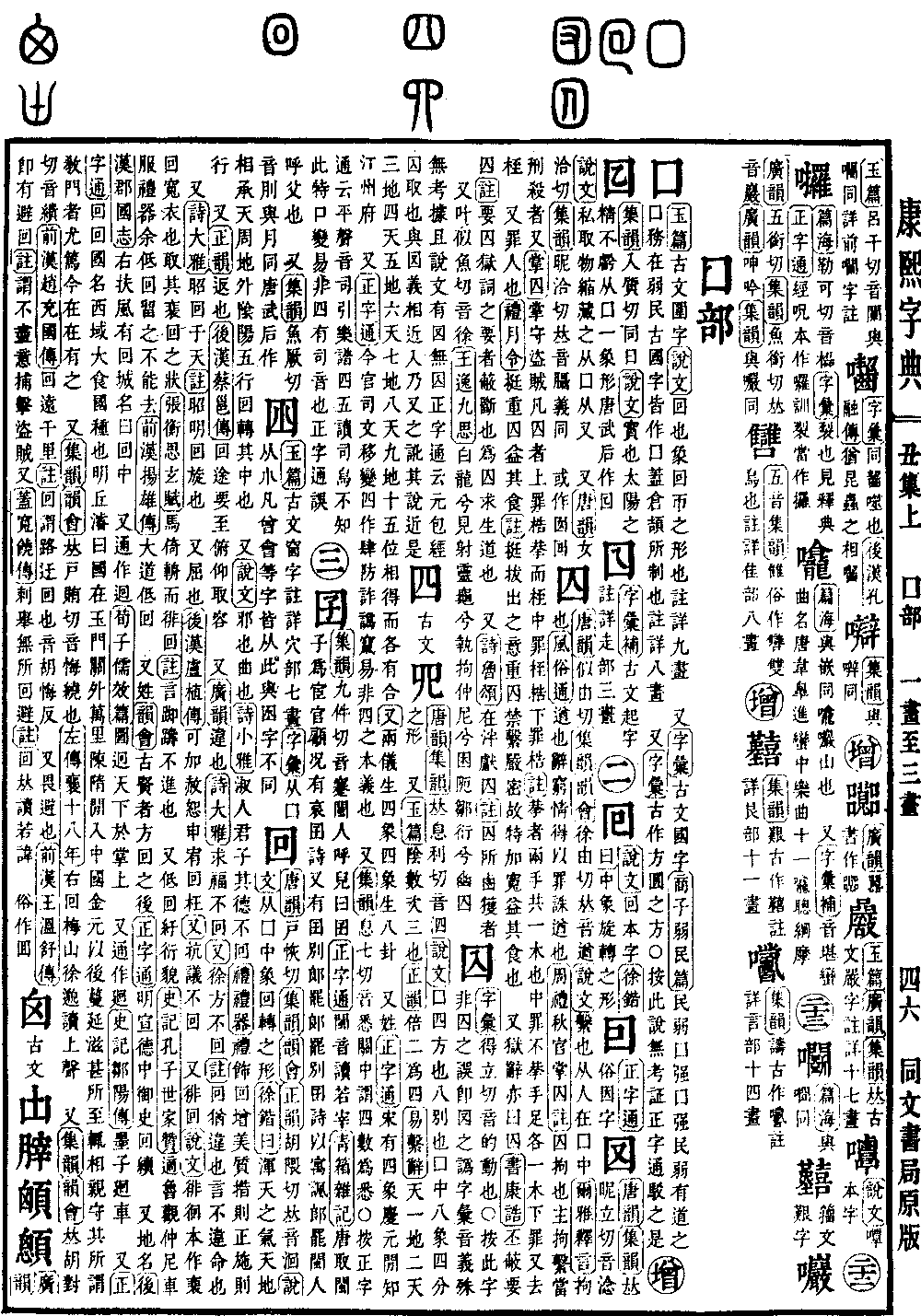
Ancient form. Tang Rhymes (Tangyun) and Collected Rhymes (Jiyun) state it is pronounced si (falling tone), with the same sound as the character for a river name. Explaining Simple and Analyzing Compound Characters (Shuowen Jiezi) states: The enclosure radical indicates the four directions, and the character for eight indicates separation. With eight inside the enclosure, it symbolizes the shape of something divided into four parts.
Jade Chapter (Yupian) records: Four is the third in the sequence of yin numbers. Correct Rhymes (Zhengyun) states: Four is double two.
Book of Changes (Yijing), Appended Remarks (Xici) states: Heaven is one, Earth is two, Heaven is three, Earth is four, Heaven is five, Earth is six, Heaven is seven, Earth is eight, Heaven is nine, Earth is ten. These five odd and even numbers correspond to one another.
The text further states: The Two Forms (Liangyi) give birth to the Four Symbols (Sixiang), and the Four Symbols give birth to the Eight Trigrams (Bagua).
There is also a surname Four. Correct Character Guide (Zhengzitong) records: During the Song Dynasty, there was a man named Sixiang, who served as the Prefect of Tingzhou during the Qingyuan era.
Correct Character Guide (Zhengzitong) further states: Present-day official documents often write four as a more complex formal variant (si) to prevent forgery and alteration, but this is not the original meaning of the character four.
Collected Rhymes (Jiyun) records: Pronounced xi. In the Guanzhong region, the number four is pronounced as xi.
Note: Correct Character Guide (Zhengzitong) states that the level tone is pronounced si, citing music scores where four and five are pronounced si and wu; however, this is merely a phonetic change in colloquial speech, and the character four does not actually possess the pronunciation si. This claim in the Correct Character Guide is erroneous.