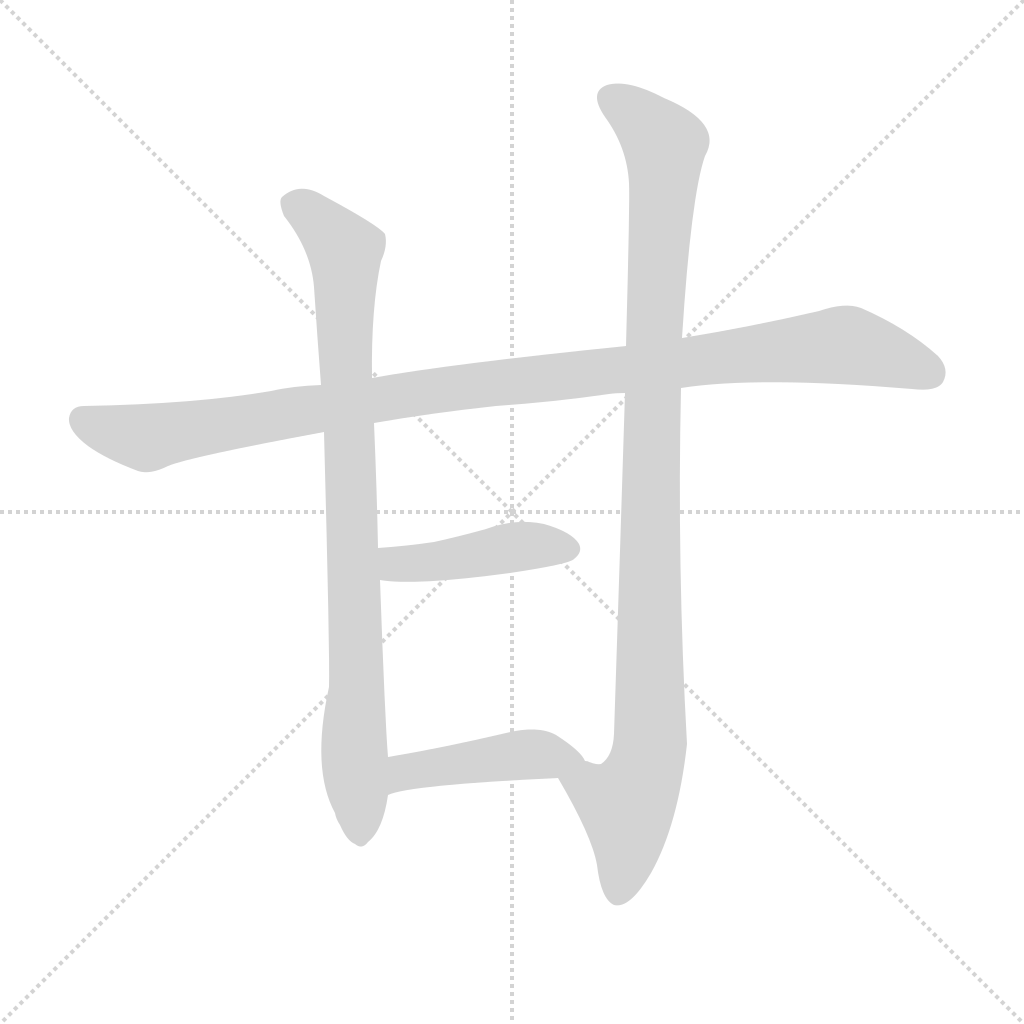
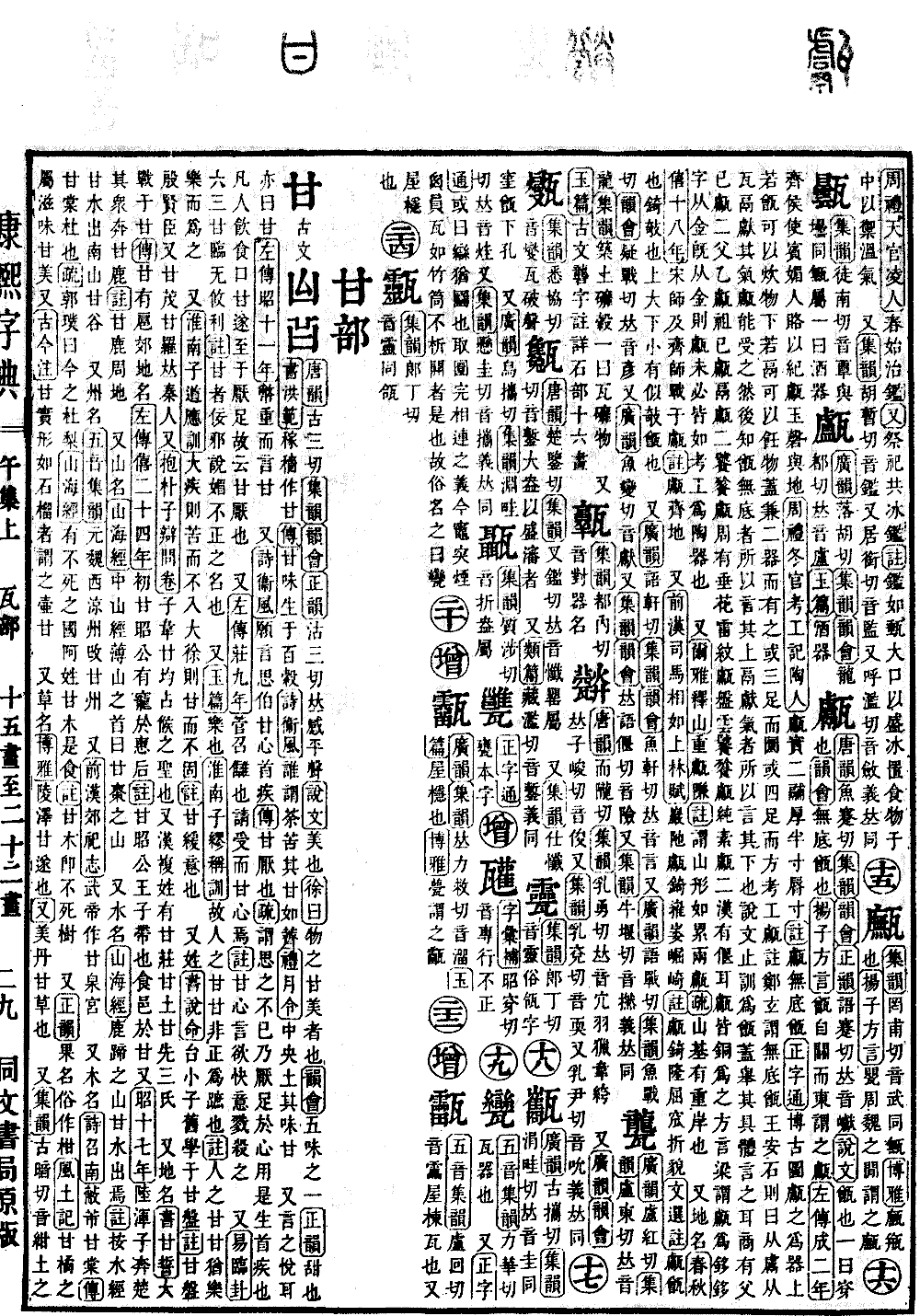
Wu Collection, Upper Volume. Radical: Sweet (gān); Kangxi strokes: 5; Page 753, Entry 19.
Pronounced gan. According to Tang Rhymes (Tangyun), Collected Rhymes (Jiyun), Rhyme Compilation (Yunhui), and Correct Rhymes (Zhengyun), it is pronounced gan (level tone). Explaining the Characters and Writing (Shuowen Jiezi) defines it as pleasant or good. Xu Xuan states it refers to things with a sweet taste. The Rhyme Compilation describes it as one of the five flavors. The Correct Rhymes defines it as sweet. The Book of Documents (Shangshu), section Great Plan (Hongfan), states: Planted and harvested grains produce a sweet taste. The Commentary states: Sweetness arises from various grains. Book of Odes (Shijing), Odes of Wei (Weifeng): Who says the sowthistle is bitter, its sweetness is like that of the shepherd's purse. Book of Rites (Liji), Monthly Ordinances (Yueling): The central region belongs to earth, and its flavor is sweet. Also refers to words that are pleasing and agreeable to the ear. Also written as sweet. Zuo Tradition (Zuo Zhuan), 11th Year of Duke Zhao: The gifts are generous and the words are pleasing. Also, Book of Odes (Shijing), Odes of Wei (Weifeng): I pine for my husband, even willing to suffer a headache from longing, yet I am content. The Commentary states: Sweet here means satisfied. The Sub-commentary explains: It means the longing does not cease, the heart is satisfied, and thus a headache is induced. Whenever people eat, if the taste is sweet, they are satisfied; therefore, to be sweet is to be satisfied. Also, Zuo Tradition (Zuo Zhuan), 9th Year of Duke Zhuang: Guan Zhong and Shao Hu were enemies; he requested to receive them in order to dispose of them with satisfaction. The Note states: To be content means to want to kill them with gratification. Also, Book of Changes (Yijing), Approach hexagram (Lin Gua), six in the third place: Using sweet words to govern the people is of no benefit. The Note states: Sweet refers to using flowery speech to flatter, which is an improper method. Also, Jade Records (Yupian) defines it as happiness. Master Huainan (Huainanzi), Essays on Various Themes (Miao Cheng Xun): Therefore, when people are happy to do something, it is not necessarily because they want to become like the robber Zhi. The Note states: People's willingness (gan gan) is like being happy to do something and doing it. Also, Master Huainan (Huainanzi), Principles of the Way (Dao Ying Xun): If it is too hasty, it is bitter and hard to accept; if it is too slow, it is loose and insecure. The Note states: Sweet here means loose or relaxed. Also a surname. Book of Documents (Shangshu), Counsels of Gao Yao (Shuo Ming): I, the little child, once studied under Gan Pan. The Note states: Gan Pan was a worthy minister of the Yin dynasty. There were also Gan Mao and Gan Luo, who were people of the Qin state. Also, Baopuzi, Questions and Debates (Bian Wen Juan): Zi Wei and Gan Jun were sages of divination. Also, there are the compound surnames Gan Zhuang, Gan Tu, and Gan Xian from the Han dynasty. Also a place name. Book of Documents (Shangshu), Oath at Gan (Gan Shi): A great battle was fought at the land of Gan. The Commentary states: Gan is a place name in the suburbs of the capital of the Youhu clan. Also, Zuo Tradition (Zuo Zhuan), 24th Year of Duke Xi: Initially, Gan Zhao Gong was favored by Empress Hui. The Note states: Gan Zhao Gong was Prince Dai, who was enfeoffed at Gan. Also, Zuo Tradition (Zuo Zhuan), 17th Year of Duke Zhao: The son of Luhu fled to the Chu state, and his followers fled to Ganlu. The Note states: Ganlu was a place name in the Zhou dynasty. Also a mountain name. Classic of Mountains and Seas (Shanhaijing), Classic of the Central Mountains: The first mountain of the Bo Mountains is called Ganzhao Mountain. Also a river name. Classic of Mountains and Seas (Shanhaijing): At Luti Mountain, the Gan River originates here. The Note states: According to the Commentary on the Water Classic (Shuijing), the Gan River originates from Gan Valley in the Southern Mountains. Also a province name. Five Tones Collected Rhymes (Wuyin Jiyun): During the Northern Wei dynasty, the Western Liang province was changed to Gan Province. Also, Book of the Former Han (Qian Hanshu), Treatises on the Suburban Sacrifices (Jiaosi Zhi): Emperor Wu of Han built the Ganquan Palace. Also a tree name. Book of Odes (Shijing), Odes of Shao (Shaonan): The lush Gantang tree. The Commentary states: Gantang is the wild pear tree. The Sub-commentary states: Guo Pu said: It is the present-day wild pear. Classic of Mountains and Seas (Shanhaijing): There is a country of immortals, the people are surnamed A, and they eat the sweet tree. The Note states: The sweet tree is the immortal tree. Also, Correct Rhymes (Zhengyun): A type of fruit, commonly written as gan (citrus). Customs and Traditions (Fengtu Ji): A variety of citrus, the taste is sweet and fresh. Also, Records of Ancient and Modern Times (Gujin Zhu): A sweet fruit shaped like a pomegranate is called hugan. Also a grass name. Guangya: Lingze is gansui (a medicinal herb). Also: Meidan is gancao (licorice). Also, Collected Rhymes (Jiyun): Pronounced gan (falling tone). Refers to the taste of earth. Also, Collected Rhymes (Jiyun), Rhyme Compilation (Yunhui), and Correct Rhymes (Zhengyun): Pronounced han. Book of Documents (Shangshu), Songs of the Five Sons: Addicted to fine wine and music. Also interchangeable with han (to sleep soundly). Master Zhuang (Zhuangzi), Xu Wugui: Sleeping soundly. Note: The Correct Rhymes also lists it as hu-gan, but hu and hu share the same initial consonant and should not be listed separately.