Chen Collection, Lower Volume
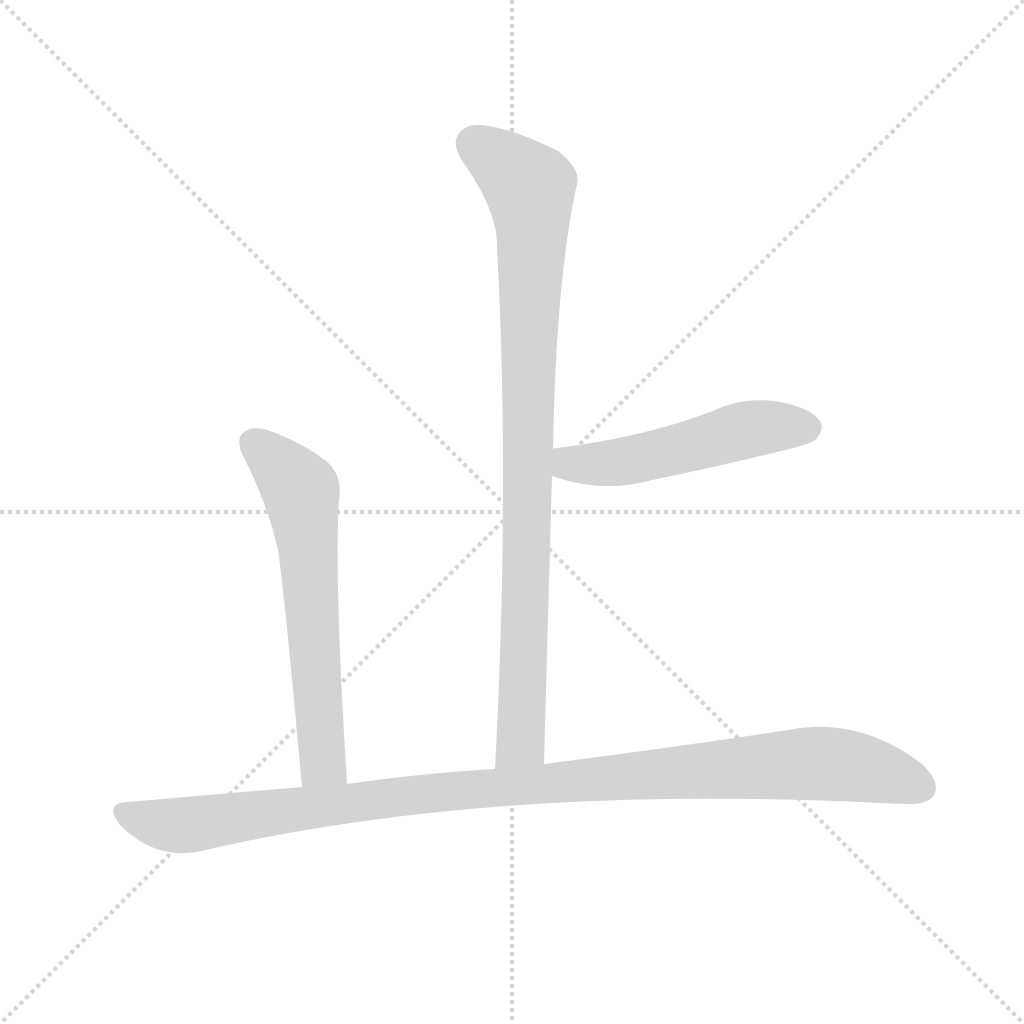
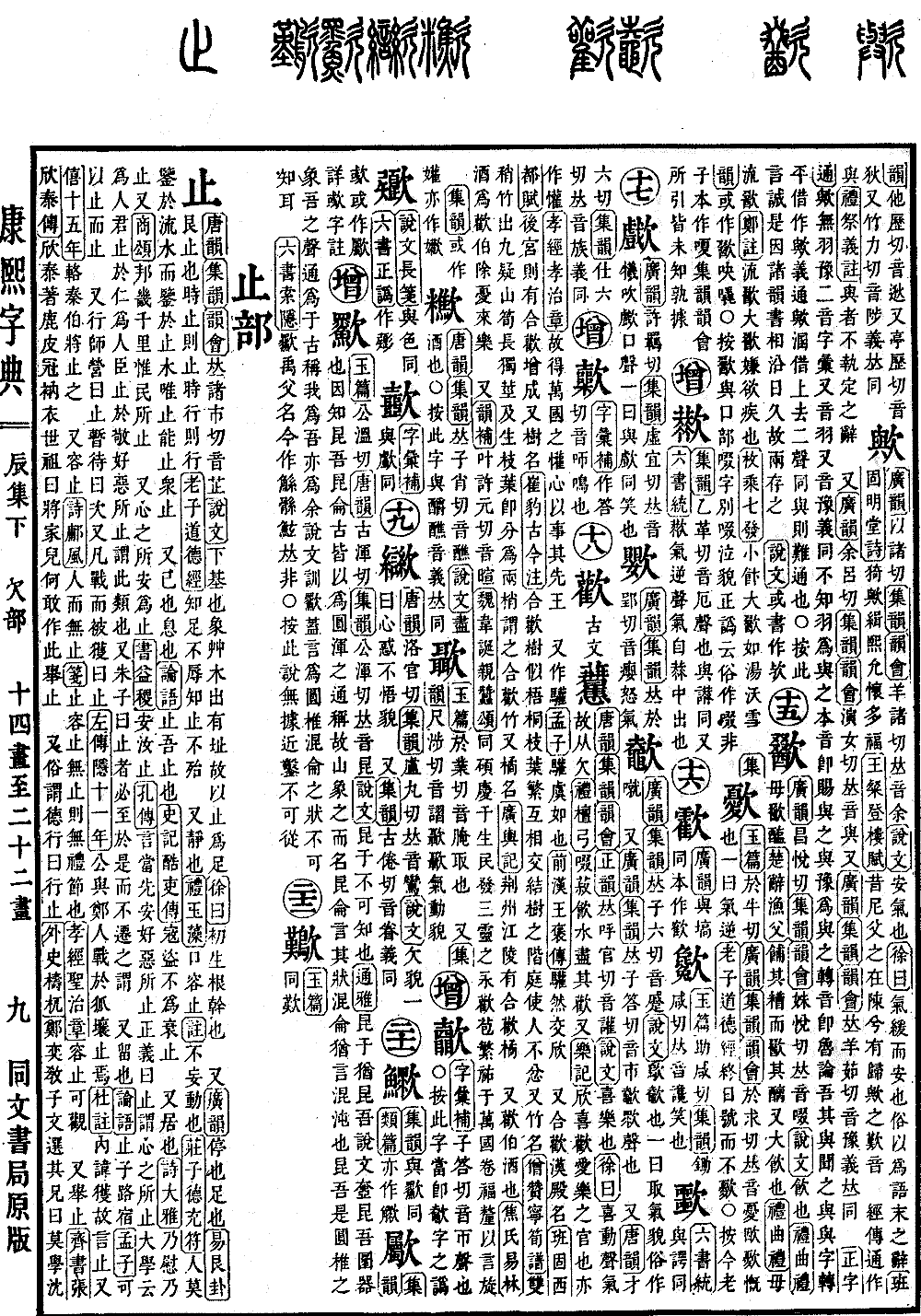
Radical: Stop (zhǐ)
Page 573, Entry 24
Pronounced zhǐ.
According to the Explaining Graphs and Analyzing Characters (Shuowen Jiezi), it represents the root or foundation of a thing. It resembles the root of a plant or tree, and thus "stop" is used to denote the foot.
According to Xu Kai, it refers to the nascent root or stem of a plant.
Also, according to the Extensive Dictionary of Characters (Guangyun), it carries the meanings of stopping or the foot.
Classic of Changes (Yijing), Hexagram Gen (Mountain): Gen means to stop. One should stop when it is time to stop, and act when it is time to act.
Laozi, Classic of the Way and Virtue (Daodejing): To know satisfaction is to avoid disgrace, and to know when to stop is to avoid danger.
It also denotes stillness or rest.
Book of Rites (Liji), Jade Pattern: One must maintain a composed expression in the mouth.
Commentary: This refers to not moving restlessly.
Zhuangzi, Sign of Virtue Complete: One does not view one's reflection in moving water, but in still water; only that which is still can bring stillness to many other things.
It also carries the meaning of ceasing or pausing.
Analects (Lunyu): I shall stop when it is time to stop.
Records of the Grand Historian (Shiji), Biographies of Harsh Officials: The bandits and thieves neither diminished nor ceased.
It also means to reside or dwell.
Book of Odes (Shijing), Greater Odes: Thus he lived in peace, thus he settled down.
Also, Shang Odes: The territory of the state spans a thousand miles, a place for the people to reside.
It also refers to the inner state of being settled or anchored.
Book of Documents (Shangshu), Yi and Ji: Establish the place where your heart rests.
Kong Anguo's Commentary: It says one should first settle the places of one's likes and dislikes.
The Correct Meaning (Zhengyi) states: "Stop" refers to the place where the heart is settled.
The Great Learning (Daxue) states: The ruler should settle upon benevolence, the minister should settle upon respect; the "place of likes and dislikes" refers to such matters.
Zhu Xi states: "Stop" means the state of being absolutely certain to arrive at a destination without moving elsewhere.
It also means to lodge or accommodate.
Analects (Lunyu): He let Zilu stay for the night.
Mencius (Mengzi): One may stay when it is permissible to stay.
Military encampment is called "stop," while a short halt is called "sojourn."
Also, any capture in warfare is referred to as "stop."
Zuo Commentary (Zuozhuan), Eleventh Year of Duke Yin: Duke Yin of Lu engaged in battle with the people of Zheng at Hurang and was "stopped."
Du Yu's Commentary: Out of respect for the ruler of one's own state, the term "stopped" is used to avoid the explicit term for being captured.
Also, Fifteenth Year of Duke Xi: (The State of Jin) intercepted the Earl of Qin, intending to detain him.
It also refers to one's demeanor or conduct.
Book of Odes (Shijing), Odes of Yong: If a person has no proper conduct.
Zheng Xuan's Annotations: "Stop" refers to demeanor. To have no "stop" is to be without propriety.
Classic of Filial Piety (Xiaojing), Chapter on Sage Governance: His demeanor and conduct are worthy of being observed.
It also refers to behavior or action.
Book of Qi (Nan Qi Shu), Biography of Zhang Xintai: Zhang Xintai wore a deerskin cap and monk's robes. Emperor Wu of Qi said: How could the son of a prominent military family dare to engage in such behavior?
Also, moral character and conduct are commonly called "xingzhi."
Unofficial History of the Iron Rod (Waishi Chouwu): Zheng Yi taught his son the Selections of Refined Literature (Wenxuan). His elder brother said: Do not imitate the frivolous poems of Shen Yue and Xie Tiao, which tarnish a person's character.
It also refers to a part of a musical instrument.
Erya, Explanation of Music: The component used to strike the wooden percussion instrument (zhu) is called a "stop."
Commentary: "Stop" is the name of that mallet.
Book of Documents (Shangshu), Yi and Ji: (Use it) in harmony with the wooden instruments (zhu and yu) to perform.
Zheng Xuan's Commentary: The zhu is shaped like a lacquered bucket with a mallet inside; to perform with it means to insert the mallet and strike the interior.
Birds nesting is also called "stop."
Book of Odes (Shijing), Lesser Odes: Now it flies, now it stops.
"Three Stops" refers to three types of ritual protocols.
Ban Gu, Rhapsody on Dark Communication: The Ying clan (Qin) obtained prestige from Bo Yi, while the foundation of the Jiang clan (Qi) lies in the "three stops."
Commentary: This refers to the ancestor of the Qi state, Bo Yi, who presided over three ritual protocols.
Also acts as a modal particle.
Book of Odes (Shijing), Odes of Zhou: The granaries are all full, and the wives and children are all at peace.
"Shouzhi" is a place name in the State of Wei, located in Xiangyi, Chenliu Commandery.
Spring and Autumn Annals (Chunqiu), Fifth Year of Duke Xi: The Marquis of Qi held a meeting with the Crown Prince of the Zhou King at Shouzhi.
Also, it is a variant of "zhi," meaning foot.
Book of Etiquette and Ceremonial (Yili), Marriage Rites of the Scholars: Both had pillows, with feet pointing north.
Zheng Xuan's Commentary: "Stop" means foot. In ancient scripts, "stop" was written as "zhi" (foot).
Classic of Mountains and Seas (Shanhaijing): Han Liu had the body of a qilin, legs like irrigation ditches, and feet like pig's hooves.
Guo Pu's Commentary: "Stop" means foot.
History of the Former Han (Qian Hanshu), Hymns for the Suburban Sacrifices: A white qilin was captured, ah, it has five hooves.
Yan Shigu's Commentary: "Stop" means foot. The white qilin in question had five hooves on its feet.