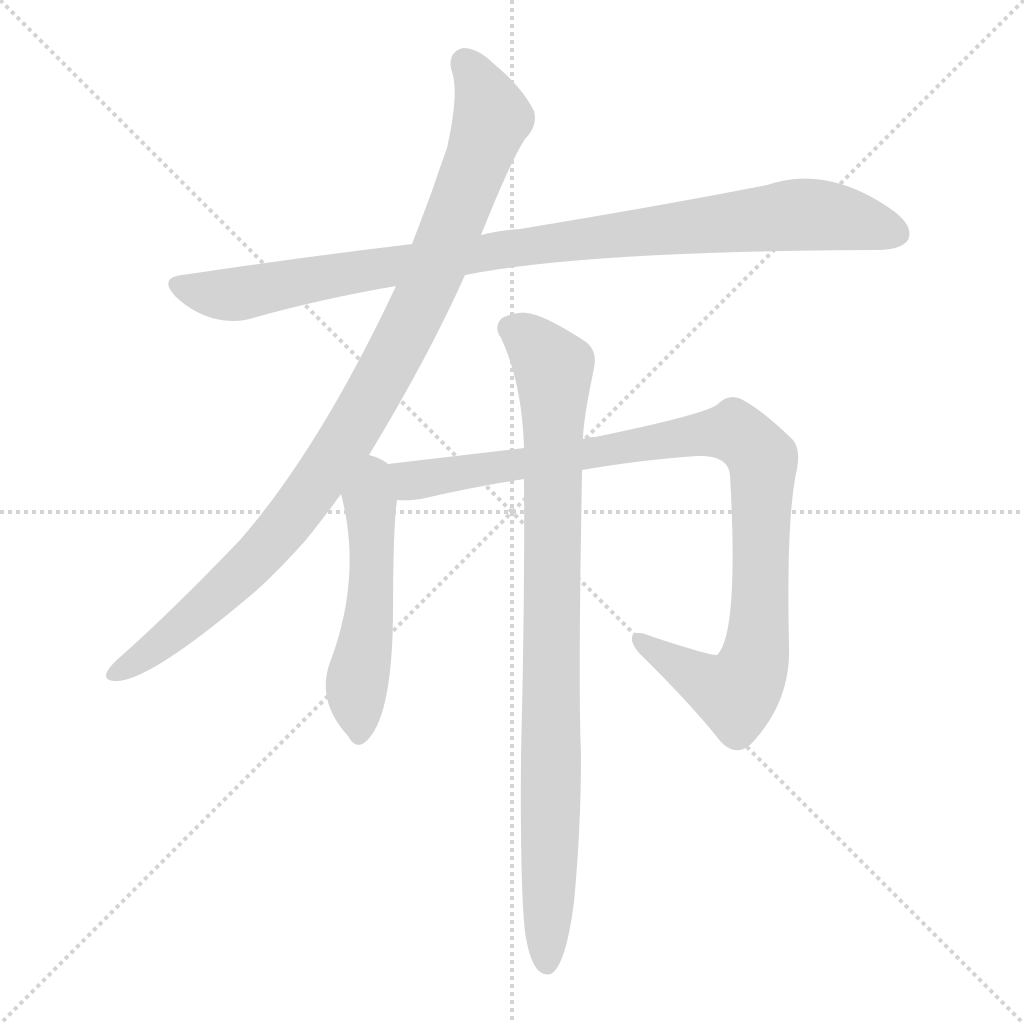
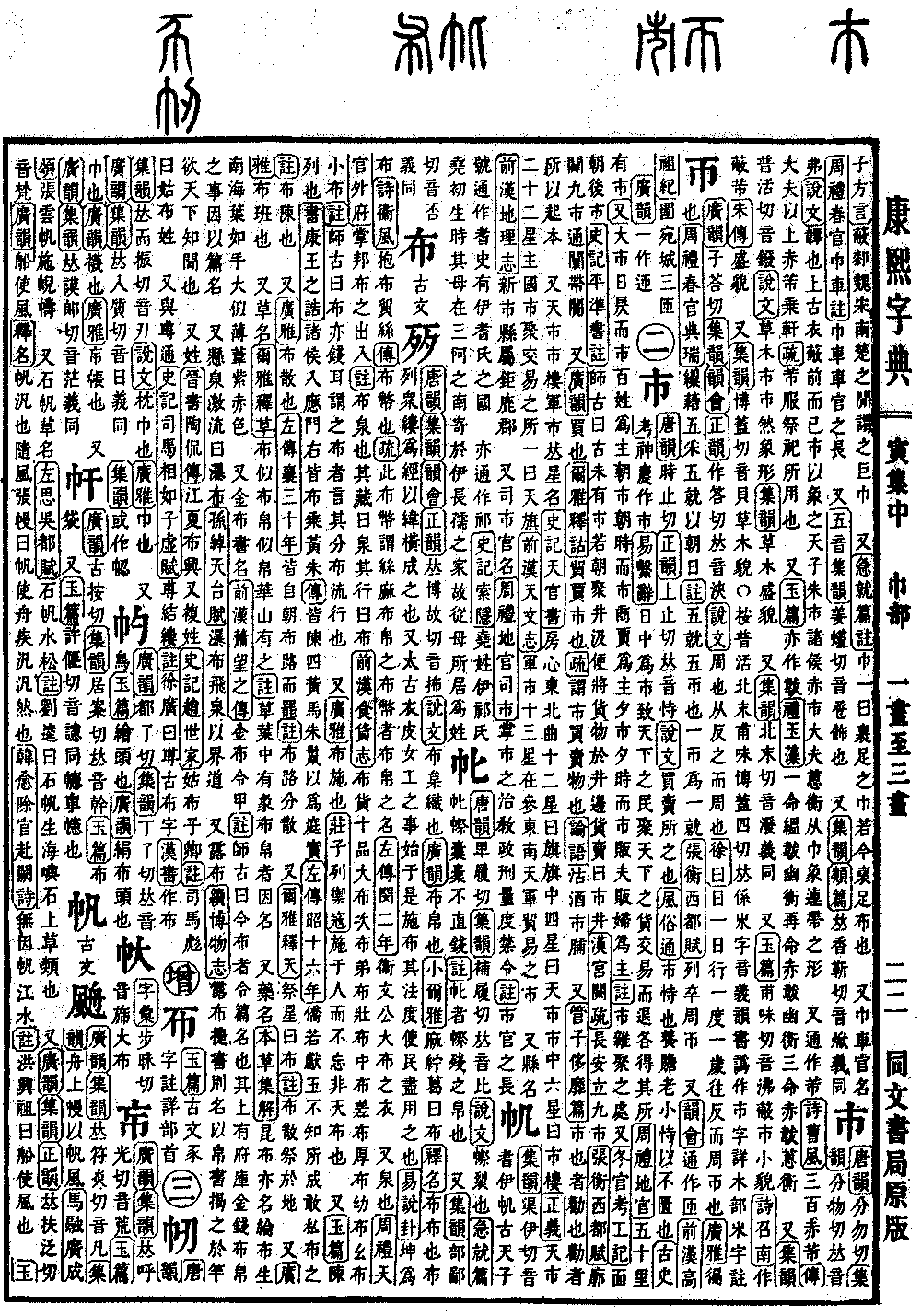
Yin Collection, Middle Volume. Radical: Cloth (jīn). Kangxi strokes: 5. Page 328, Entry 06.
Ancient form. Pronounced bu.
Shuowen Jiezi (Shuowen): Cloth (bu) made of hemp (xi), woven fabric.
Guangyun: Cloth, silk fabric.
Xiao Erya: Hemp, ramie, and kudzu fibers are called cloth.
Shiming: Cloth is diffusion. It means arranging many threads as the warp and weaving the woof across them. In ancient times, people wore animal skins; the work of women began with this, spreading and establishing its methods so that the people would fully utilize it.
Book of Changes (Yijing): Kun represents cloth.
Book of Odes (Shijing): Holding cloth to trade for silk. Commentary: Cloth refers to currency. Sub-commentary: This refers to currency made of silk or hemp fabrics. Currency is the name for silk and hemp cloth.
Zuo Zhuan (Zuo Zhuan): Duke Wen of Wei wore clothes of coarse cloth.
Also, currency.
Rites of Zhou (Zhouli): Responsible for the incoming and outgoing currency of the state. Commentary: Cloth is currency. When stored it is called spring (quan), when in circulation it is called cloth (bu).
Book of Han (Hanshu): There are ten categories of currency, including large cloth, secondary cloth, and small cloth. Commentary: Shigu said that cloth is also money. It is called cloth because it refers to its distribution and circulation.
Guangya: Cloth, to bestow or to apply.
Zhuangzi (Zhuangzi): To bestow upon others without forgetting is not the way of heaven.
Yupian: To arrange.
Book of Documents (Shangshu): The feudal lords entered to the right of the response gate, all arranging teams of four yellow horses with red manes. Commentary: All are four yellow horses with red manes, used as ceremonial offerings in the courtyard.
Zuo Zhuan: If I offer jade, I do not know if it will be accepted, so I dare to privately present it. Commentary: Cloth means to display or set out.
Guangya: Cloth, to scatter or disperse.
Zuo Zhuan: Everyone left the court, scattering along the roads to disperse. Commentary: Scattering along the roads means to disperse.
Erya: Offering sacrifices to the stars is called cloth. Commentary: Cloth means to scatter the sacrifice on the ground.
Guangya: Cloth, to distribute.
Erya: A plant named cloth; it looks like cloth. There is a mountain called Mount Hua that has it. Commentary: There are plants with leaves resembling cloth, hence the name.
Also, a medicinal name. Bencao Jijie: Konbu (sea tangle), also known as lunbu. It grows in the South Sea, its leaves are as large as a hand, resembling thin reeds, and are purple-red in color.
Also, Jinbu, the name of a book. Book of Han: The Jinbu Lingjia statutes. Commentary: Shigu said that Jinbu is the title of a legal chapter. It contains matters concerning government storehouses, money, and fabrics, hence the name of the chapter.
Also, hanging springs and rushing water are called waterfalls (pubu). Sun Chuo, Tiantai Fu: The waterfall and flying spring divide the path.
Also, a Lubu. Xu Bowuzhi: Lubu is another name for a report of victory, written on silk and displayed on a pole so that the world may know of it.
Also, a surname. Book of Jin: Bu Xing of Jiangxia.
Also, a double-character surname. Records of the Grand Historian (Shiji): Gubu Ziqing. Commentary: Sima Biao said Gubu is a surname.
Also, interchangeable with the character fu (variant form). Records of the Grand Historian: Spread (zhuan) with knotted threads. Commentary: Xu Guang said that this is an ancient form of the character for cloth. The Book of Han uses the character for cloth.