Zi Collection, Page Position: Upper
Radical: One (yī)
Bu
Kangxi Stroke Count: 4
Page Number: Page 76, Number 15
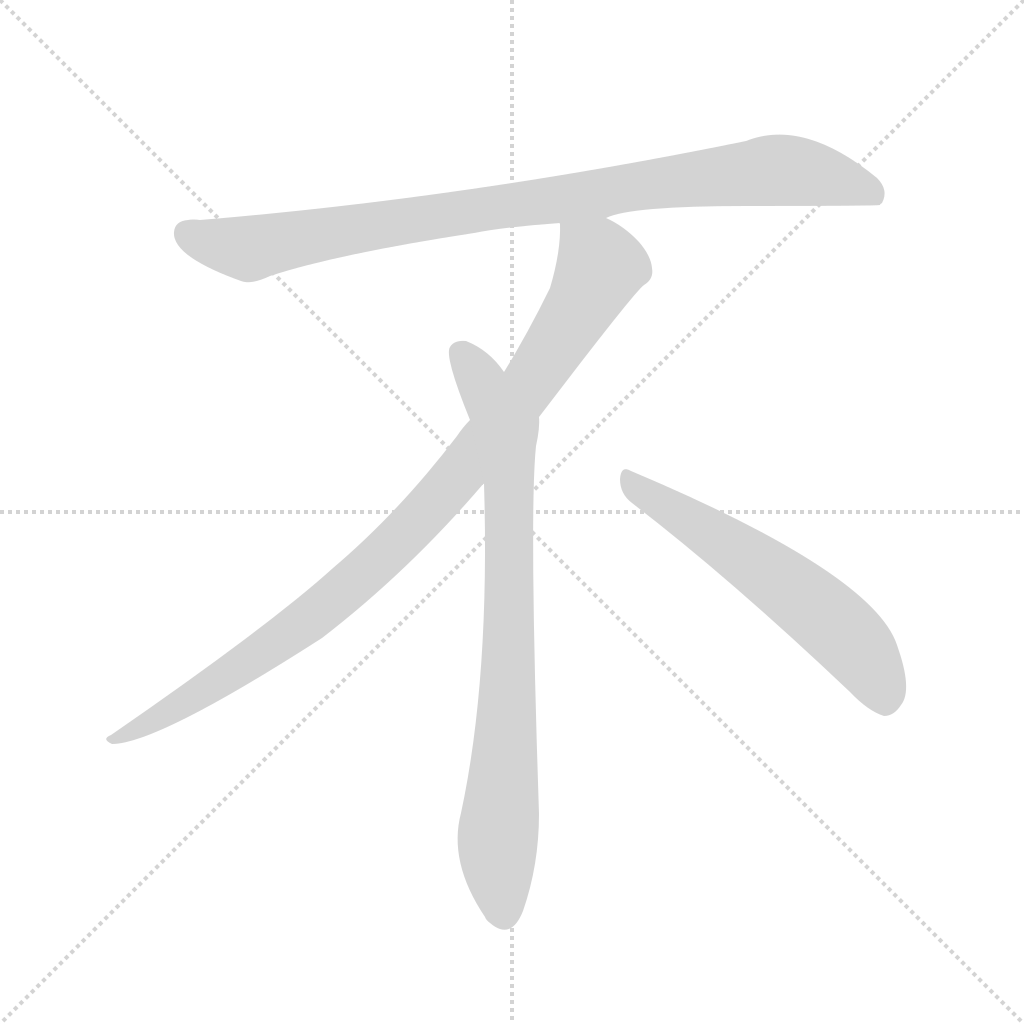
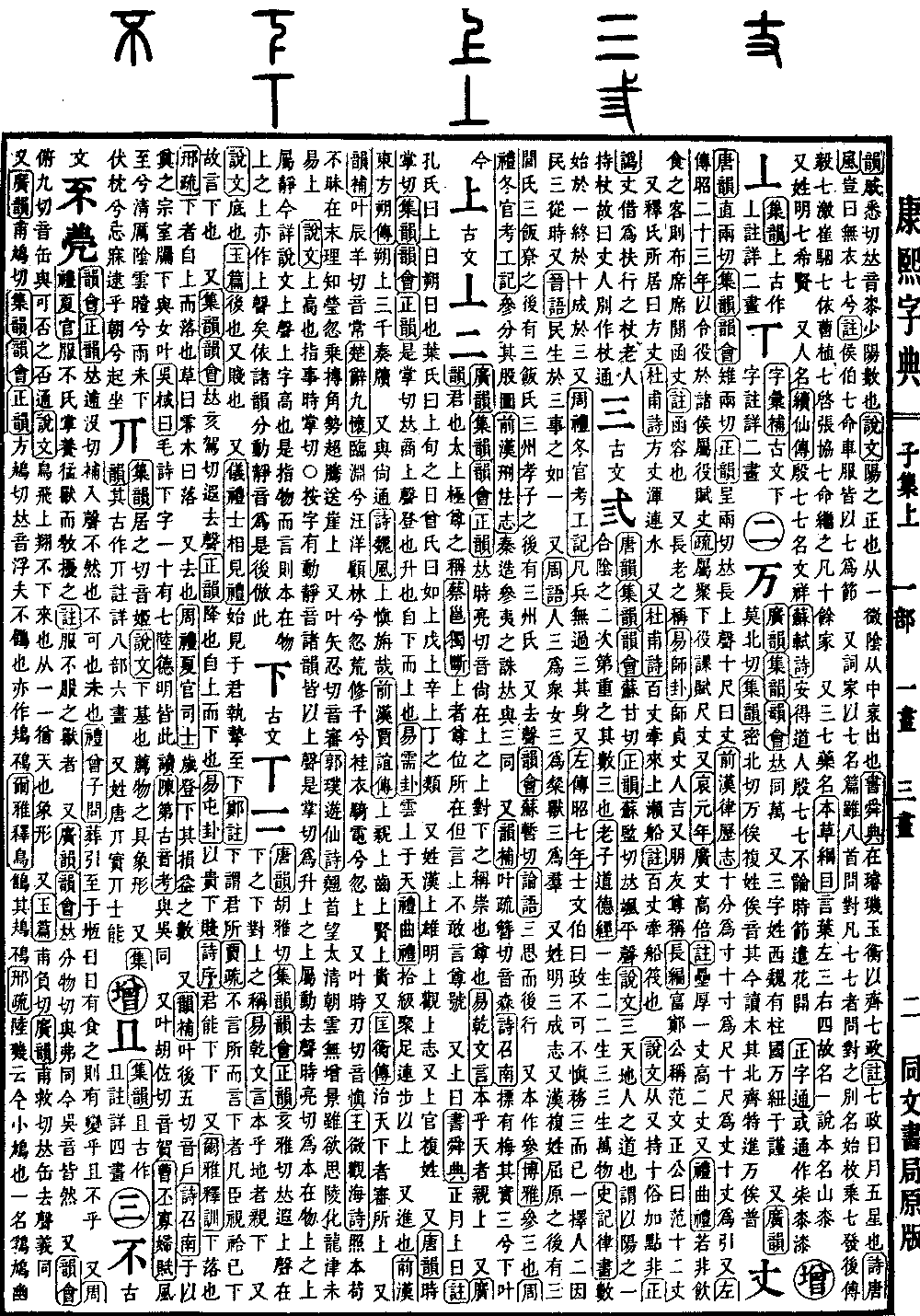
Ancient form. Collected Rhymes (Yunhui) and Correct Rhymes (Zhengyun) provide the fanqie pronunciation bu-mo, read in the entering tone of the syllable bu. Indicates negation, equivalent to meanings such as is not, cannot, or not yet. Book of Rites (Liji), Questions of Zengzi: When the funeral procession reaches the path to the tomb and a solar eclipse occurs, should the ritual be changed or not changed? Also, Rites of Zhou (Zhouli), Summer Officials: The Fubu clan is responsible for raising wild beasts and training them to be submissive. Note: The Fubu clan refers to those who tame beasts that are not submissive. Also, Expanded Rhymes (Guangyun) and Collected Rhymes provide the fanqie pronunciation fen-wu. It has the same meaning as fu. This is the current pronunciation in the Wu region. Also, Collected Rhymes provides the fanqie pronunciation fu-jiu, sounding like fou. It is interchangeable with the fou meaning whether or not. Explaining Graphs and Analyzing Characters (Shuowen Jiezi): It resembles a bird flying upward and not coming down. The character form follows the radical one (yi), representing the sky. It is a pictographic character. Also, Jade Chapters (Yupian) and Expanded Rhymes provide the fanqie pronunciations fu-fu and fu-jiu, read in the departing tone of fou. The meaning is the same. Also, Expanded Rhymes, Collected Rhymes, and Correct Rhymes provide the fanqie pronunciations fu-jiu and fang-jiu, sounding like fu. It refers to the fubu, which is the turtledove. It is also written as fubu. Approaching the Refined (Erya), Explaining Birds: It is the fubu. Xing's Commentary: Lu Ji says it is the modern small dove. One name is jiu; people of Youzhou sometimes call it gaoju, those between Liang and Song call it zhui, and people of Yangzhou also call it that. Also used as a particle indicating uncertainty. Poems of Tao Qian: I do not know if it will still be like this from now on. Also a surname. Book of Jin (Jinshu): There was a person from Jijiun named Bu Zhun. According to the Correct Character Mastery (Zhengzitong): When used as a surname, the ancient derived sound of bu is read as biao. Also, Correct Rhymes provides the fanqie pronunciation fang-wu. It is interchangeable with fu, referring to the base of a flower calyx. Book of Odes (Shijing), Minor Odes: The flower calyxes are bright and eye-catching. Zheng's Commentary: That which supports the flower is the e (calyx). The character bu should be read as fu. Zheng Qiao says: The character bu resembles the shape of the flower calyx and stem. It is interchangeable with fu. Lu Ji's Commentary on the Odes: Fu is written as fu. Shu Xi's Poems to Replace Lost Ones: White flowers with red calyx bases. Tang Dynasty poems: Red flowers with green calyx bases—both follow this meaning. Also the name of a mountain called Huabuzhu, located northeast of Jinan city. Zuo Commentary (Zuozhuan), Second Year of Duke Cheng: Xi Ke of Jin fought at An, and the Qi army was soundly defeated. The Jin army pursued the Qi army, circling Mount Huabuzhu three times. Fu Chen's Records of Qi (Qiji): Citing Zhi Yu's Classic of Domains and Garments (Jifujing), the character bu here is different from the bu in the term ebu in the Book of Odes. Li Bai's poem: How steep and beautiful this mountain is, its green color like a lotus. It likely uses the flower calyx metaphor for comparison. Hu's Commentary reads bu as bu, which is incorrect. Also, Ancient Poem, Song of the Sunrise at the Southeast Corner: The governor asked Luofu, Can we ride in the carriage together? Luofu stepped forward and replied, Governor, how can you be so foolish? You have your own wife, and I have my own husband. Note: The character yu should be read as wu, with the fanqie pronunciation yi-mo, rhyming with fu, bu, and fu. These characters originally belonged to the mo rhyme group. The Correct Character Mastery is incorrect in not changing the pronunciation of bu while letting it rhyme with fu and yu. Also the same as pi. Book of Documents (Shangshu), Great Announcement: You should be able to recognize from afar the achievements of your ancestors. Ma Rong's version writes it as bu. Qin Dynasty, Curses Against Chu (Zuchuwen): The great and illustrious high deity Wu Xian. Qin Dynasty, Inscription on the Harmony Bell: The great and illustrious imperial ancestor. This is the same as the phrase bu-xian-bu-cheng in the Book of Odes, Eulogies of Zhou. Bu-xian-bu-cheng is like the phrase pi-xian-pi-cheng in the Book of Documents. Also, Rhyme Supplement (Yunbu) provides the rhyming fanqie pronunciation bu-mei, sounding like bi. Xunzi, Chapter on Fu: Yet it is easy to understand and highly organized; is this what the gentleman respects but the petty person despises? The term suo-bu refers to what the petty person looks down upon. Correct Character Mastery: The pronunciation of the character bu in the entering tone varies by regional dialect; some read it as the entering tone of bu, others as the entering tone of bei. Sima Guang's Charts of Rhymes (Qieyun Tu) sets it as the fanqie pronunciation bu-gu. Currently, in the north, it is read as bang-pu. Although the entering tone has shifted to the level tone, the meaning remains the same. Textual Research: In the Book of Rites, Questions of Zengzi, for the phrase when the funeral procession reaches the path to the tomb and a solar eclipse occurs, one instance of the word day has been deleted according to the original text. In Xunzi, Chapter on Fu, the word discourse has been deleted according to the original book. Note: The phrase meaning what the petty person despises did not have this specific note in the original text; it has been changed to suo-bu refers to what the petty person despises.