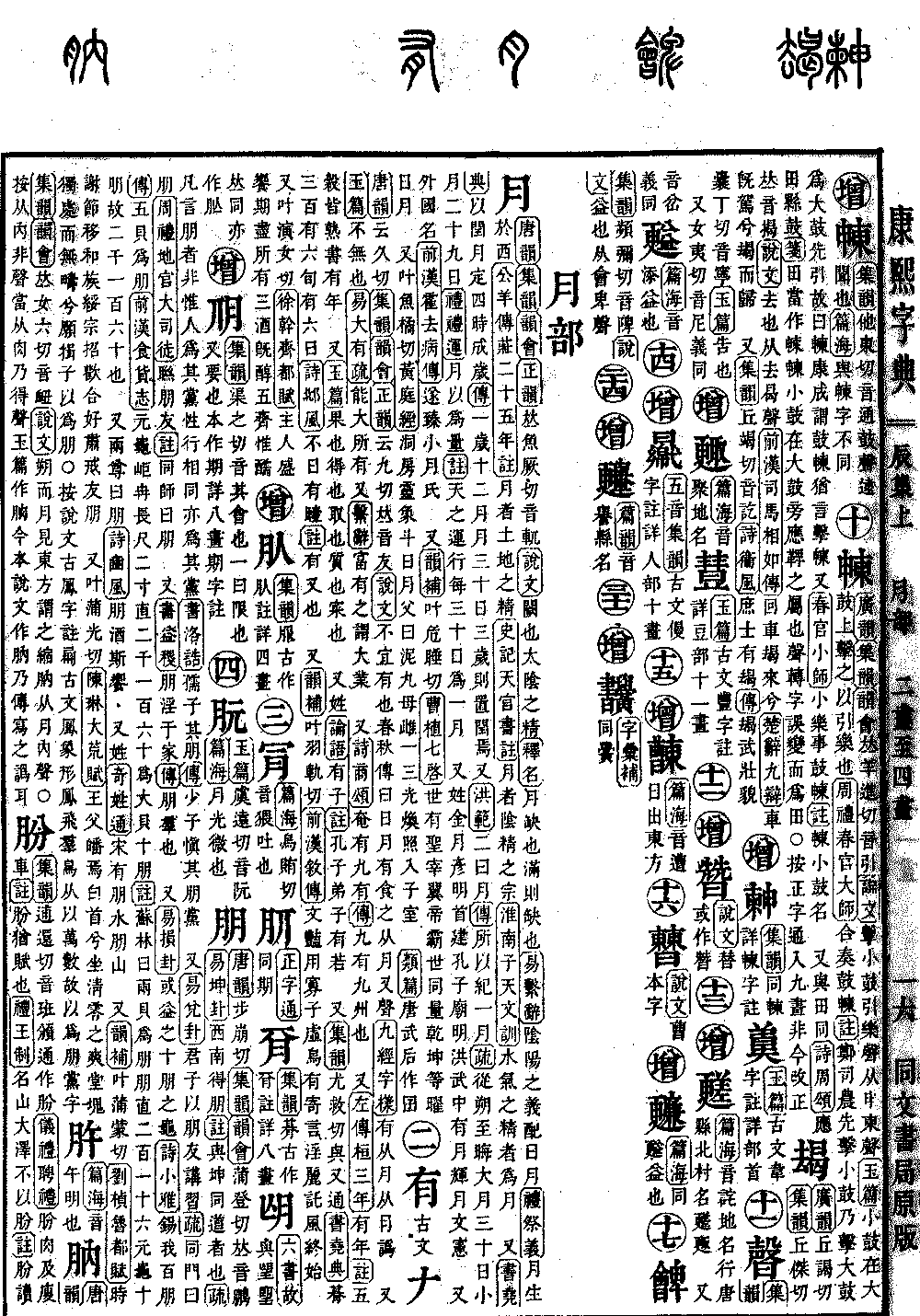
Chen Collection, Upper Volume
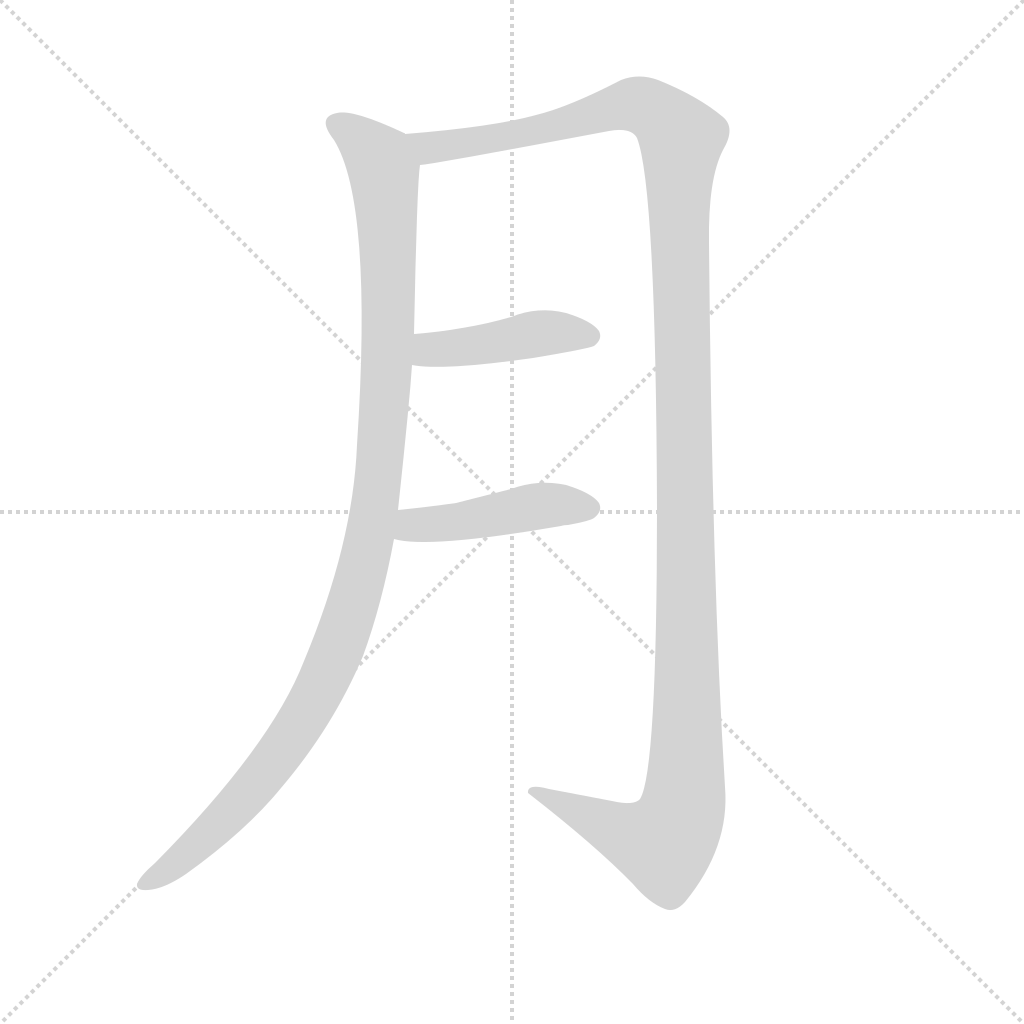
Radical: Moon (yuè)
Kangxi Strokes: 4
Page 504, Entry 19
Pronounced yuè. Pronounced the same as the character for a shaft-coupling (yuè).
Shuowen Jiezi explains it as "the waning," the essence of the great shade.
Shiming states: Moon (yuè) means to be deficient (quē); once it is full, it will begin to wane.
I Ching (Yijing), Appended Remarks: The meaning of yin and yang corresponds to the sun and moon.
Book of Rites (Liji), Sacrificial Meaning: Records that the moon rises in the west.
Gongyang Zhuan, Commentary on the twenty-fifth year of Duke Zhuang: States that the moon is the essence of the earth.
Records of the Grand Historian (Shiji), Commentary on the Treatise on the Celestial Offices: Calls the moon the sovereign of the yin essence.
Huainanzi, Treatise on Astronomy: States that the essence of water vapor condenses to form the moon.
Also, Book of Documents (Shangshu), Canon of Yao: Records the establishment of intercalary months to determine the four seasons and constitute a year. The Commentary explains that a year consists of twelve months, each thirty days long, with an intercalary month added every three years.
Also, Book of Documents (Shangshu), Great Plan: The second category is called month. The Commentary states it is the unit used to record a month. The Sub-commentary explains that from the first day of the lunar month (shuò) to the last day (huì), a long month has thirty days and a short month has twenty-nine days.
Book of Rites (Liji), Transmission of Rites: Mentions using the month as a unit of measurement. The Note states that the movement of the heavens defines one month as thirty days.
There is also the surname Yue. In the Jin dynasty, there was Yue Yanming who was the first to establish a Confucius temple; in the Ming dynasty, during the Hongwu period, there were Yue Hui and Yue Wenxian.
There is also a foreign name. Book of Han (Qian Hanshu), Biography of Huo Qubing: Records that they then reached the Lesser Yuezhi.
Also, Yunbu: Rhymes with the sound wēi. Cao Zhi, Seven Exhortations: In the world there are sagely ministers who assist the emperor in achieving hegemony. Their merits are equal to heaven and earth, and their brilliance is as bright as the sun and the moon.
Also rhymes with the sound yú. Yellow Court Classic (Huangtingjing): The spiritual phenomena in the inner chamber are like the Big Dipper and the sun and moon; the father is called Niwan and the mother is called Ciyi, and the three lights of the sun, moon, and stars shine into the dwelling of the children.
Leipian: Records that in the Tang dynasty, Wu Zetian created the character (jiǎn) to represent it.
Zhengzitong: Explains that when the character for meat (ròu) serves as a radical, it was originally written as (ròu). In the Stone Classics, it was changed to be written as (yuè), with the two strokes in the middle connecting to the left and right, which is different from the moon (yuè) character. It is now commonly written as (yuè) to distinguish it. The middle of the character for moon follows the two-dot (bīng) component, not the character for two (èr).