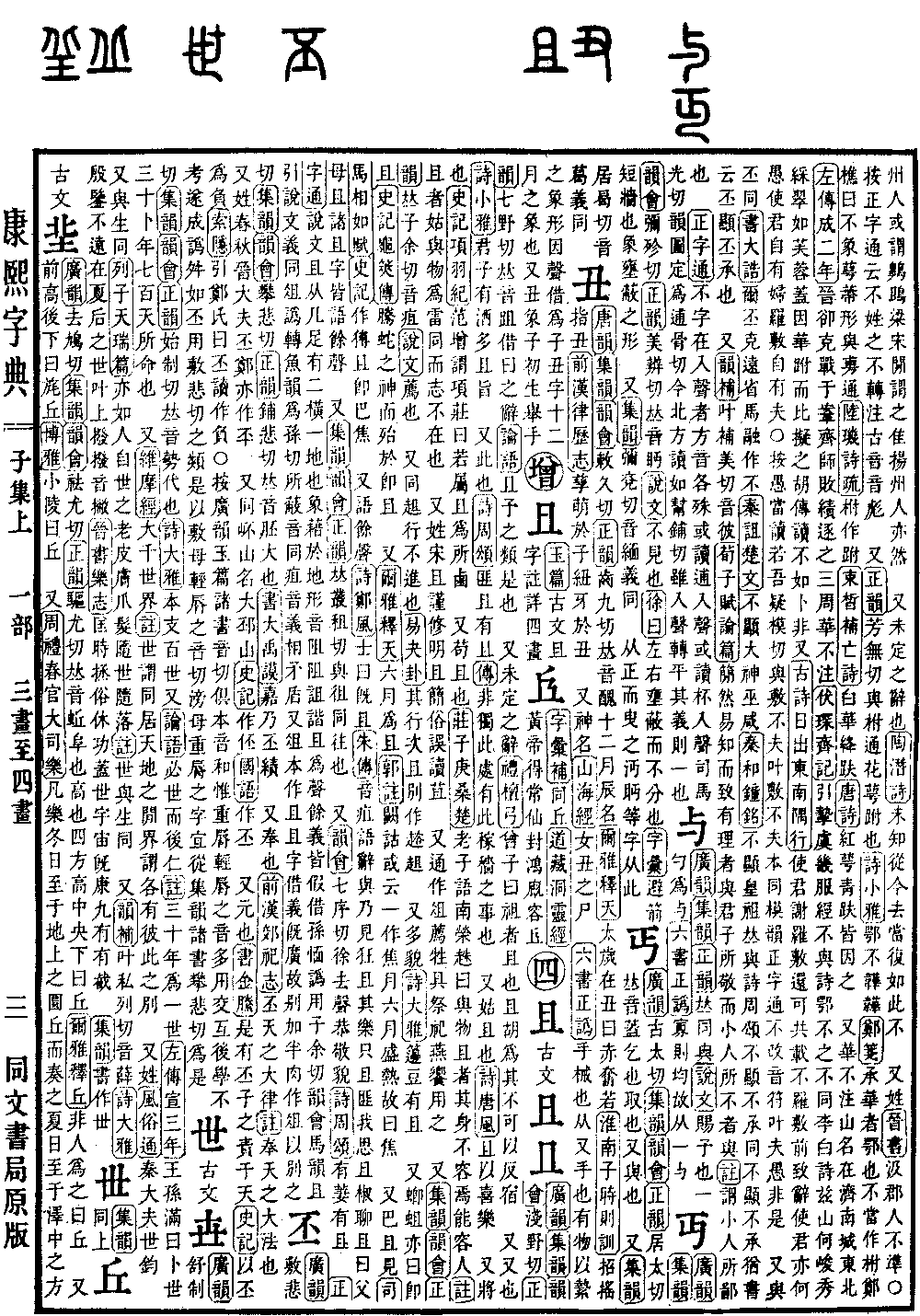
Zi Collection, Page Position: Upper. Radical: One (yī). Shi. Kangxi strokes: 5. Page: Page 77, Number 06.
The ancient form is written as shì.
In the Expanded Rhymes (Guangyun), the fanqie phonetic notation is shū zhì qiè. In the Collected Rhymes (Jiyun), Rhyme Assembly (Yunhui), and Correct Rhymes (Zhengyun), the fanqie phonetic notation is shǐ zhì qiè, pronounced the same as shì.
The definition is generation.
The Book of Odes (Shijing), Greater Odes (Daya) records: The main and branch lineages for a hundred generations.
Also, the Analects (Lunyu) says: It must take a generation before benevolence prevails.
Note: Thirty years is called one generation.
The Commentary of Zuo (Zuo Zhuan), Third Year of Duke Xuan: Wangsun Man said: Divined for thirty generations and seven hundred years; this is the decree of Heaven.
Also, the Vimalakirti Sutra (Weimojing) mentions: The Great Thousand World.
Note: Shi refers to living together between heaven and earth, while jie refers to the distinctions between one another.
Also used as a surname.
The Comprehensive Meaning of Customs (Fengsu Tong) records: The State of Qin had a high official named Shi Jun.
Also interchangeable with sheng, meaning birth or life.
The Liezi, Tianrui Chapter says: Just as a person ages from birth, skin, nails, and hair fall off as life progresses. Note: Shi has the same meaning as sheng.
In the Rhyme Supplement (Yunbu), the leaf sound or yèyīn is sī liè qiè, pronounced the same as xuē.
The Book of Odes, Greater Odes: The mirror for Yin is not far off; it is in the generation of the sovereign of Xia. It rhymes with the word bō, which is pronounced piě.
The Book of Jin (Jinshu), Treatise on Music: Correcting the times and saving the customs, excellent merits cover the world. The universe is at peace, and the nine provinces are unified.
The Collected Rhymes records the written form as a variant character.