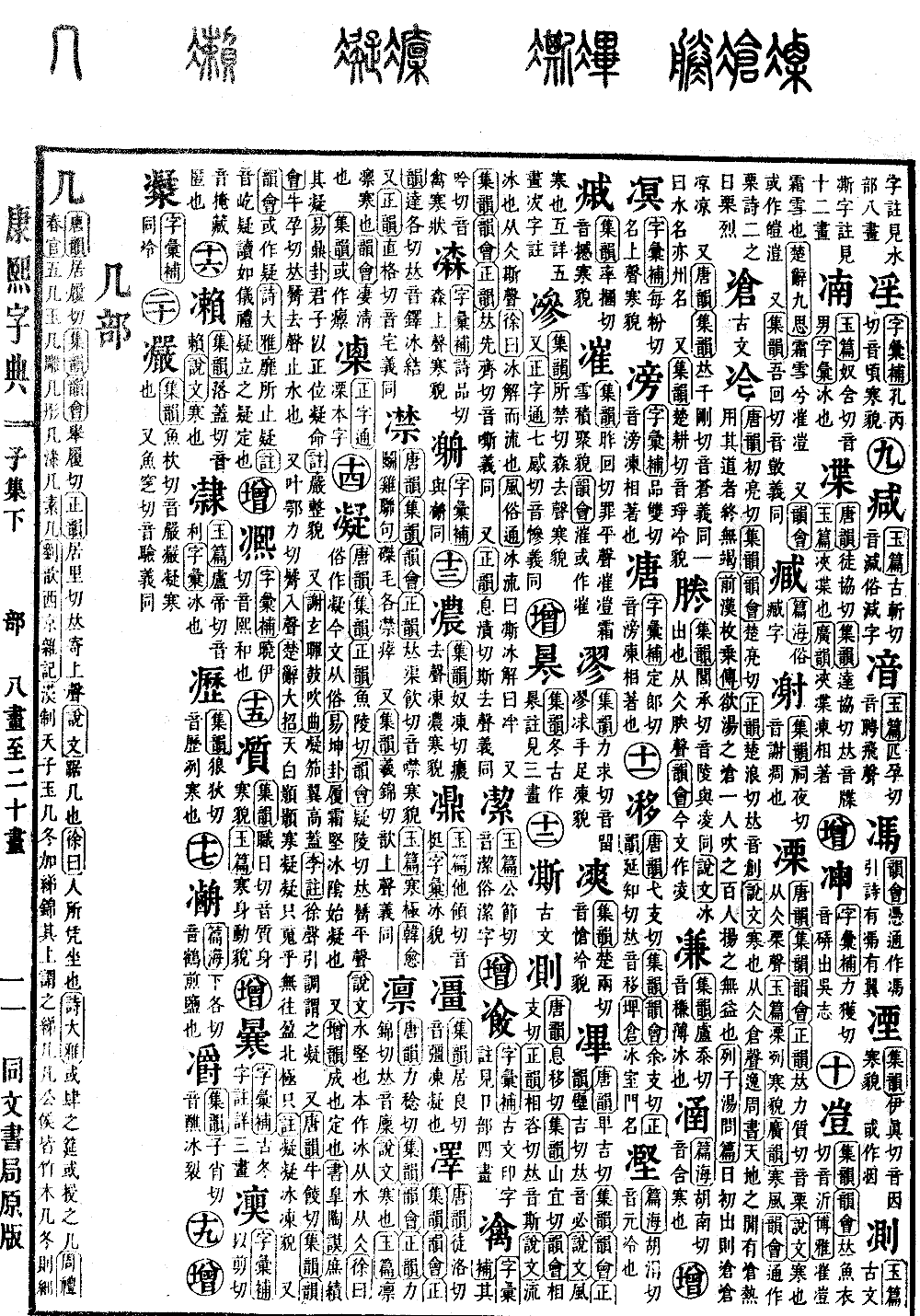
Zi Collection, Page Position: Lower
Radical: Table (jǐ)
Kangxi strokes: 12
Page: 133, Entry 57
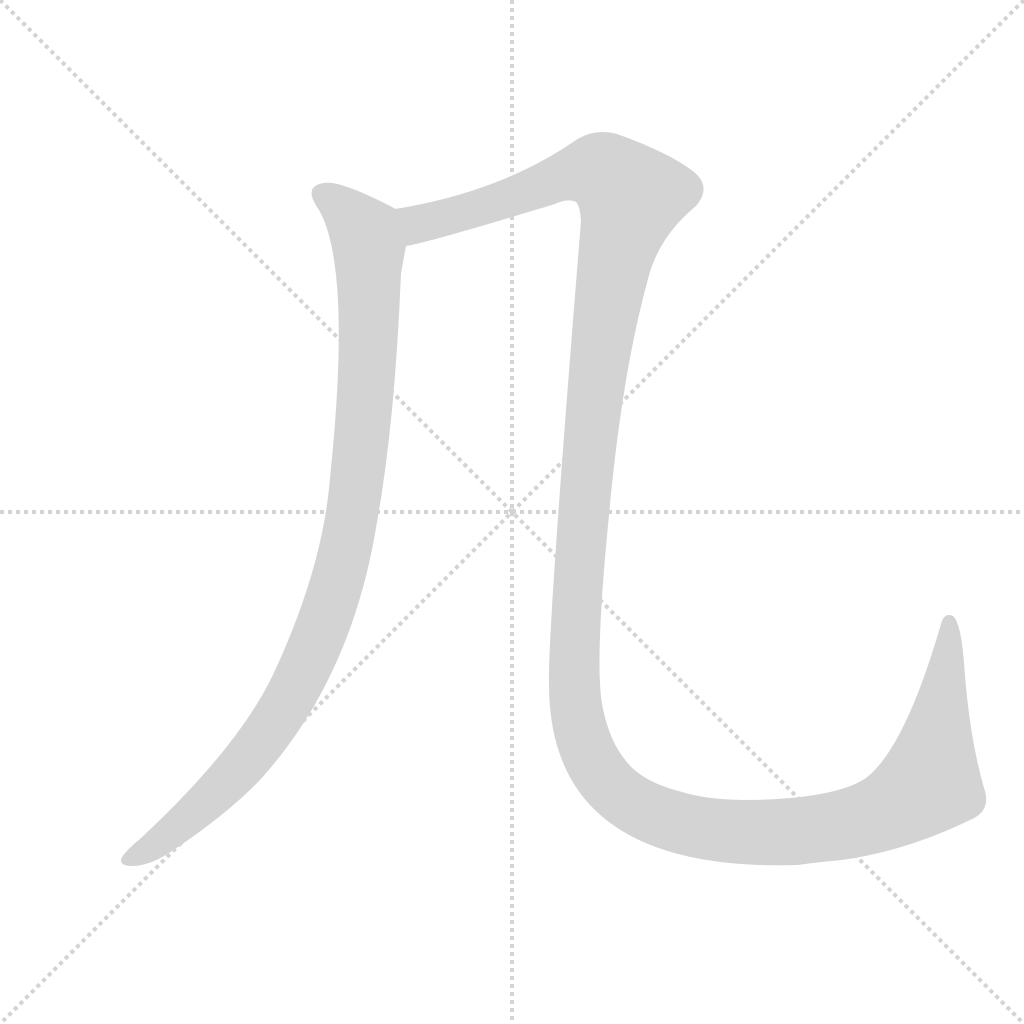
The character 几 (jǐ)
Tangyun (Tángyùn): jū lǚ qiè; Jiyun (Jíyùn), Yunhui (Yùnhuì): jǔ lǚ qiè; Zhengxun (Zhèngxùn): jū lǐ qiè, rising tone.
Shuowen Jiezi (Shuōwén Jiězì): To sit on a table. Xu Kai says: What people lean on and sit on.
Book of Odes (Shijing), Greater Odes: "Some spread out mats, some offer tables."
Rites of Zhou (Zhouli), Spring Officials: "Five kinds of tables: jade table, carved table, red table, lacquered table, plain table."
Xijing Zaji (Xījīng Zájì) by Liu Xin (Liú Xīn): "Under the Han system, the Son of Heaven used a jade table. In winter, brocade was added to it, called a brocade table. All dukes and marquises used bamboo or wooden tables. In winter, fine covers were made for them to lean on."
Yupian (Yùpiān): A desk. Also written as 机. Zuo Commentary (Zuǒzhuàn), Year 5 of Duke Zhao: "He set up a table but did not lean on it."
Also, jǐjǐ describes a secure and dignified appearance. Book of Odes (Shijing), Odes of Bin: "With red shoes, dignified and steady."
The character 几 (jī) - ancient form
Tangyun: jū yī qiè; Jiyun, Yunhui: jū xī qiè, pronounced jī.
Shuowen Jiezi: Subtle. I Ching (Yì Jīng), Appended Remarks: "The subtle is the first manifestation of movement, the precursor of good fortune."
Book of Documents (Shujing), Gaotao's Counsel: "Cautious and diligent, every day and two days, myriad subtle matters." Commentary: It means one should be cautious and fearful of the subtle aspects of all matters.
Also, Shuowen Jiezi: Dangerous. Composed of (a variant of rén, person) and 戍 (shù, guard). 戍 means soldiers guarding. And soldiers guarding is dangerous. Erya (Ěryǎ), Explanation of Words: "Jī means dangerous." Annotation: Jī is similar to dai (dangerous).
Book of Odes, Greater Odes: "Heaven sends down nets; how precarious they are!"
Also, Yupian: A fixed time, a period. Book of Odes, Lesser Odes: "May your hundred blessings be as fixed and as regulated." Commentary: The hundred kinds of blessings given to you, their coming early or late, is as if there is a fixed time; the amount of these blessings is as if there is a fixed measure.
Also, Erya, Explanation of Words: "Shùjī means to hope." Commentary: To hope refers to what the heart wishes for. Mencius (Mèngzǐ): "The King may perhaps change it."
Also, to examine. Book of Rites (Lǐjì), Jade Girdle: "The blind musician examines the high and low pitches of sounds." Rites of Zhou, Earth Officials, Officer of the Gate: "Examines those who enter or exit uncommonly." Annotation: "Uncommonly" means different from the crowd.
Also, Officer of the Pass: "Those without gate tax are still examined." Annotation: Without rent or tax, they are still strictly scrutinized to prevent villains from entering or exiting.
Also, Yunhui: About to reach. Erya, Explanation of Words: Near. I Ching, Central Fu: "The moon is near full." Book of Rites, Record of Music: "To understand music is to be near to understanding ritual." Records of the Grand Historian (Shǐjì), Hereditary House of Marquis Liu: "He almost ruined your lord's affairs."
According to Erya, Shìwén (釋文) provides the pronunciation jī; Records of the Grand Historian, Suǒyǐn (索隱) provides qǐ; Book of Rites, Shìwén provides jī. Also pronounced jù yī fǎn. Yunhui states: jī and qǐ are the two correct pronunciations.
The character 几 (qǐ)
Also, Guangyun (Guǎngyùn), Jiyun, Yunhui: qú xī qiè, pronounced qǐ. Jiyun: The carved edges of a vessel. Book of Rites, Single Victim at the Suburban Sacrifice: "The beauty of a red-lacquered, carved jǐ." Annotation: Jǐ refers to lacquering and decorating the edges. Commentary: "Carved" means engraving. "Jǐ" means edges. It means to decorate it with red lacquer and carving, to make it have edges. Shìwén: Jǐ, pronounced jù yī fǎn.
The character 几 (jǐ)
Also, Guangyun: jū xī qiè; Jiyun, Yunhui: jǔ kǎi qiè, jī rising tone. Yupian: Jǐjǐ, many. Guangyun: Jǐ, what? Yunhui: Jǐ, a term used to ask about quantity, how many or how much. Zuo Commentary, Year 27 of Duke Xi: "He brought peace within but suffered defeat outside; how many were gained?"
Records of the Grand Historian, Biography of Wan Shi Jun: "His younger son Qing served as the Grand Coachman. When he went out, the Emperor asked how many horses were in the carriage."
Also, Yunhui: "Not much time" is called wú jǐ. Also, "not many things" is also called wú jǐ.
The character 几 (jǐ)
Also, Guangyun, Jiyun, Yunhui: qí jì qiè, qǐ departing tone. Guangyun: Jǐ, not yet finished.
Also, Jiyun: Connects with jì (to hope for). Zuo Commentary, Year 16 of Duke Ai: "The people of the state looked forward to their lord as they look forward to the year, day by day hoping." Annotation: Hoping for the lord to come. Records of the Grand Historian, Hereditary House of Jin: "Not long before he became lord." Annotation: Jǐ means hope.