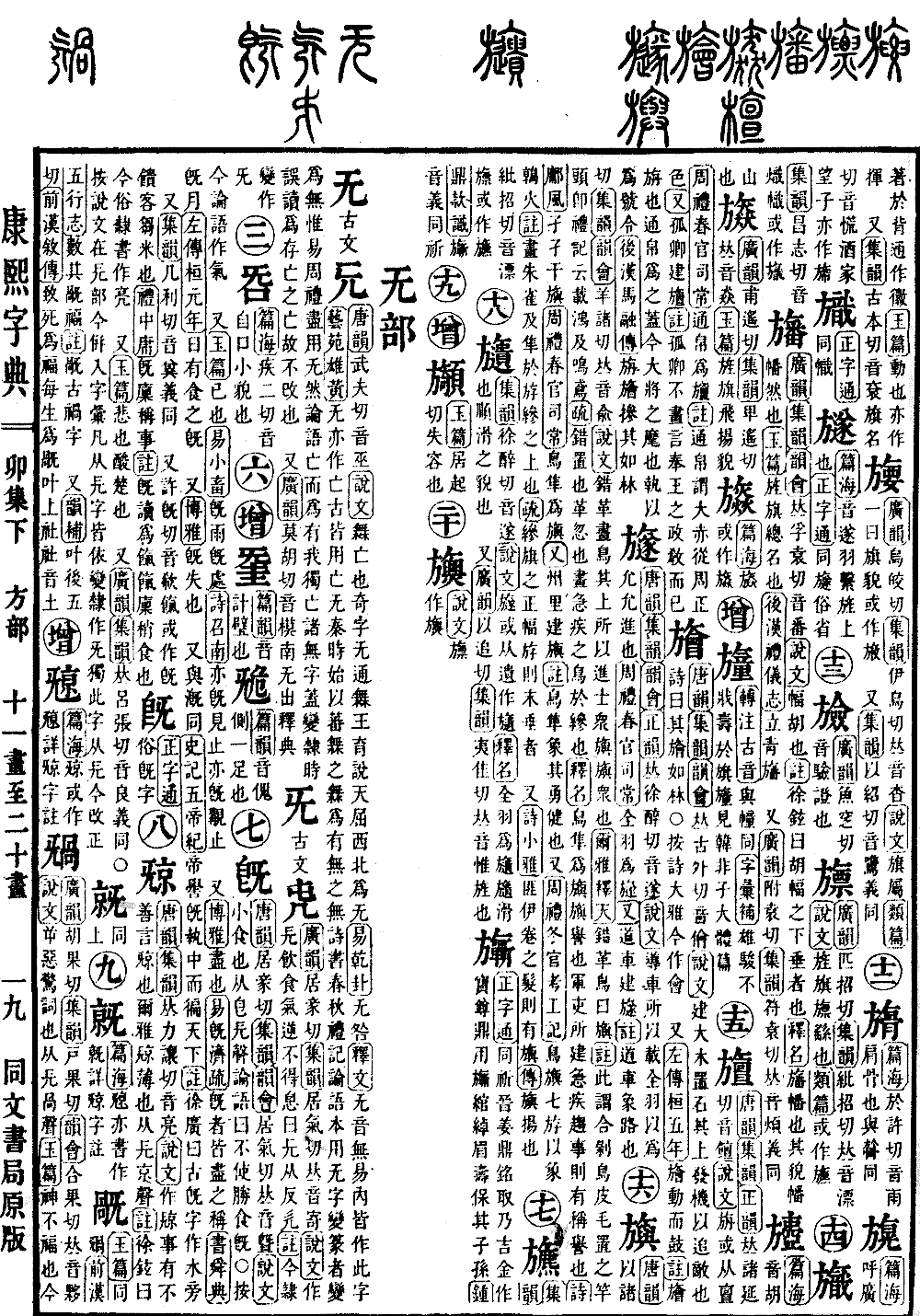
Mao Collection, Lower Volume
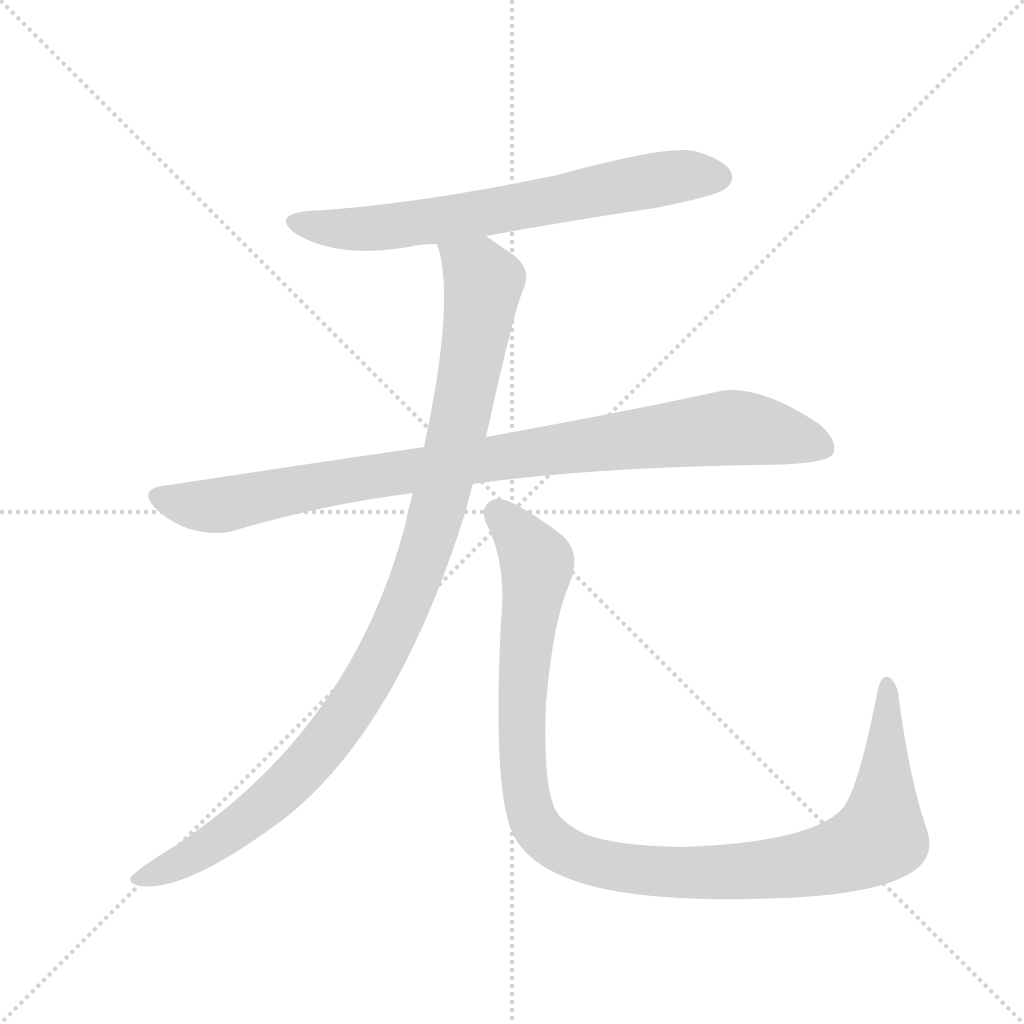
Radical: Not (wú)
wú
Kangxi Stroke Count: 12
Page Number: Page 485, Number 23
Ancient script form. According to the Tang Rhymes (Tangyun), the fanqie pronunciation is wǔ fū qiè, sounding like wú. The Analytical Dictionary of Characters (Shuowen Jiezi) defines it as not having (wáng). As a rare script character (qízì), it is interchangeable with the standard form for nothingness. Wang Yu states that the sky bending in the northwest is called wú. In the Book of Changes (Yijing), Qian Hexagram, it appears in the phrase no blame. The Explanations of Words (Shiwen) notes the pronunciation as wú and states that this character form is used throughout the Book of Changes. The Yiyuan Xionghuang states that wú is also written as wáng. In antiquity, wáng and wú were used interchangeably; it was only during the Qin dynasty that the character mǔ, originally meaning lush growth, began to be used for the sense of having or not having. The Book of Odes (Shijing), Book of Documents (Shujing), Spring and Autumn Annals (Chunqiu), Record of Ritual (Liji), and Analects (Lunyu) originally used the character wú. Those who modified the seal script changed it to the form meaning lush growth, while the Book of Changes and the Rites of Zhou (Zhouli) consistently used the form wú. However, in the Analects, the phrases having while lacking and I alone lack use the character wáng. This is likely because during the transition to clerical script, it was mistakenly read as the wáng meaning to perish or be lost, and thus was not corrected. Furthermore, the Expanded Rhymes (Guangyun) gives the fanqie pronunciation mò hú qiè, sounding like mó. This is used in the term Namo (nánmó), which originates from Buddhist scriptures. For the character wú, the ancient script form is given in the Tang Rhymes as wǔ fú qiè. The Expanded Rhymes gives wǔ fū qiè. The Collected Rhymes (Jiyun), Rhyme Assembly (Yunhui), and Correct Rhymes (Zhengyun) give the fanqie pronunciation wēi fū qiè, sounding like wú. The Analytical Dictionary of Characters defines it as not having (wáng). The Jade Chapters (Yupian) defines it as not possessing. In the Book of Documents, Canon of Shun (Shundian), it appears as firm but not cruel, kind but not arrogant. In the Counsel of Gao Yao (Yi Ji), it appears as exchanging what one has for what one lacks and trading goods. The Erya defines it as the space of emptiness and nothingness in the section Explaining Words (Shi Gu). A commentary notes that emptiness and nothingness both possess gaps. In the Classic of the Way and Virtue (Daodejing), it is said that all things are born from being, and being is born from non-being. In the Explanation of the Diagram of the Supreme Ultimate (Taijitu Shuo), it is referred to as the Ultimateless and yet the Supreme Ultimate. In the Record of Ritual, in the section Questions on the Three Years' Mourning (Sannian Wen), it appears in the phrase the unchanging way, where wú is used to mean not. It is also a county name; the Book of Han (Hanshu) in the Geography Records (Dilizhi) mentions Huiwu County in Yuexi Commandery. It is also a surname; the Correcting Character Errors (Zhengzitong) mentions the Han dynasty figures Wu Qieming and Wu Neng. The Expanded Rhymes notes the Han dynasty compound surnames Wuyong and Wugou, both originating from the State of Chu. Wenwu is the name of a medicinal herb; the Notes on Things Past and Present (Gujin Zhu) mentions that it was given as a parting gift. Wenwu is another name for dāngguī. In the rare script forms of the Analytical Dictionary of Characters, it is written as wú. The Jade Chapters defines it as emptiness and nothingness, noting that in the Book of Changes, the character for nothingness is consistently written as wú. The Collected Rhymes notes it is sometimes written as wáng. In the Book of Odes, Odes of Wei (Wei Feng), it appears in the phrase whether there is or there is not. It is also interchangeable with mǔ, as seen in the Against Luxurious Ease (Wuyi) chapter of the Book of Documents, which is written with mǔ in the Records of the Grand Historian (Shiji), House of Lu (Lu Shijia) section. It is also interchangeable with máo; in the Book of the Later Han (Hou Hanshu), Biography of Feng Yan (Feng Yan Zhuan), the phrase the hungry eat nothing uses máo for wú. A note in Feng Yan's collected works states that máo should be wú. This usage persists in modern colloquial speech and may have been common in antiquity. The Peixi Collection states that in the Heshuo region, wú is called máo. The Comprehensive Refinement (Tongya) states that in the Jiang, Chu, and Guangdong regions, wú is called máo. The Collected Rhymes notes it is sometimes written as wǔ. According to the Record of Ritual, in the section Ritual Vessels (Liqi), the phrase instructing the assistant in the right direction uses wǔ, but a commentary states wǔ should be wú, representing a phonetic error. Zheng Xuan's commentary explicitly identifies this as an error. The Collected Rhymes incorrectly treats wú and wǔ as the same character. The Collected Rhymes also notes that wú is sometimes written as mǔ. The Rhyme Assembly states this was originally an ancient character for lush growth (fán), which the seal script borrowed to mean having or not having. Li Si changed the clerical script by altering the forest (lín) component to four dots. According to the Analytical Dictionary of Characters, the character is derived from wáng with wú as the phonetic component and is categorized under the wáng radical. However, the character mǔ meaning lush growth is categorized under the forest radical. Their pronunciations and meanings are distinct, and they are not stated to be interchangeable. Furthermore, the meanings of having or not having and lush growth are opposites, so they should not be used interchangeably. The Jade Chapters, Collected Rhymes, and Rhyme Assembly are all incorrect in this regard. The Rhyme Assembly's version of the lush growth character is especially erroneous. Furthermore, the Mastery of Reading (Dushutong) claims it is interchangeable with characters like wù, mò, mò, méi, miè, wēi, bù, màn, and mào, but these either only share a meaning or a similar sound and are not truly the same character. The Mastery of Reading is in error. In Sanskrit (fànyán), the term Namo (nánmó) is pronounced nà mó. The syllable nà is like the rising tone of ná, and mó sounds like mó, meaning to take refuge (guīyī).