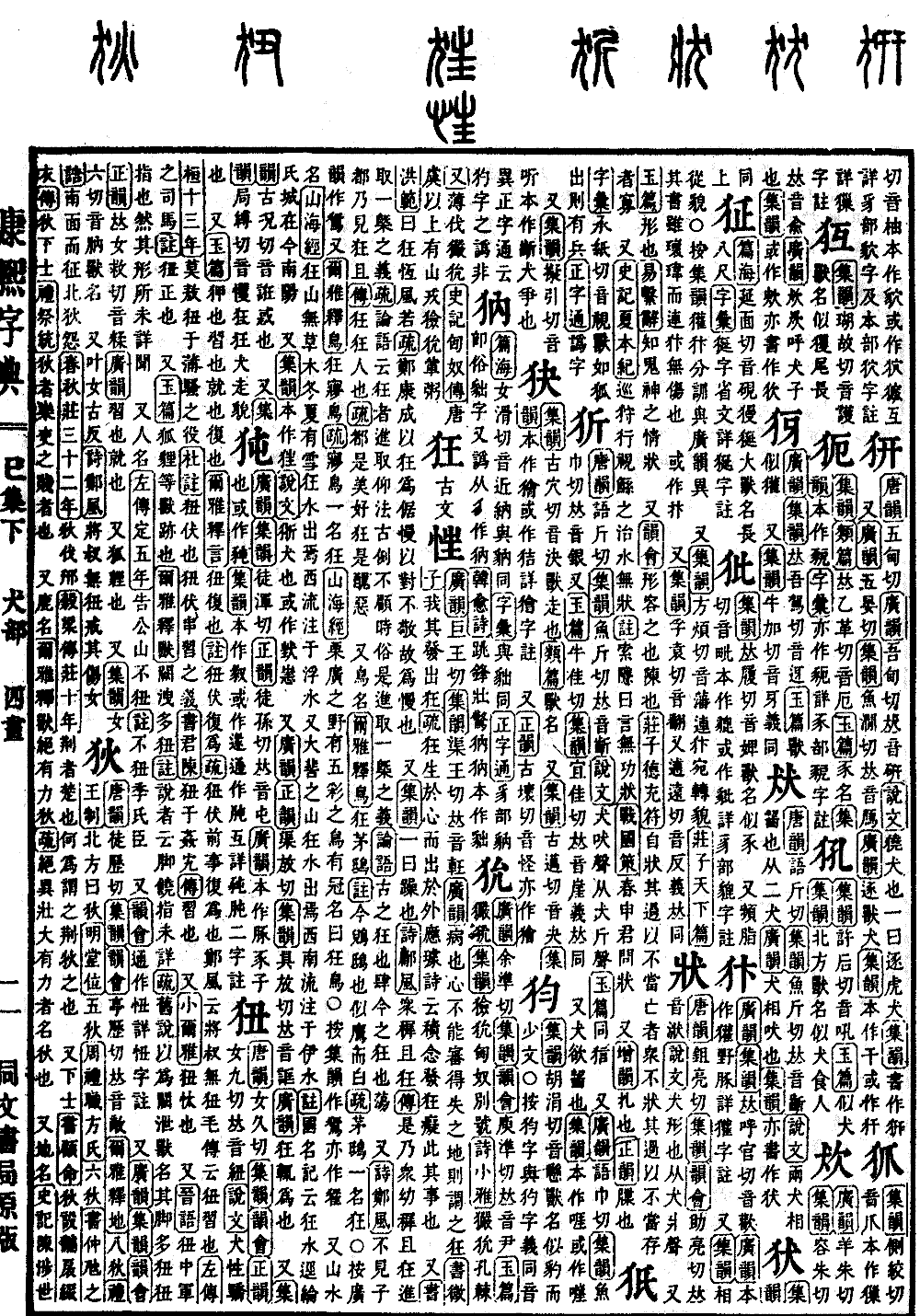
Si Collection, Lower Volume
Radical: Dog (quǎn)
Kangxi Strokes: 8
Page 707, Entry 24
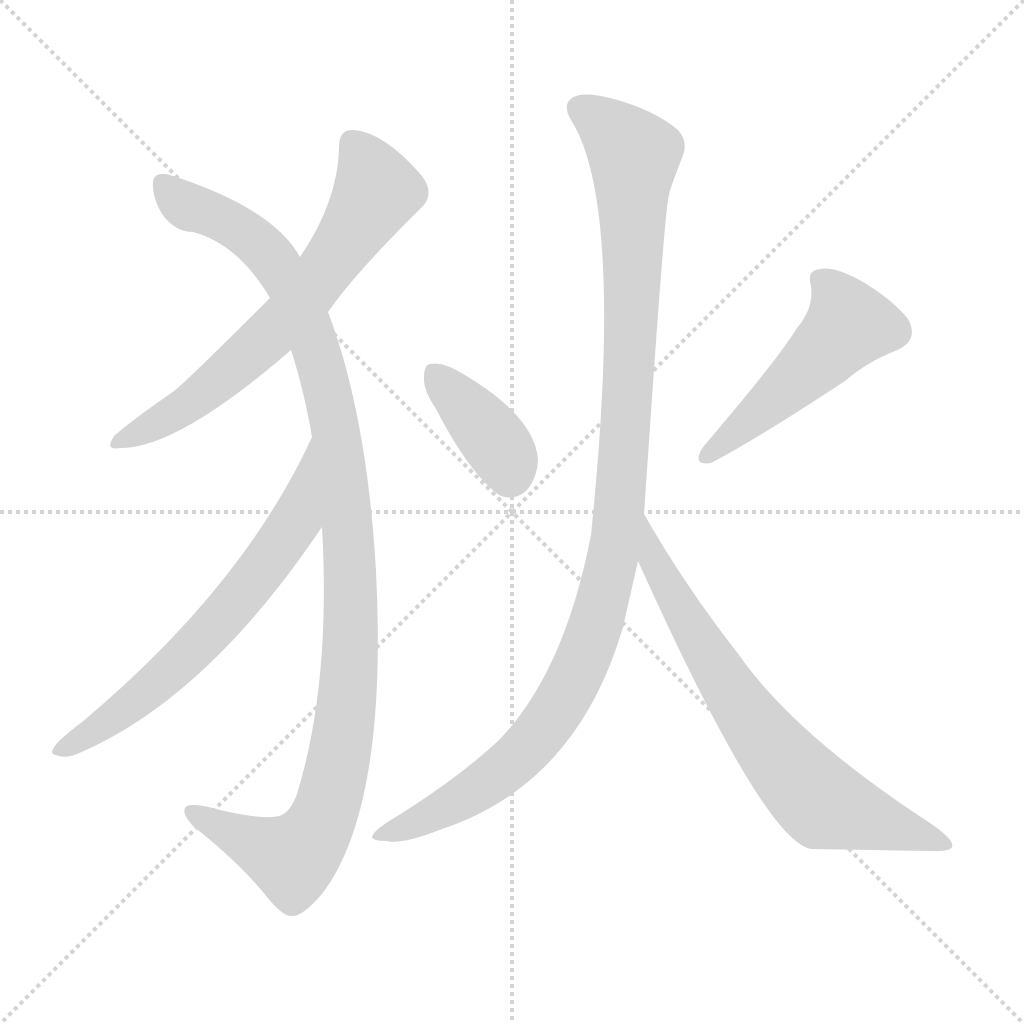
Pronounced dí.
Book of Rites (Liji), Royal Regulations: The people of the north are called Di.
Book of Rites (Liji), The Order of the Bright Hall: The five Di tribes.
Rites of Zhou (Zhouli), Offices of the Provinces: The six Di tribes.
Book of Documents (Shujing), Announcement of Zhong Hui: Having marched south to campaign, the northern Di were resentful.
Spring and Autumn Annals (Chunqiu), 32nd year of Duke Zhuang: The Di attacked the state of Xing.
Guliang Commentary (Guliang zhuan), 10th year of Duke Zhuang: The Jing are the Chu. Why call them Jing? It is to treat them as Di.
Also, a low-ranking official.
Book of Documents (Shujing), Testamentary Charge: The Di set up the axe-patterned screen and decorated robes.
Commentary: Di refers to a low-ranking official.
Book of Rites (Liji), Record of Sacrifices: Di refers to the lowliest of the music officials.
Also, a name for a species of deer.
Erya, Explanation of Beasts: That which is exceptionally strong and large is called Di.
Subcommentary: That which is exceptionally strong and large is named Di.
Also, a place name.
Records of the Grand Historian (Shiji), Hereditary House of Chen She: Zhou Shi campaigned north to seize territory, reaching Di.
Annotation: Xu Guang says it is present-day Linji.
Also, a person's name.
Records of the Grand Historian (Shiji), Annals of Yin: The mother of Xie of Yin was called Di.
Also, a surname.
Zuo Commentary (Zuozhuan), 10th year of Duke Xiang: Di Simi built the wheels of a large carriage.
Annotation: Di Simi was a man of the state of Lu.
Records of the Grand Historian (Shiji), Biography of Zhang Tang: The erudite scholar Di Shan.
Guangyun: Descendants of the state of Di during the Spring and Autumn period.
Also interchangeable with the character zhai.
Book of Rites (Liji), Jade Pattern: The consort wears the di robe.
Subcommentary: Yu is read like yao. Di is read like zhai. This refers to painting the pheasant pattern on robes.
Also, Classic of Music (Yueji): Using shields, axes, yak tails, and pheasant feathers to dance.
Subcommentary: Di refers to feathers.
History of the Former Han (Hanshu), Treatise on Geography: Yuquan and Xiadi.
Also, the name of a spring. Located in Luoyang.
Gongyang Commentary (Gongyang zhuan), 29th year of Duke Xi: A covenant at Diquan.
Note: The two other commentaries write it as zhai.
Pronounced tì.
Originally written as ti. It means distant.
Book of Odes (Shijing), Greater Odes: Abandon your great distance, and we shall avoid each other.
Commentary: Di means distant.
Also, Book of Odes (Shijing), Praise Songs of Lu: Resolutely marching, clearing away the southeast.
Annotation: Di should be read as ti. Ti means to govern.
Explanation of Texts: Han School of Odes says it means to clear away.
Also, Book of Rites (Liji), Classic of Music: Flowing, aberrant, wicked, and scattered, the sounds of clearing away and overflowing arise.
Annotation: Di-ti describes the appearance of moving rapidly back and forth.
Also interchangeable with the character yi.
Wang Chong, Balanced Inquiries (Lunheng): The seasoning by Yi Ya. Both classics and histories write it as Yi Ya.
Textual Research: In the Zuo Commentary, 10th year of Duke Xiang, regarding Di Simi and the wheels of a large carriage, the character jian has been added to match the original text.