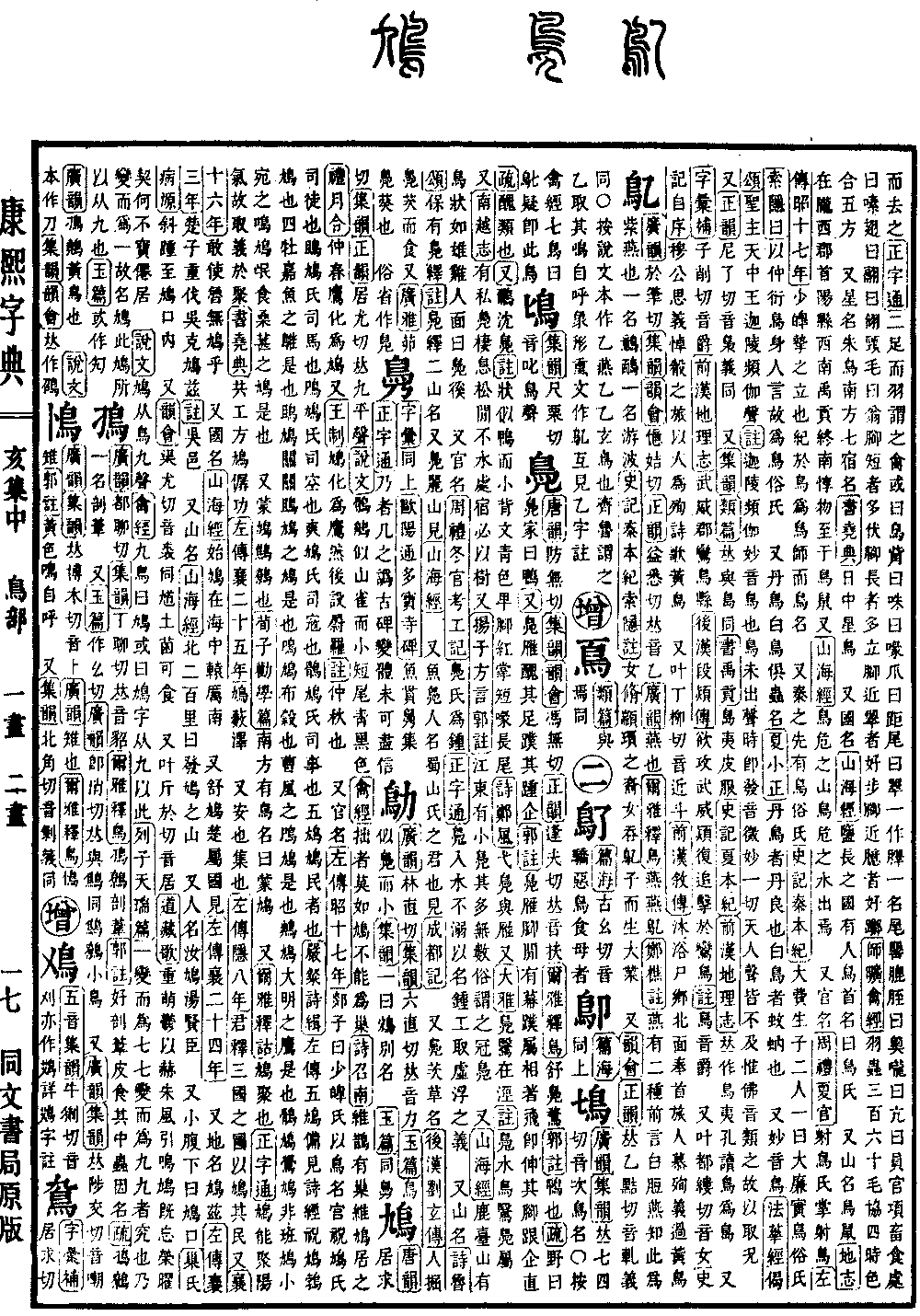
Hai Collection, Middle Volume
Radical: Bird (niǎo)
Kangxi strokes: 13
Page 1481
Fú; pronounced fú.
Erh-ya (Erya), Explanation of Birds: Shufu is a duck. Guo Pu's commentary: It is a duck. Annotation: In the wild, it is called fu; at home, it is called ya (duck).
Also: Fu, a type of goose, its feet are webbed, its heels are upright. Guo Pu's commentary: Fu and geese have webbed membranes between their toes; when flying, they extend their heels straight. Annotation: It is a similar kind.
Also: Qu (jí), a diving fu. Commentary: It resembles a small duck, with a blue pattern on its back, red feet and webs, a short beak, and a long tail.
Book of Odes (Shijing), Odes of Zheng: "Shoot fu and geese."
Also, Greater Odes (Daya): "Fu and yi (yī) are in the Jing River." Commentary: Fu is a water bird. Yi is a type of fu.
Also, Records of Nanyue (Nanyuezih): There are "private fu" (sīfú) that rest among pines, not in water, and always roost in trees.
Also, Yang Xiong's Fangyan (Fangyan), Guo Pu's Commentary: In Jiangdong, there are small fu, countless in number, commonly called "bandit fu" (kòufú).
Also, Classic of Mountains and Seas (Shanhaijing): On Lutai Mountain, there is a bird that resembles a rooster, with a human face, called fu xi (fúxī).
Also, an official title. Rites of Zhou (Zhouli), Artisans' Records: The Fushi (fúshì) makes bells. Zhengtzitong (Zhengzitong): Fu (duck) enters water without drowning; using this to name a bell maker signifies the meaning of "buoyancy" or "lightness."
Also, a mountain name. Book of Odes (Shijing), Odes of Lu: "Possessing Fuyi (fúyì)." Commentary: Fuyi are two mountain names.
Also, Fuli Mountain (fúlì shān). Seen in Classic of Mountains and Seas (Shanhaijing).
Also, Yufu (yúfú), a person's name. He was a ruler of the Shushan clan. Seen in Records of Chengdu (Chengduji).
Also, fuci (fúcí), a type of grass. History of the Later Han (Hou Hanshu), Biography of Liu Xuan: "People dug up fuci and ate them."
Also, Guangyun (Guangyun): Maofu (máofú) is mallow. Commonly abbreviated as fu.
Erh-ya (Erya), Explanation of Birds: Qu (jí), a diving fu. Shuowen Jiezi (Shuowen Jiezi), Radical: Bird (niǎo): Fu, shufu, a duck. From "bird" with "fu" as the phonetic component.
Correction: In Yang Xiong's Fangyan (Fangyan), Guo Pu's Commentary: "In Jiangdong, there are small fu, countless in number, commonly called guanfu (guānfú)." Carefully, according to the original text, "guanfu" is corrected to "koufu" (kòufú).