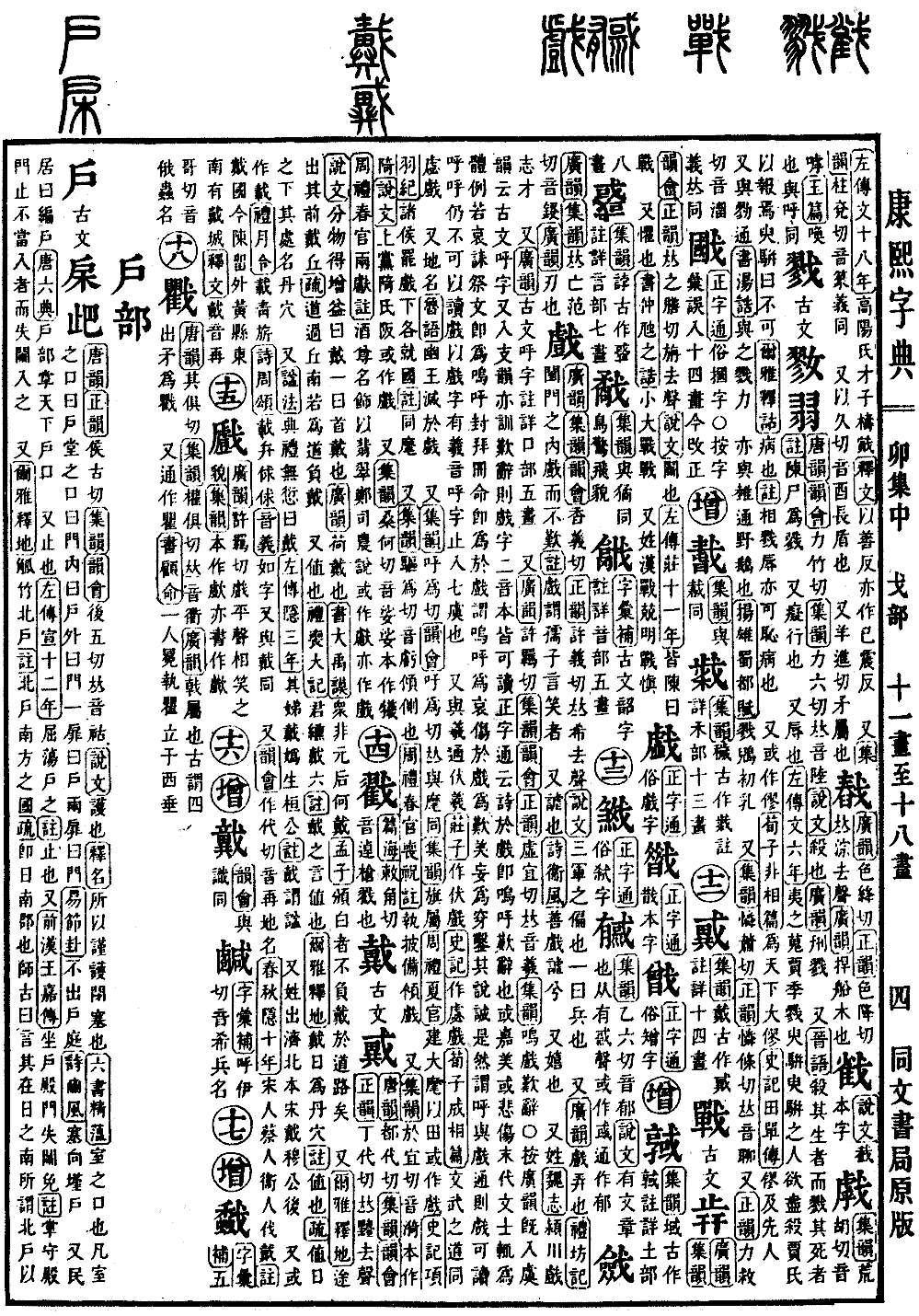
Mao Collection, Middle Volume
Radical: Household (hù)
Kangxi Strokes: 4
Page 414, Entry 32
According to Tang Rhymes (Tang Yun) and Correct Rhymes (Zheng Yun), the pronunciation is hou. According to Collected Rhymes (Jiyun) and Rhymes Collection (Yunhui), the pronunciation is hou; the sound is identical to the character meaning "blessing." The Explaining Graphs and Analyzing Characters (Shuowen Jiezi) defines it as meaning "to protect." The Explanations of Names (Shiming) defines it as a facility used to guard cautiously and to block or close off access. The Essence of the Six Writings (Liushu Jingyun) defines it as an opening in a house. Any opening in a house is called a hu, while an opening in a main hall is called a men. An opening on the inner side is called a hu, and an opening on the outer side is called a men. A single-leaf door is called a hu, while a double-leaf door is called a men. The Book of Changes (Yijing) contains the phrase "do not go out of the courtyard gate." The Book of Odes (Shijing) contains the phrase "block the vent and plaster the door."
It also refers to residents, known as "registered households." The Six Statutes of the Tang Dynasty (Tang Liudian) records that the Ministry of Revenue (Hubu) managed the household registries of the empire.
It also carries the meaning of "to obstruct." The Zuo Commentary (Zuozhuan) contains the phrase "Qu Dang obstructed him." The commentary explains this as meaning to obstruct.
Additionally, the History of the Former Han (Qian Hanshu) records that a person was dismissed from office for negligence in guarding a palace gate, failing to prevent those who should not enter from doing so. The commentary explains this as meaning to be responsible for guarding the palace gate and stopping those who should not enter, yet failing in one's duty and allowing someone to break in.
Also, the Er Ya (Erya) mentions "Gu Zhu and Bei Hu." The commentary explains "Bei Hu" as a country in the south. The sub-commentary explains that this refers to Rinan Commandery. Yan Shigu states: it means the country is located south of the sun; the term "Bei Hu" refers to doorways facing north toward the sun.
Also, the Book of Rites (Liji) records that hibernating insects begin to move and open their burrows to emerge. The commentary notes that "hu" refers to a burrow.
Also, regarding drinking, there are the terms "large capacity" and "small capacity." The Records of Wu (Wuzhi) records that every time Sun Hao held a banquet, each person was limited to seven liters of wine; those with a small capacity, even if they could not finish, were forced to drink it all. The poetry of Bai Juyi contains the line "those with a large capacity dislike sweet wine."
It also exists as a surname. During the Han Dynasty, there was a person named Hu Zun.
It is also used interchangeably with a character meaning "brightly patterned." The Rhapsody on the Capital of Shu (Shu Du Fu) by Yang Xiong contains the phrase "the patterned leopard can be yellow."
It is also used interchangeably with a character meaning the name of a musical composition from the time of King Tang of Shang. The Rhapsody on the Capital of Shu (Shu Du Fu) by Yang Xiong contains the phrase "the musical performance reached its sixth movement."
It is also pronounced as wu. In the Huainanzi (Huainanzi), the "Wusun State" is written as "Hu Sun."