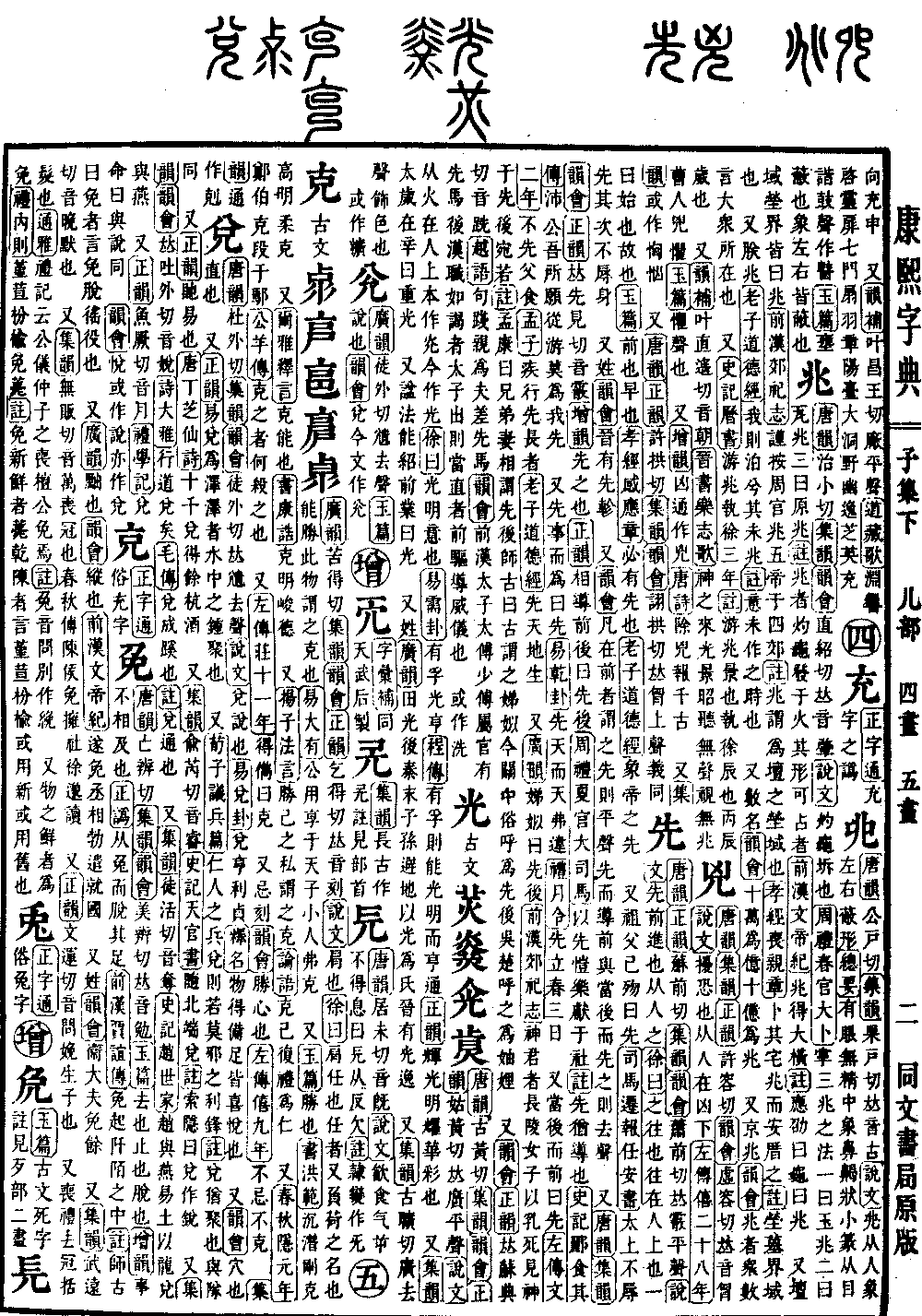
Zi Collection, Page Position: Lower
Radical: Child (ér)
Kangxi Dictionary stroke count: 7; page number: 124
According to Tangyun, pronounced Dùwài qìe. According to Jiyun and Yunhui, pronounced Túwài qìe, with a falling tone (qùshēng) similar to duì.
According to Explanations of Words (Shuowen Jiezi), duì means "to be pleased" or "joy" (shuō).
In the Book of Changes (Yijing), the Duì hexagram symbolizes smooth progress and prosperity, beneficial for perseverance in righteousness.
According to Explanations of Names (Shimíng), when things are complete and abundant, one feels joy.
Also, according to Yunhui, it means "cave" or "straight".
Also, according to Zhengyun, in the Book of Changes (Yijing), duì represents marsh. A marsh is a place where water collects.
Also, in Xunzi (Xúnzǐ), "On Military Affairs," "The army of a benevolent person, when gathered, is like the sharp edge of a Moyé (Mòyé) sword." The commentary states that duì has the meaning of "to gather," similar to duì.
Also, according to Zhengyun, it means "to exchange" or "to trade".
From a poem by Ding Zhixian of the Tang dynasty: "Used ten thousand cash to exchange for Yuhang (Yúháng) wine."
Also, according to Jiyun, pronounced Yúruì qìe, similar to ruì.
In Records of the Grand Historian (Shǐjì), "Treatise on Celestial Offices": "Three stars follow the sharp northern tip." In the Book of Han (Hànshū), duì is written as ruì.
Also, according to Jiyun and Yunhui, pronounced Tùwài qìe, similar to tuì.
In the Book of Odes (Shijing), "Major Odes": "The roads became clear." Maó's Commentary states that duì refers to forming a small path. The commentary states that duì means "to be clear" or "unobstructed."
Also, according to Jiyun, pronounced Túhuó qìe, similar to duó.
In Records of the Grand Historian (Shǐjì), "Hereditary House of Zhao": "The state of Zhao exchanged land with the state of Yan, giving Longduì (Lóngduì) to Yan."
Also, according to Zhengyun, pronounced Yújué qìe, similar to yuè.
In the Book of Rites (Lǐjì), "Record of Learning": "The Announcement of Duì states: (this character duì) is the same as the character shuō."
According to Yunhui, yuè is sometimes written as shuō, and also as duì.
Textual Annotation: In Records of the Grand Historian (Shǐjì), "Treatise on Celestial Offices": "following the northern tip duì." It is noted that in the original text of Records of the Grand Historian, the two characters "three stars" should be added before "following the northern." The commentary states that Suǒyǐn (a commentary) says duì is written as ruì. It is noted that it is the "Treatise on Astronomy" in the Book of Han (Hànshū) that writes it as ruì, not Suǒyǐn. The phrase "The commentary states Suǒyǐn says" is respectfully changed to "The Book of Han (Hànshū)".