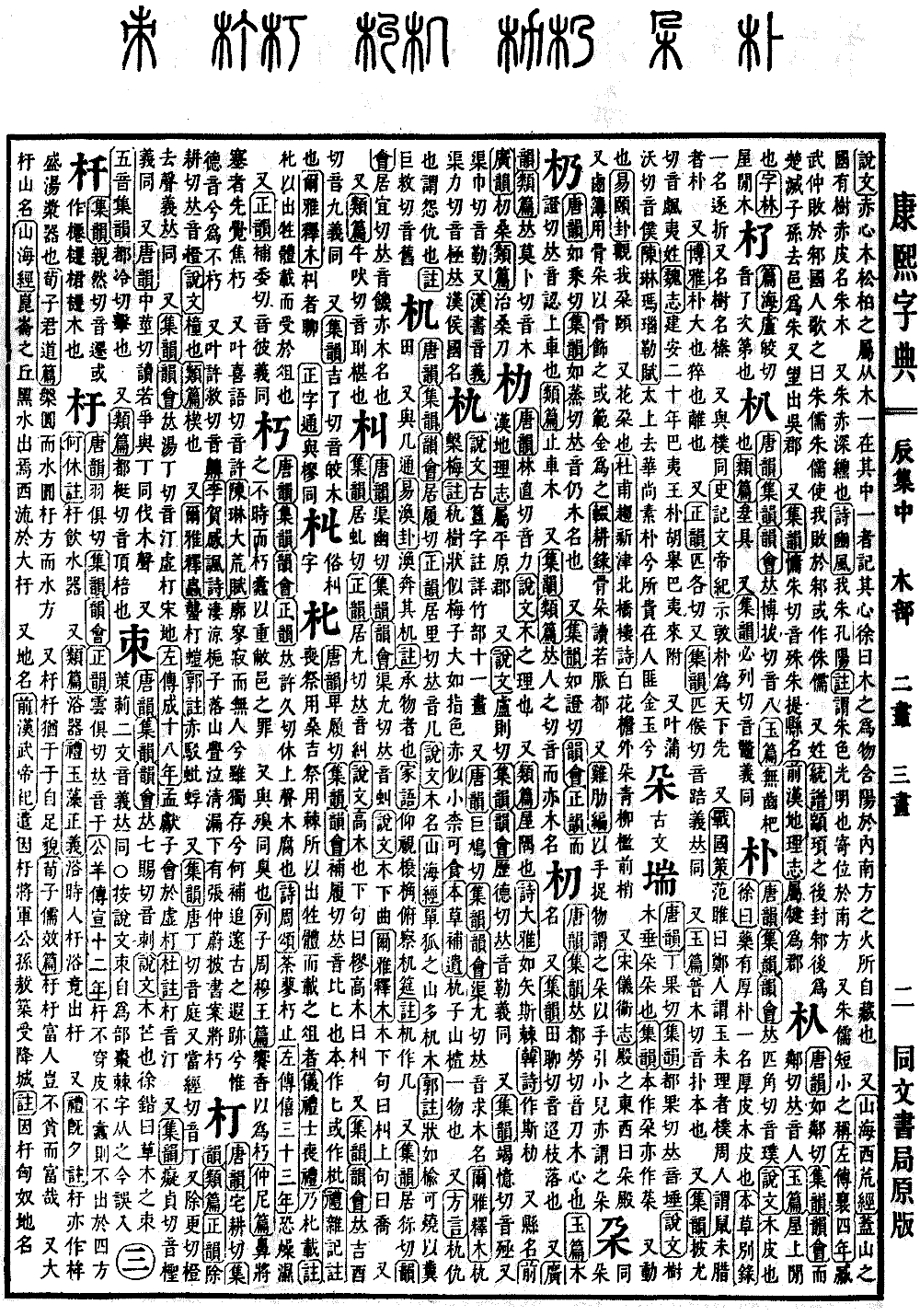
Chen Collection, Middle Volume
Radical: Tree (mù)
Kangxi Strokes: 16
Page 510, Entry 12
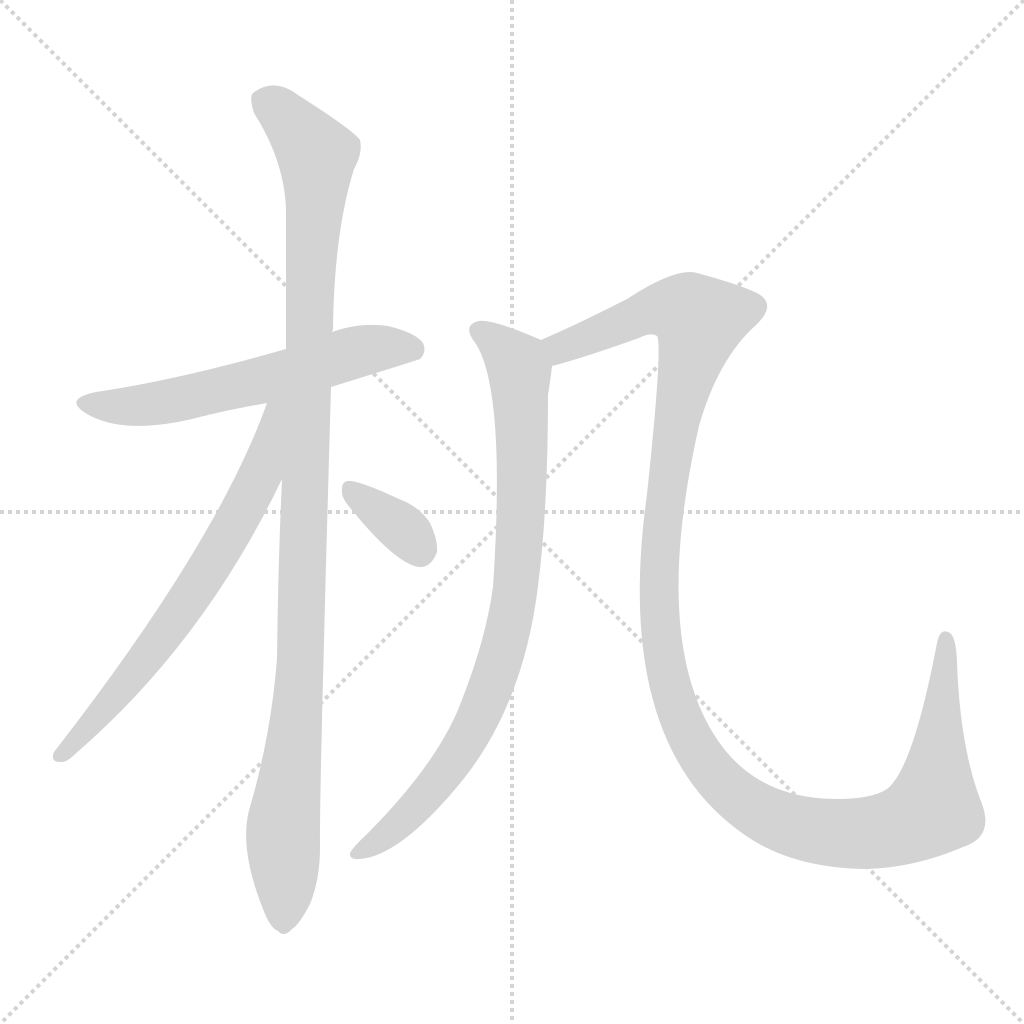
Pronounced ji.
In the dictionary Shuo Wen Jiezi (Shuo Wen), it is defined as the name of a tree.
Classic of Mountains and Seas (Shanhaijing): On Mount Danhu, there are many ji trees.
Commentary by Guo Pu: The shape of the tree resembles an elm; it can be burned to ashes and used to fertilize fields.
Also interchangeable with the character meaning table or desk.
Book of Changes (Yijing), Huan hexagram: To disperse and flee to one's table.
Commentary: This refers to an object used to support items.
Family Sayings of Confucius (Kongzi Jiayu): Look up to see the roof rafters, look down to observe the tables and mats.
Commentary: Written as the character for table.
Also pronounced ji. It is the name of another tree.
In the dictionary Lei Pian, pronounced er. Refers to a chopping block.
Pronounced ji.
In the dictionary Shuo Wen Jiezi (Shuo Wen), the device that controls the release of an object is called a ji.
Book of Documents (Shangshu), Taijia chapter: Like the mechanism of a crossbow, where one observes the alignment of the arrow tail and the scale before releasing.
Great Commentary on the Book of Documents (Shangshu Dazhuan): A trap for catching beasts.
Great Learning (Daxue): Its key point is like this.
Commentary: Refers to the underlying reason for movement.
Sub-commentary: Refers to a pivot or mechanism. It is triggered nearby but takes effect from a distance.
Also the name of a star.
Boya: The third star in the Big Dipper is called ji.
Tonggua Yan: When the Sui Emperor first appeared, he mastered astronomical observation instruments, modeled them after the seven stars of the Big Dipper, and established the seven administrative responsibilities.
Also, the tool used for weaving is called a loom. The ji is used to rotate the warp beam, and the shuttle is used to hold the weft threads.
Also, the changes in atmospheric energy or cosmic fate are called ji.
Zhuangzi, Tianyun chapter: There must be some mechanism, some secret constraint, that forces things to be this way.
Zhuangzi, Zhile chapter: All things originate from a subtle trigger and return to a subtle trigger.
Also, machinery, referring to ingenious devices.
Zhuangzi, Tiandi chapter: Those who use machinery will inevitably have ingenious affairs. Those who have ingenious affairs will inevitably have ingenious intentions.
Also, heaven-sent nature, referring to innate character.
Zhuangzi, Dazongshi chapter: Those with deep desires have shallow innate characters.
Also, refers to a pivot, a crucial point, or something subtle.
Book of Documents (Shangshu), Gaoyao Mo chapter: In one or two days, there can be ten thousand subtle changes.
Sub-commentary: Written as ji.
Also the name of a tree.
Classic of Mountains and Seas (Shanhaijing): On Mount Danhu, there are many ji trees.
Commentary by Guo Pu: The word ji is read in the departing tone.
Zhengyun: To read it as ji is incorrect.