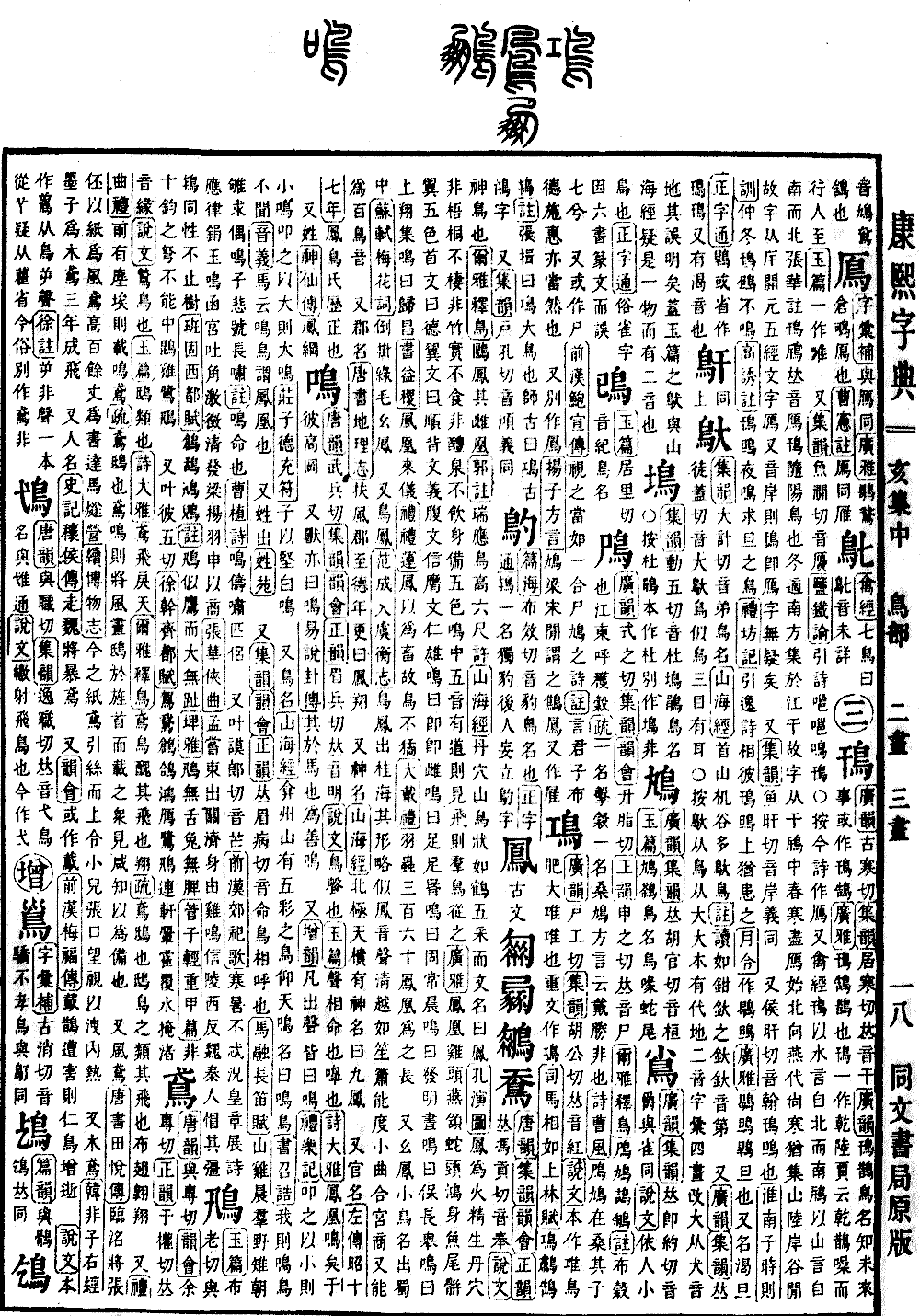
Hai Collection, Middle Volume
Radical: Bird (niǎo)
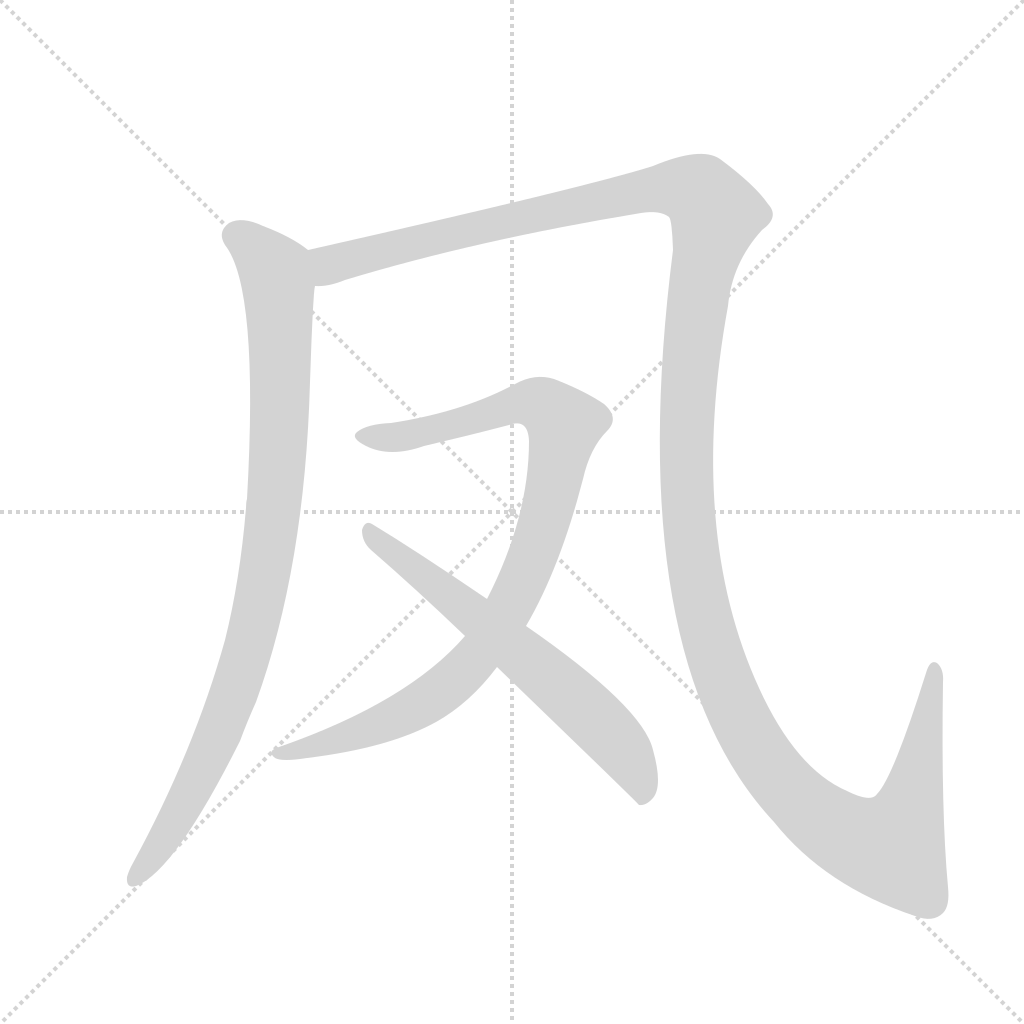
Fèng
Kangxi strokes: 14
Page 1482
Ancient script form: fèng
In Tang Rhymes (Tángyùn), Collected Rhymes (Jíyùn), Rhyme Compendium (Yùnhuì), and Correct Rhymes (Zhèngyùn), pronounced fèng (according to the fanqie method féng gòng qiē).
In Explaining Characters (Shuōwén Jiězì), it is defined as a divine bird. In Erya (Ěryǎ), Explanation of Birds, the male is fèng, its female is huáng. Guo Pu's commentary notes it is an auspicious bird, about six chi (chǐ) tall. In Classic of Mountains and Seas (Shānhǎi Jīng), on Danxue Mountain, there is a bird shaped like a crane, with five colors and patterns, named Fèng. In Kong Yantu, the phoenix is a spirit of fire, born on Danxue Mountain. It only rests on wutong (wútóng) trees, eats only bamboo fruit, drinks only sweet spring water. Its body possesses five colors, its call matches the five musical notes, and it only appears in times of virtuous rule. When it flies, other birds follow it. In Broad Meanings (Guǎngyǎ), the male fèng and female huáng have a head like a rooster, a jaw like a swallow, a neck like a snake, a body like a wild goose, a tail like a fish, and joined wings. Its five colors: the pattern on its head is called Virtue, the pattern on its wings is called Obedience, the pattern on its back is called Righteousness, the pattern on its abdomen is called Trustworthiness, and the pattern on its breast is called Benevolence. The male's cry is "jíjī", the female's cry is "zúzú", its dusk cry is "gùcháng", its morning cry is "fāmíng", its daytime cry is "bǎocháng", its cry when taking flight is "shàngxiáng", and its cry when settling is "guīchāng".
In Book of Documents (Shàngshū), Yi and Ji, "The phoenixes came to dance with graceful bearing." In Book of Rites (Lǐjì), The Conveyance of Rites, "The phoenix is domesticated, thus birds are not startled to fly away." In Da Dai's Record of Rites (Dà Dài Lǐjì), "Among the three hundred and sixty kinds of feathered creatures, the phoenix is their leader."
There is also yāofèng, the name of a small bird. It is produced in Shu. In Su Shi's Poem on Plum Blossoms (Sū Shì Méihuā Cí), "An yāofèng with green feathers hangs upside down."
There is also niǎofèng. In Fan Chengda's Records of the Supervisor of Forests (Fàn Chéngdà Yúhéng Zhì), niǎofèng is produced in Guihai. Its shape broadly resembles the fèng, its voice is clear and resonant like sheng (shēng) and xiao (xiāo) flutes, it can play short melodies in tune, and it can imitate the calls of a hundred birds.
There is also a commandery name. In History of Tang (Táng Shū), Treatise on Geography, Fufeng Commandery was renamed Fengxiang during the Zhìdé reign.
There is also a deity name. In Classic of Mountains and Seas (Shānhǎi Jīng), at the Northern Pole's Heavenly Cabinet, there is a deity named Jiǔfèng (Nine Phoenix).
There is also an official title. In Zuo Commentary (Zuǒ Zhuàn), Year 17 of Duke Zhao, "Fèngniǎo Shì was the official in charge of the calendar."
There is also a surname. In Biographies of Immortals (Shénxiān Zhuàn), Fèng Gāng.