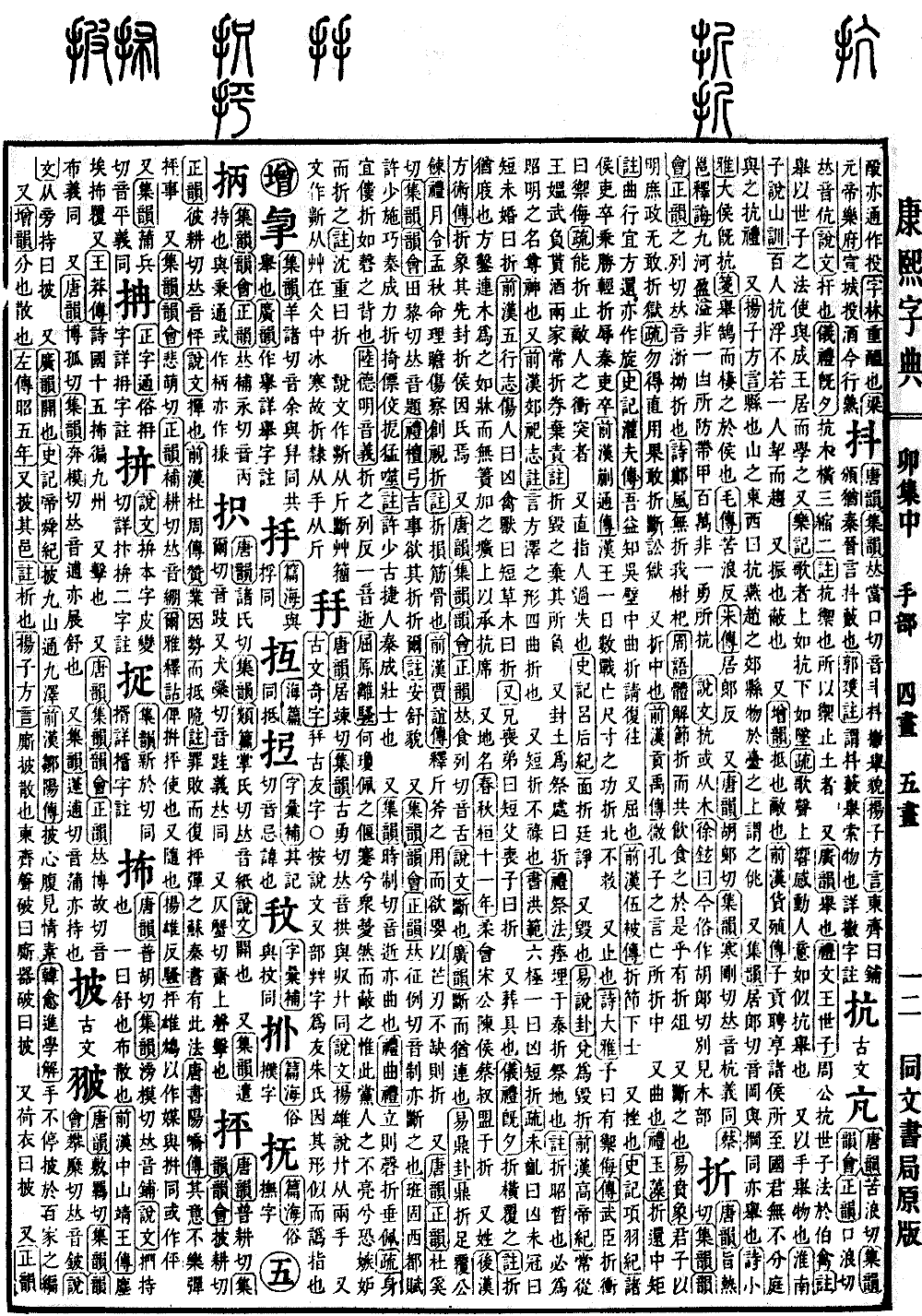
Mao Collection, Middle Volume. Radical: Hand (shǒu). Kangxi strokes: 16. Page 422, Entry 12.
Pianhai states this is a common variant form of the character for soothe. An ancient written form of soothe. Pronounced fu (rising tone). Pronounced fu (falling tone), same pronunciation as fu.
Shuowen Jiezi defines it as the meaning of to stabilize. Zengyun defines it as to comfort and encourage.
Book of Rites (Liji), section Wenwang Shizi records: In the west there are nine states, will the sovereign eventually possess them? Commentary explains that the word here means to possess. Sub-commentary further clarifies that it refers to preserving, showing compassion for, and soothing, thus it is extended to mean to possess.
Zuo Zhuan, 12th Year of Duke Wen records: Guard and soothe their states.
Also, Shuowen Jiezi provides another definition as the meaning of to follow or conform to.
Book of Documents (Shangshu), section Gaoyao Mo records: To conform to the five celestial periods, referring to the movement patterns of the sun, moon, and stars.
Also, Guangyun defines it as the meaning of to hold or maintain.
Also, it is defined as the meaning of to press down.
Book of Rites (Liji), section Quli records: The ruler presses down on the hand of the charioteer. Also records: The guest kneels and presses down on the seat mat with their hands to express decline. Sub-commentary explains that this refers to using the hand to press down and restrain.
Also records: When the ruler rides in a carriage, he leans forward and presses his hands on the crossbar. Commentary explains that here it means to lean upon.
Also defined as the meaning of to pat.
Ceremonial Rites (Yili), section Xiangshe Li records: With both hands, pat the arrows before placing them on the bowstring.
Also, Yang Xiong’s Dialects (Fangyan) records: The phrase fu-fu means to be rapid or urgent. Guo Pu’s commentary explains that this refers to pressing urgency or speed.
Also, it is the name of a prefecture. In the Han dynasty, it belonged to Yuzhang Commandery; in the Sui dynasty, Fu Prefecture was established.
Also pronounced mu (level tone). Same as the character for imitate.
Yunhui states that it is interchangeable with the character for pat.