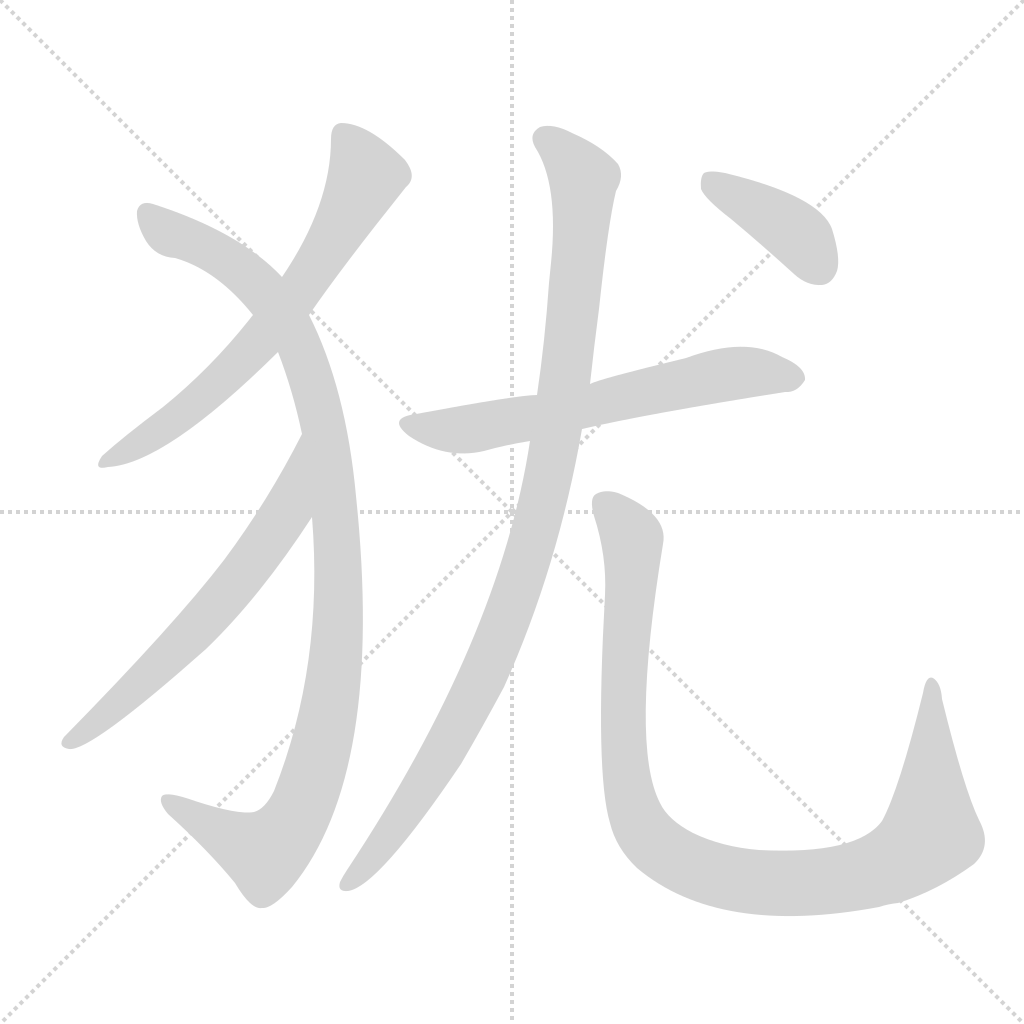
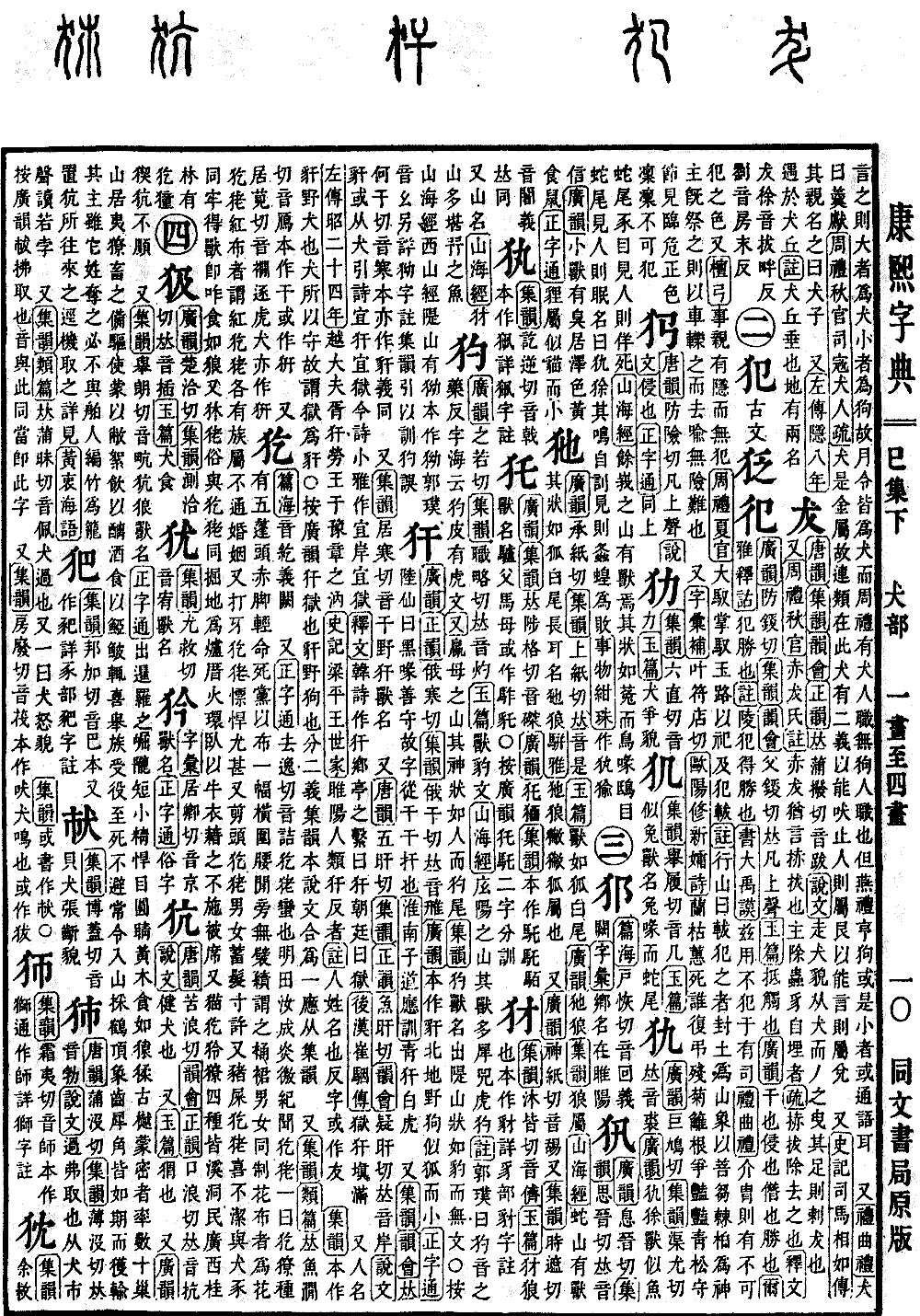
Si Collection, Lower Volume
Radical: Dog (quǎn)
13 strokes
Page 706, Entry 19
Pronounced yòu. Name of a beast.
Pronounced yóu.
According to the Explaining Graphs and Analyzing Characters (Shuowen Jiezi), it belongs to the ape category. Formed from the radical dog and the phonetic element qiú. According to the Collection of Rhymes (Jiyun), it lives in the mountains, hears human voices and climbs trees in advance, and only descends when no people are present. In the world, those who are indecisive are called yóu-yù. Sometimes written in a variant form.
According to the Erya (Approaching Elegance), the yóu is like the muntjac and is skilled at climbing trees. Commentary: It is strong at climbing trees.
According to the Book of Rites (Liji), in the chapter on Summary of the Rules of Propriety (Quli), it says that this is used to make the people resolve doubts and determine what is yóu-yǔ. Commentary: Yóu and yǔ are two beasts, both of which are suspicious and hesitant in their movements. People who are often confused are likened to them, hence they are called yóu-yǔ.
According to the Huainanzi, in the chapter on Military Strategy (Binglue Xun), it says to strike at their hesitation.
According to the Explaining Graphs and Analyzing Characters, in Longxi, a puppy is called yóu.
According to the Expanded Rhymes (Guangyun), it means similarity.
According to the Book of Odes (Shijing), in the Zhou South (Zhaonan) section, it says that such is the fate that does not remain so. Commentary: Yóu means like.
According to the Minor Odes of the Kingdom (Xiaoya) section of the Book of Odes, it says that for the virtuous man and gentleman, his virtue does not remain the same.
According to the Book of Rites, in the chapter on Rules of Mourning (Sangfu), it says that the son of a brother is considered like a son (yóu zǐ).
According to the Collection of Rhymes, it is a term for something that can be stopped.
According to the Book of Odes, in the Wei Airs (Wei Feng) section, it says to be cautious about it, and it can be stopped. Commentary: Yóu means it is permissible.
Originally written as yóu (plan).
According to the Book of Odes, in the Minor Odes of the Kingdom section, it says to strengthen one's plans. Commentary: Yóu means path. Commentary: Yóu means plan, specifically military plans. Commentary: To be able to magnify the path of one's plans. Also, plans and schemes are twisted and wayward. Commentary: Plans are the way of governing.
According to the Great Odes of the Kingdom (Daya) section, it says the king's plans are truly full. Commentary: Yóu means plan.
According to the Expanded Rhymes, it means still or yet.
According to the Book of Rites, in the chapter on Tangong, it says that the superior man is still thus. Commentary: A middle state between fast and slow.
According to the Songs of Chu (Chuci), in the Nine Songs (Jiuge) section, it says the lord does not travel, lingering and hesitant.
According to the Guanzi, in the chapter on Earth's Inhabitants (Di Yuan Pian), it says the lower soils are called five yóu. The appearance of the five yóu is like manure.
According to the History of the Former Han (Qian Hanshu), in the Treatise on Geography (Dili Zhi), there is the Qiúyóu County, which belongs to Linhuai Commandery.
Also a surname. According to the Correct Character Encyclopedia (Zhengzitong), there was a Song dynasty individual named Yóu Daoming.
Pronounced yáo. According to the Collection of Rhymes, it was originally written as a different character. It refers to chanting/singing. Sometimes written as yáo (ballad).
Also interchangeable with yáo (shake). According to the Book of Rites, in the chapter on Tangong, it says chanting this yóu, like dancing this. Commentary: Yóu should be read as yáo, meaning the body is shaking. In Qin, the sounds of yóu and yáo are similar. Commentary: The explanatory text says that in the commentary, yóu is written as yáo, pronounced yáo.
Pronounced jiū.
Pronounced yòu.
Also rhyming as yòu. According to the Book of Odes, in the Minor Odes of the Kingdom section, it says let us be on good terms and not be suspicious of each other.