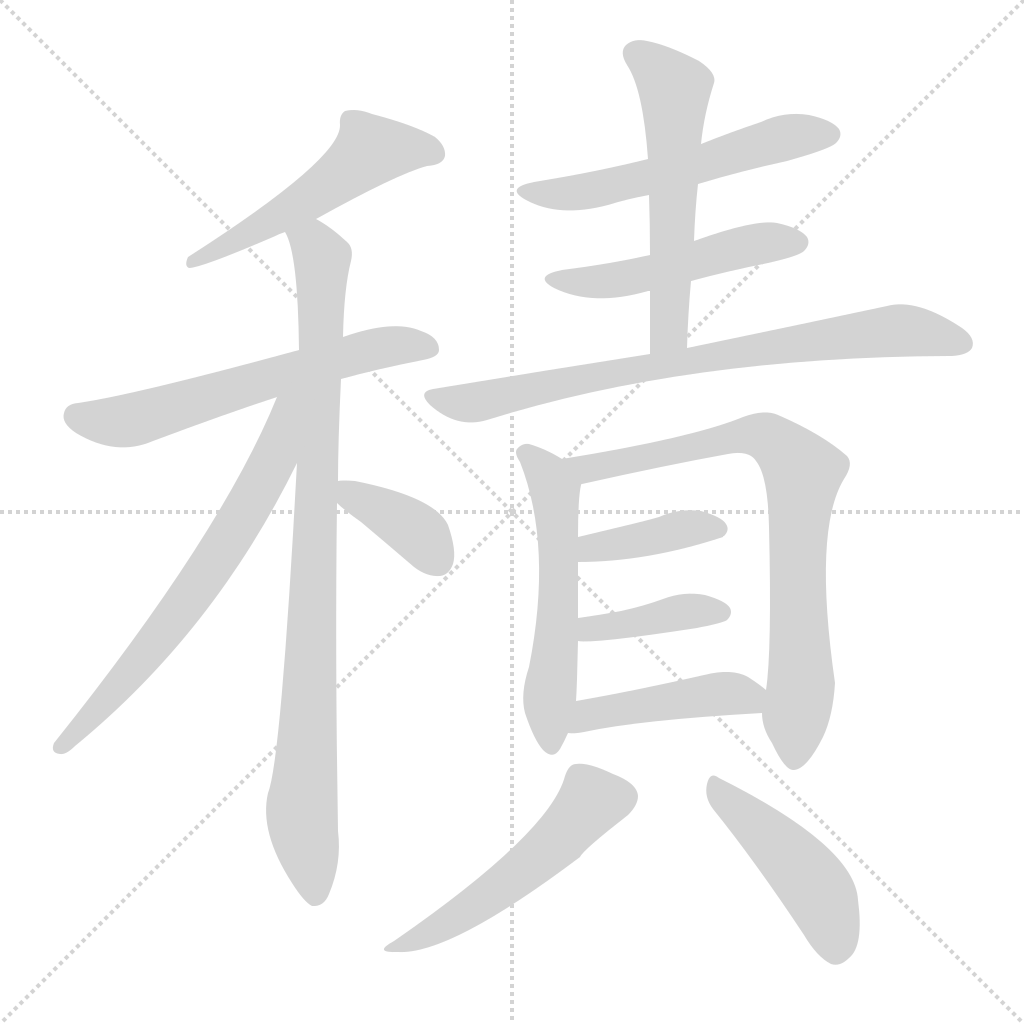
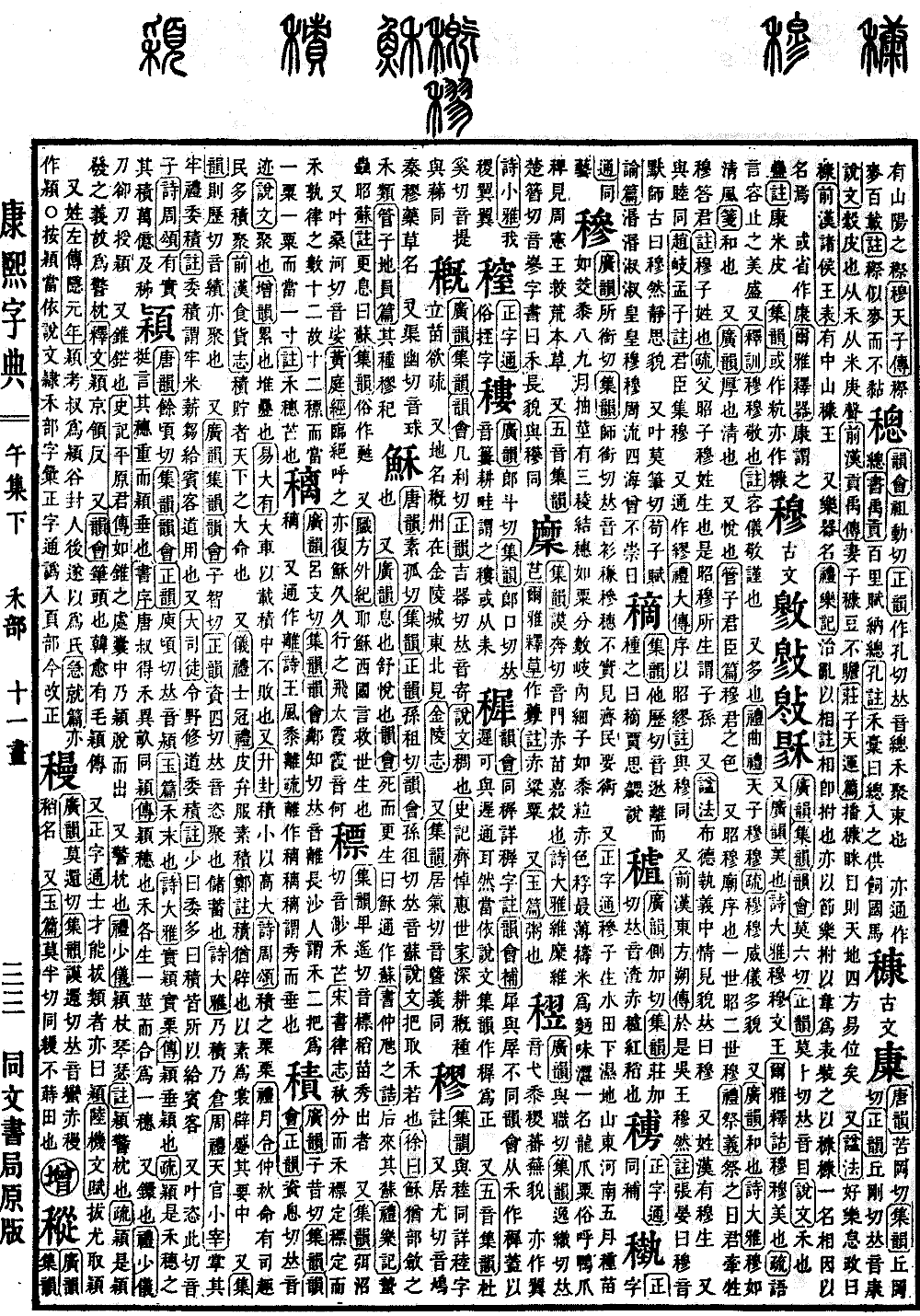
Wu Collection, Lower Volume
Radical: Grain (hé)
Kangxi stroke count: 16
Page 859, Entry 24
Broad Rhymes (Guangyun): Pronounced ji. Collected Rhymes (Jiyun), Rhyme Meetings (Yunhui), and Orthodox Rhymes (Zhengyun): Pronounced ji.
Shuowen Jiezi: To accumulate.
Supplement to Rhymes (Zengyun): To pile up. To heap.
Book of Changes (Yijing): Great carts are used to carry; if the accumulation is centered, it will not collapse.
Also, in the Ascending Hexagram: Accumulate small things to become great and high.
Book of Odes (Shijing): Accumulating them in quantity.
Book of Rites (Liji): In the second month of autumn, the ruler commands the officials to urge the people to accumulate and store goods.
History of the Former Han Dynasty (Qian Hanshu): Accumulated provisions are the vital lifeblood of the empire.
Also, in the Book of Etiquette and Ceremonial (Yili): Wearing a leather cap and white skirt (suji).
Zheng Commentaries: The term ji signifies to fold or pleat; using white silk for a lower garment, pleated at the waist.
Also, in Collected Rhymes (Jiyun): Pronounced ji. Also means to accumulate.
Also, in Broad Rhymes (Guangyun), Collected Rhymes (Jiyun), and Rhyme Meetings (Yunhui): Pronounced zi. Orthodox Rhymes (Zhengyun): Pronounced zi.
To collect; to store.
Book of Odes (Shijing): Then they accumulate, then they store in granaries.
Rites of Zhou (Zhouli): Managing the sacrificial offerings, provisions, and stores (weiji).
Commentaries: Weiji refers to meat, rice, firewood, and fodder supplied for the travel expenses of guests.
Also, in the Office of the Grand Minister of Instruction (Da situ): Ordering the rural areas to maintain roads and store provisions (weiji).
Commentaries: A small amount is called wei, a large amount is called ji; both are used to provide for guests.
Also, rhyming with zi and ci: Pronounced zi.
Book of Odes (Shijing): Filled with their harvest, reaching ten thousand millions and billions.