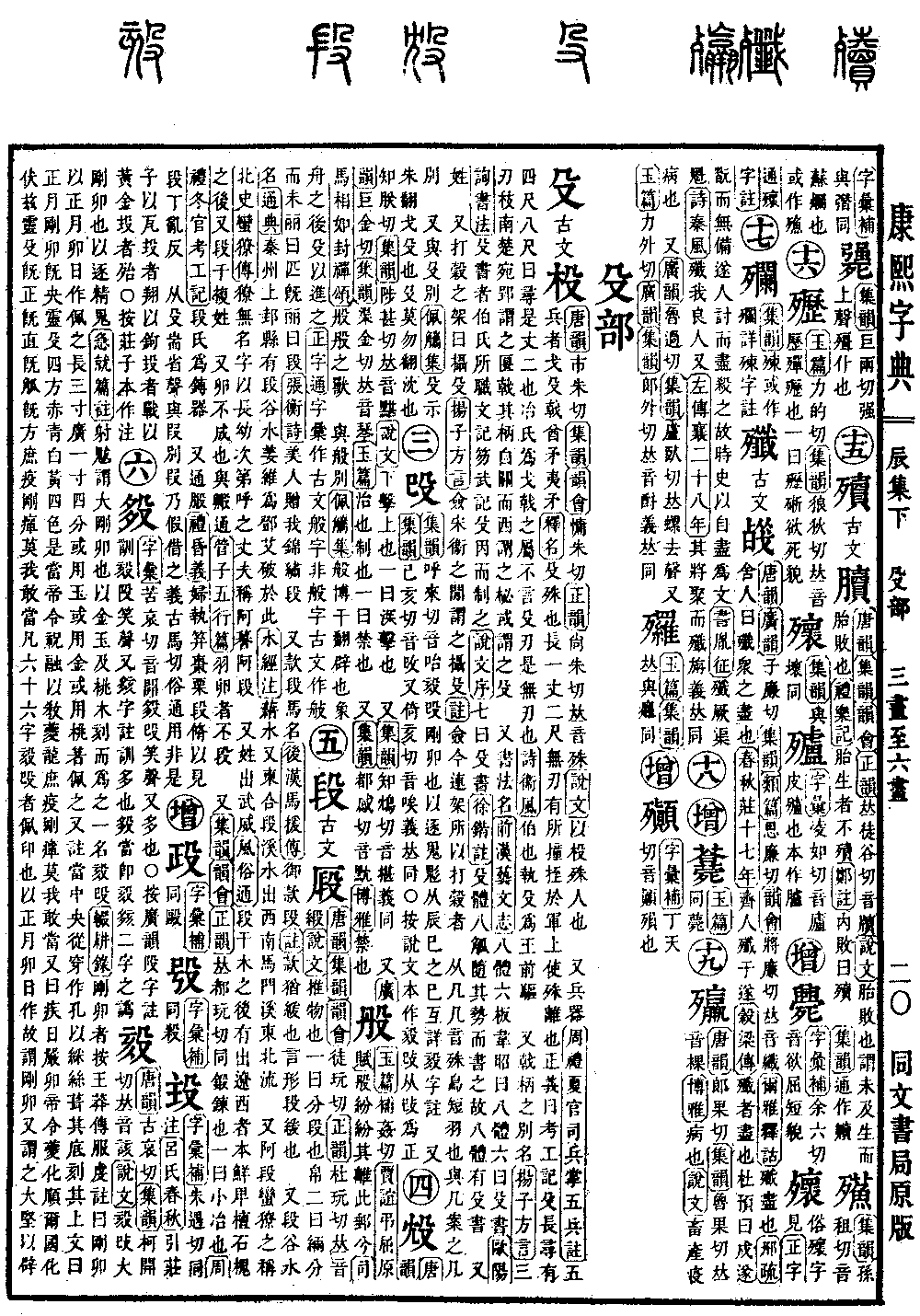
Chen Collection, Lower Volume
Radical: Weapon (shū)
Kangxi strokes: 4
Page 584, Entry 17
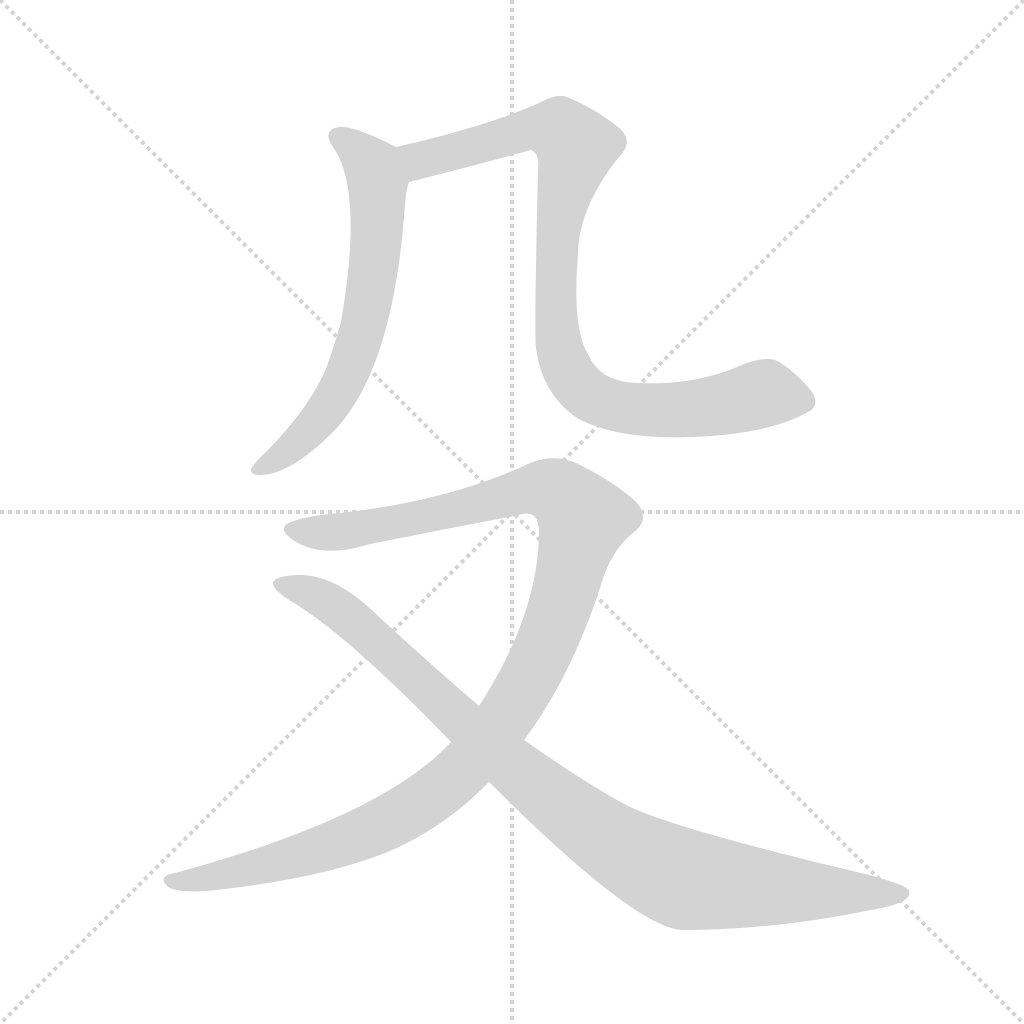
Ancient form: Shu (a weapon with a wooden shaft)
Pronounced shu
Shuowen Jiezi: To strike a person with a wooden shaft. It is also a weapon.
Zhou Rites (Zhouli), Summer Offices, Ministry of War: The five weapons are the dagger-axe, the wooden shaft, the halberd, the short spear, and the long spear.
Explanation of Names (Shiming): The term shu implies separation. It is one zhang and two chi long, has no blade, and is used to strike from a carriage to cause opponents to be separated and retreat.
Correct Meaning: The Record of Trades (Kaogongji) states the shu is one xun plus four chi long. Eight chi constitutes one xun, totaling one zhang and two chi. Since the metallurgical records mention the dagger-axe and halberd but do not mention a blade for the shu, it confirms it is bladeless.
Book of Odes (Shijing), Odes of Wei: My uncle holds the shu, serving as the vanguard for the king.
Also a specific name for a halberd shaft.
Dialects (Fangyan): A three-bladed weapon is called yan-ji in the southern Chu region. Its shaft is called bi west of the mountain passes, or sometimes called shu.
Also a style of calligraphy.
History of the Former Han (Hanshu), Treatise on Literature: Eight bodies of writing and six boards. Wei Zhao states: The eighth of the eight bodies is known as shu script.
Ouyang Xun, Calligraphy: Shu script is the duty of the Bo clan. They recorded civil matters on tablets and military matters on the shu, devising the script accordingly.
Preface to the Shuowen Jiezi: The seventh is called shu script.
Xu Kai Commentary: The shaft of the shu has eight facets; the characters are written according to these facets, hence among the eight bodies is the shu script.
Also a surname.
Also a frame for threshing grain called she-shu.
Dialects (Fangyan): A thresher is called she-shu in the regions of Song and Wei.
Commentary: The qian is the modern threshing flail used for beating grain. It is distinct from the character for a small table (ji).
Also interchangeable with the character for separate.
Collection of Ornamental Ornaments (Peixi Ji): The character shu is pronounced like the character for vermilion, referring to the weapon. The other character mentioned is pronounced like the word for sink.
Textual correction: Explanation of Names (Shiming) original text read military carriage, which has been corrected to carriage.