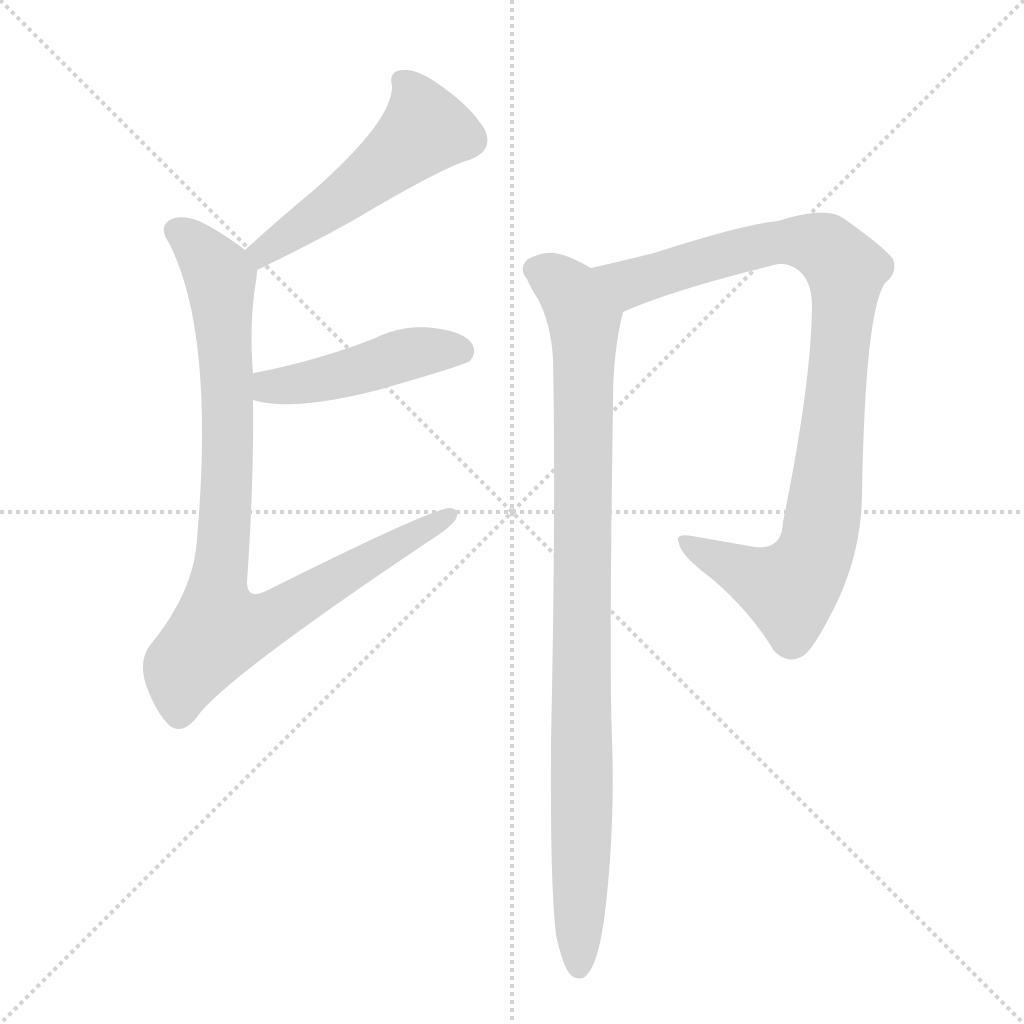
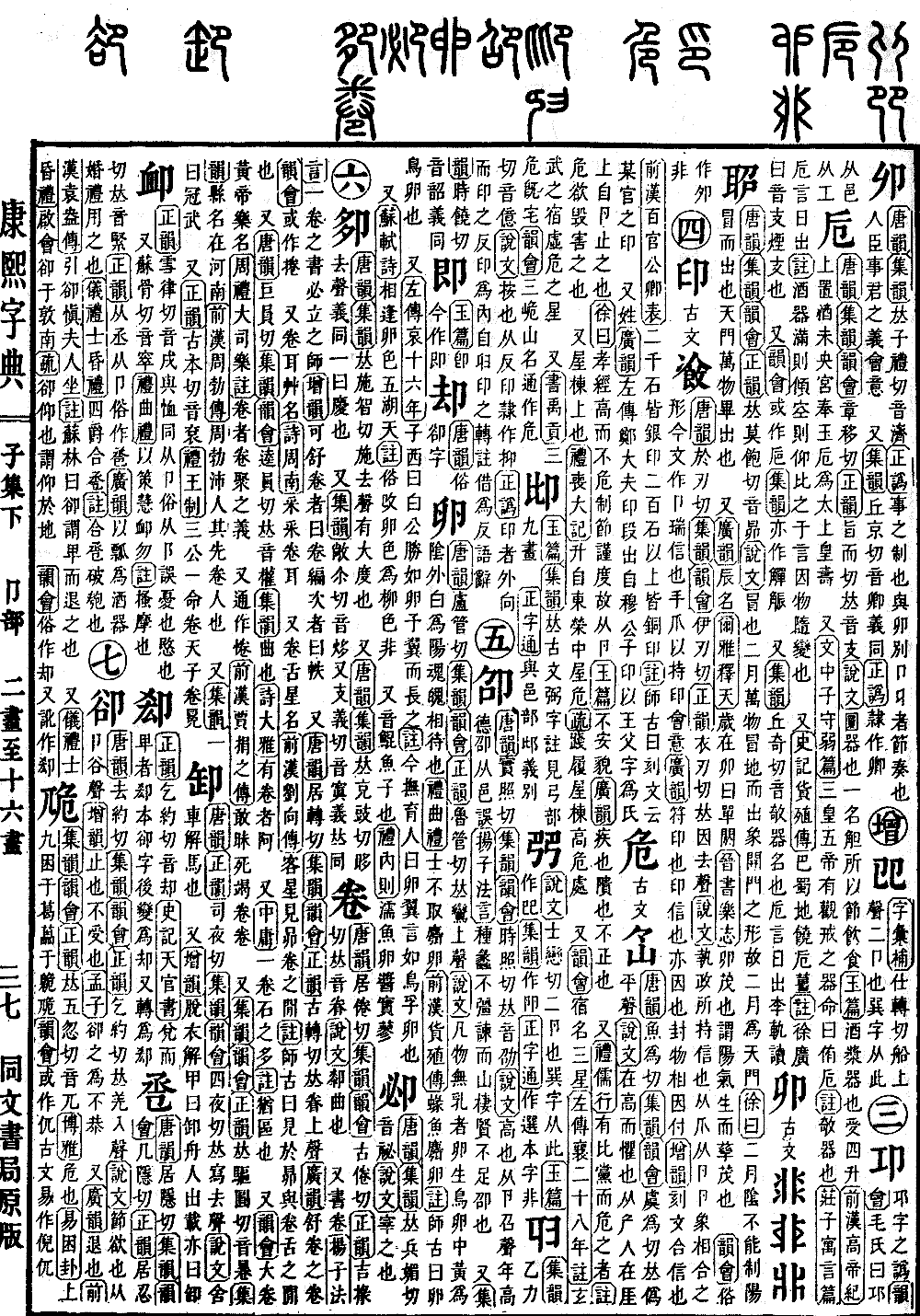
Zi Collection, Page Position: Lower
Radical: Kneeling Person (jié)
Kangxi Strokes: 6
Page 159, entry 10
Ancient texts record: According to Tangyun (Tángyùn), it is pronounced “yū rèn qiè”. According to Jiyun (Jíyùn) and Yunhui (Yùnhuì), it is pronounced “yī rèn qiè”. According to Zhengyun (Zhèngyùn), it is pronounced “yī rèn qiè”. Its pronunciation is similar to the departing tone of the character “因” (yīn). According to Shuowen Jiezi (Shuōwén Jiězì), it refers to a credential held by those in authority. The character form is composed of “爪” (claw/hand) and “卪” (tally). “卪” symbolizes the shape of two halves of a tally fitting together. It is now written as “卩”, representing a tally as a token of trust. The “爪” signifies a hand holding a seal. This is an associative compound character. Guangyun (Guǎngyùn) states: A tally is an印 (yìn). An 印 (yìn) is a token of trust, and also signifies reliance, or mutual reliance and delivery when sealing packages. Zengyun (Zēngyùn) explains: It is a token of trust inscribed with characters, used for verification. The Table of Officials and Dukes (Bǎiguān Gōngqīng Biǎo) in the Book of Han (Qián Hàn) records: Officials holding two thousand dàn (a unit of grain measure) were all given silver seals, and officials holding two hundred dàn and above were given copper seals. Yan Shigu's commentary states: The inscribed characters read "Seal of [official's name]".
Also used as a surname. Guangyun (Guǎngyùn) records: In the Zuo Tradition (Zuǒzhuàn), it is mentioned that Yin Duan, a high official of the State of Zheng, descended from Mu Gong's son, Yin. His surname was derived from his grandfather's given name.