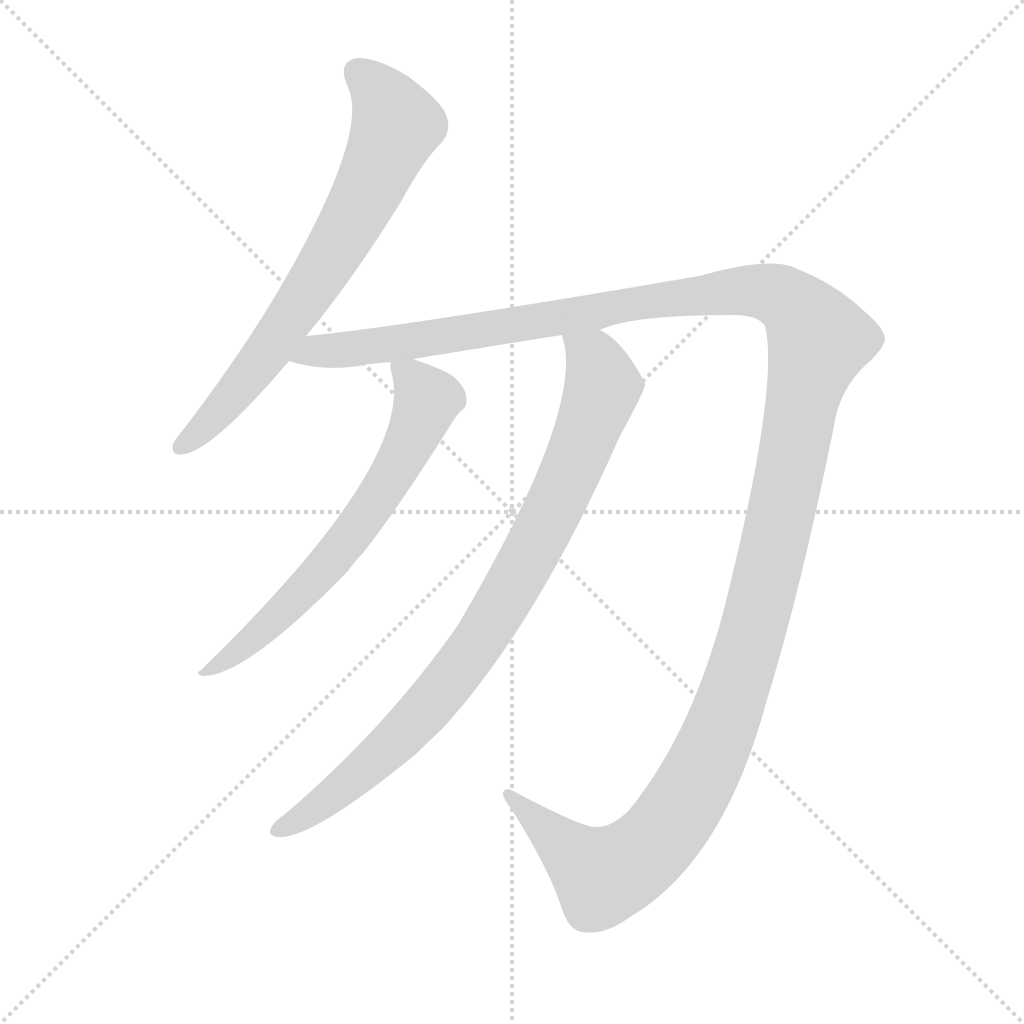
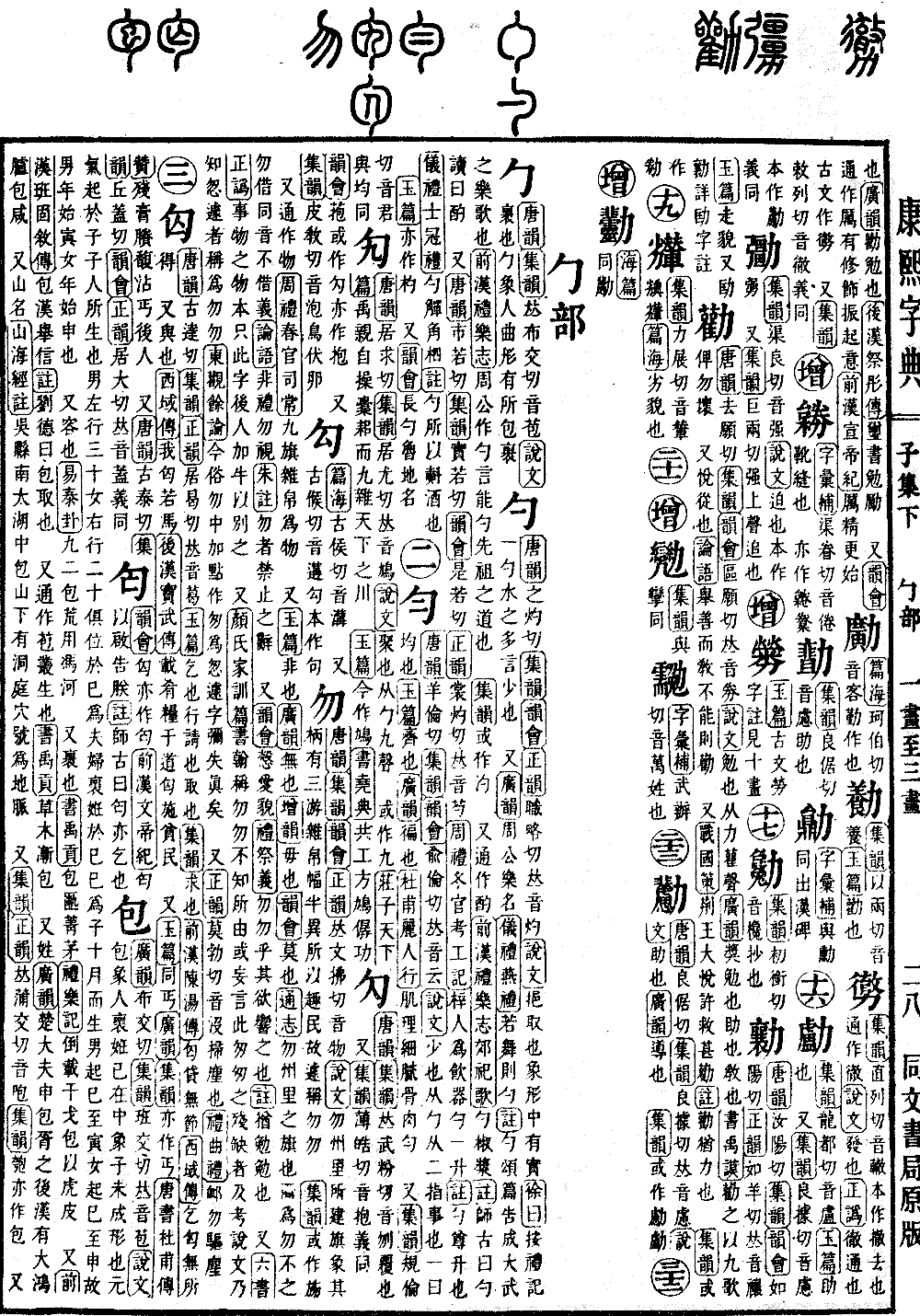
Zi Collection, Page Position: Lower
Radical: Wrap (bāo)
Strokes: 4
Page: 150, No. 24
Tangyun (Tángyùn), Jiyun (Jíyùn), Yunhui (Yùnhuì), and Zhengyun (Zhèngyùn) all provide the fanqie pronunciation wén fú qiè, sounding the same as the character wù.
Explaining the Character (Shuōwén Jiězì) explains: Wù refers to the flags erected in ancient districts and villages. The character shape resembles a flagpole with three streamers made of multicolored silk, where half the colors are different. It was used to urge the common people, thus the state of being urgent is called wù wù.
Jiyun records: Sometimes written in a variant form.
Also used interchangeably with the character wù.
Rites of Zhou (Zhōulǐ) records: Among the nine types of flags, those made of multicolored silk are called wù.
Jade Chapters (Yùpiān) explains: It indicates a negative.
Expanded Rhymes (Guǎngyùn) explains: It indicates not having.
Augmented Rhymes (Zēngyùn) explains: It indicates do not.
Collected Rhymes (Yùnhuì) explains: It indicates must not.
Treatise on Genealogies (Tōngzhì) explains: Wù was originally a district flag, but its use as a negative particle is a phonetic loan and does not use the original meaning.
Analects (Lúnyǔ) contains the phrase: Look not at what is contrary to propriety.
Zhu Xi's Commentary (Zhū Zhù) explains: Wù is a word indicating prohibition.
Yunhui also explains: A sincere and earnest appearance.
Book of Rites (Lǐjì) contains the phrase: Wù wù describes the desire for the spirits to enjoy the sacrifice.
The commentary explains: Similar to a diligent appearance.
Correcting the Six Scripts (Liùshū Zhèng'é) points out: The character for things in the term shì wù originally used only this character wù; later generations added the cow radical to write it as wù to create a distinction.
Yan's Family Instructions (Yánshì Jiāxùn) says: In letters the term wù wù is used, though its origin was unknown to some. Some claimed it was a corrupted way of writing cōng cōng. Upon consulting the Shuowen Jiezi, it was discovered that an urgent appearance is indeed called wù wù.
Postscripts to the Records of the Eastern Pavilion (Dōngguān Yúlùn) points out: Modern vulgar writing adds a dot inside wù to form cōng to represent haste and urgency, which is even further from the original form.
Zhengyun provides the fanqie pronunciation mò bó qiè, sounding the same as the character méi. It means to brush away dust.
Book of Rites contains the phrase: Do not kick up dust.
Textual Criticism: Regarding the Book of Rites citation, the character hū is changed to zhū according to the original text. The character qí is added after the character yù. The character for sound, xiǎng, is changed to the character for sacrifice, xiǎng.