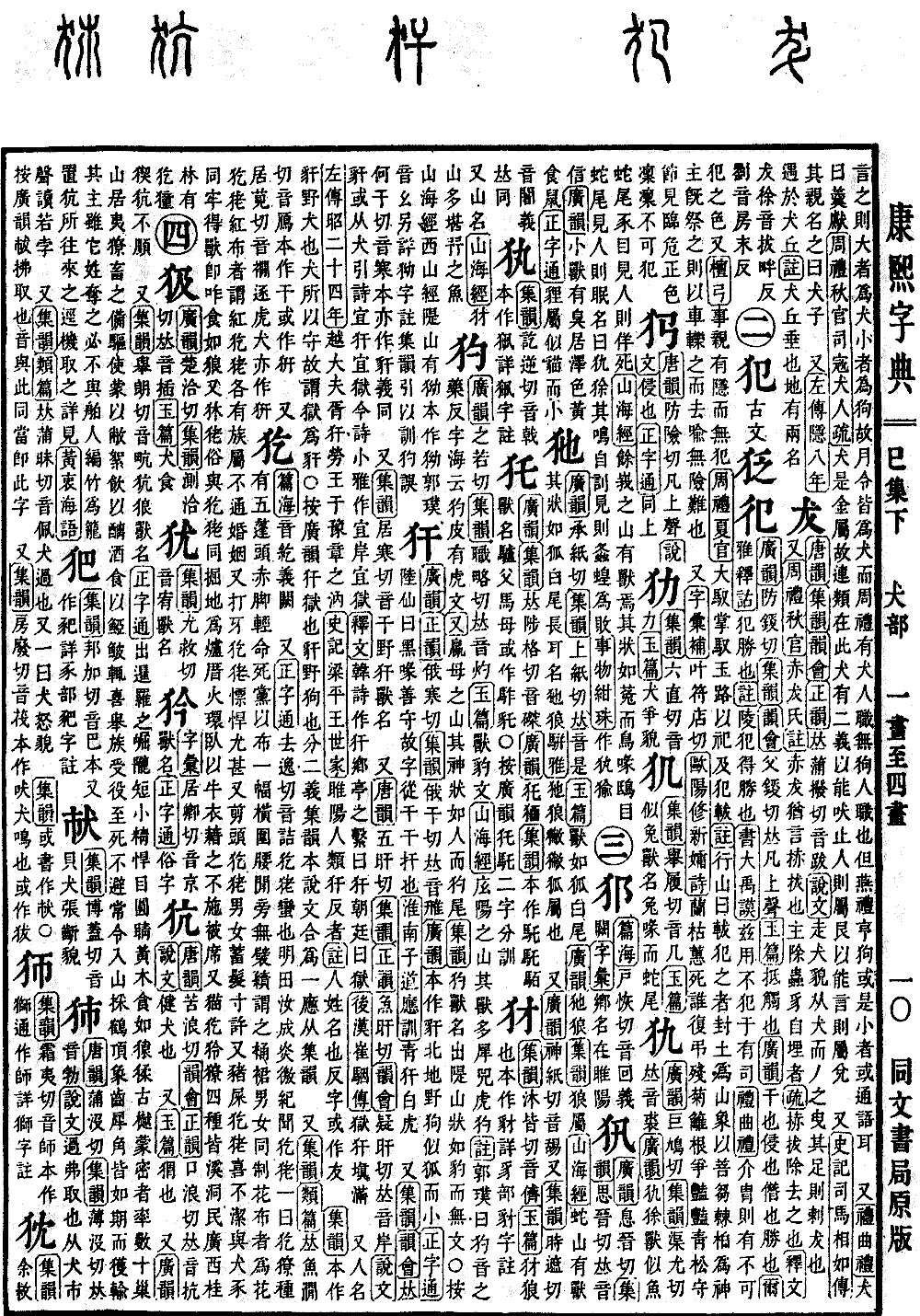
Si Collection, Lower Volume
Radical: Dog (quǎn)
Page 706, Entry 16
Pronounced yan.
Broad Rhymes (Guangyun) and Standard Rhymes (Zhengyun) state it is pronounced e, han. Collected Rhymes (Jiyun) states it is pronounced e, gan.
Broad Rhymes (Guangyun): Originally written as a character meaning a wild dog of the north, resembling a fox but smaller in size.
Standard Character Guide (Zhengzitong): Lu Dian states that it has a black mouth and is good at guarding. Therefore, the character is composed with the element for defend (gan). Defend (gan) refers to protection.
Book of Huainan (Huainanzi): Green wild dog and white tiger.
Also, Collected Rhymes (Jiyun) and Rhyme Collection (Yunhui) state it is pronounced he, gan. Originally also written as a variant form meaning the same.
Also, Collected Rhymes (Jiyun) states it is pronounced ju, han. A name for a wild animal.
Also, Tang Rhymes (Tangyun) states it is pronounced wu, gan. Collected Rhymes (Jiyun) and Standard Rhymes (Zhengyun) state it is pronounced yu, gan. Rhyme Collection (Yunhui) states it is pronounced yi, gan. Pronounced an.
Explanation of Script (Shuowen): A variant form written with the radical for dog.
Citing the Book of Odes (Shijing): Appropriate for prison and appropriate for litigation. The current version of the Book of Odes (Shijing), Lesser Odes (Xiaoya), is written with the character for bank (an).
Explanatory Text (Shiwen): The Han School (Hanshi) version is written as this character. A detention center in a local village is called a wild dog (an), while the imperial prison is called a prison (yu).
Book of the Later Han (Houhanshu), Biography of Cui Yin: The prison was filled with people.
Also used as a person's name.
Zuo Commentary (Zuozhuan), 24th Year of Duke Zhao: The Great Officer of the Yue State, Xu An, comforted the King of Zhou at the bend of the Yu River.
Records of the Grand Historian (Shiji), House of Prince Xiao of Liang: A man in the Suiyang region named Lei Anfan.
Commentary: This is a person's name. Some versions write the character fan as you.
Collected Rhymes (Jiyun): Originally written as a variant form meaning a wild dog. Dogs were used for guarding, so prisons were called by this name.
Note: Broad Rhymes (Guangyun) treats this character as referring to a prison and the variant as a wild dog, dividing them into two meanings. Collected Rhymes (Jiyun), following the Explanation of Script (Shuowen), combines them into one meaning. One should follow Collected Rhymes (Jiyun).
Also, Collected Rhymes (Jiyun) and Classified Chapters (Leipian) state it is pronounced yu, yan. Originally written as a different form. Or written as another variant.
Also pronounced ju, jian. A dog that drives away tigers. Also written as a variant. The original character is composed with the element for parity (jian).
Textual Research:
Standard Character Guide (Zhengzitong): Lu Xian states, black mouth, good at guarding. Therefore, the character is composed with the element for defend (gan). Defend (gan) refers to protection.
Cautionary Note: The statement about the black mouth originates from Lu Dian's Expanded Eulogies (Piya); therefore, Xian has been corrected to Dian.
Records of the Grand Historian (Shiji), House of Prince Xiao of Liang: A man in the Suiyang region named Lei Anfan.
Cautionary Note: Following the original text, Prince Ping has been corrected to Prince Xiao.