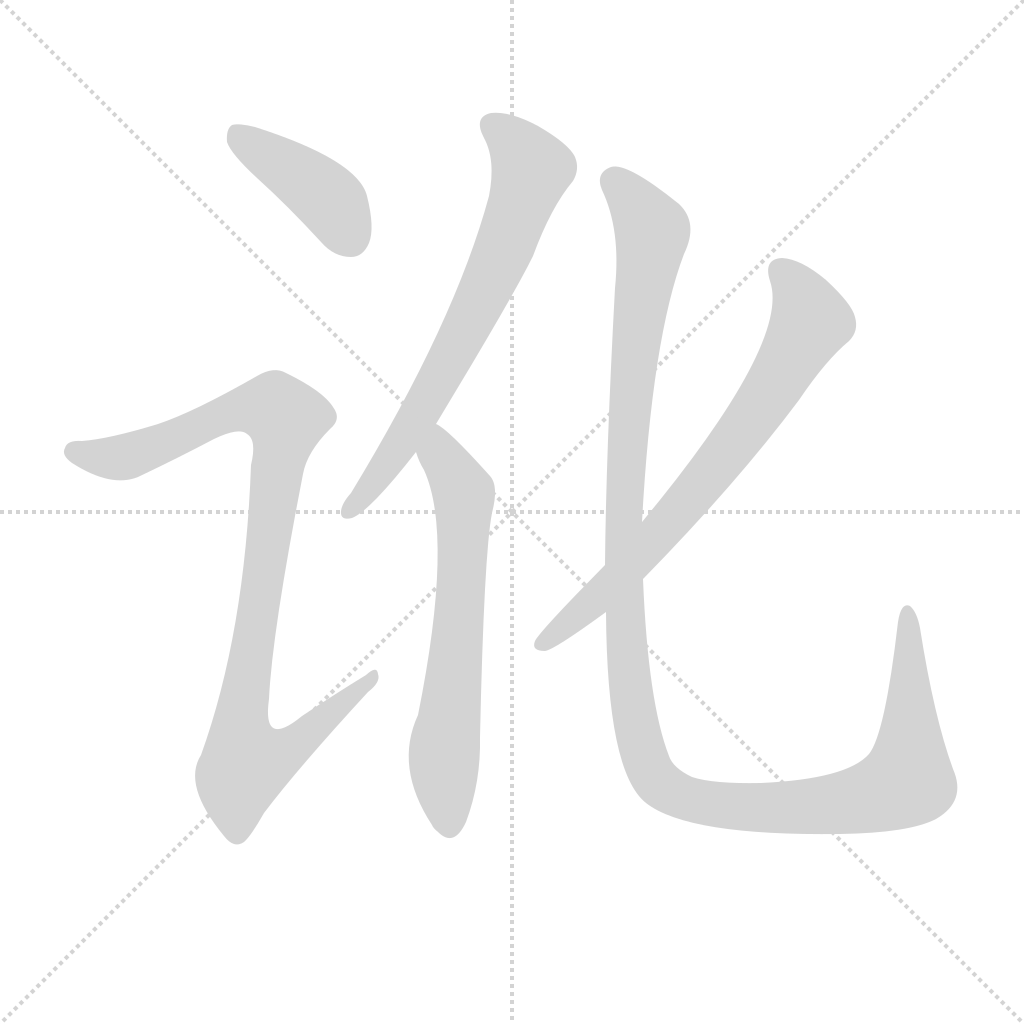
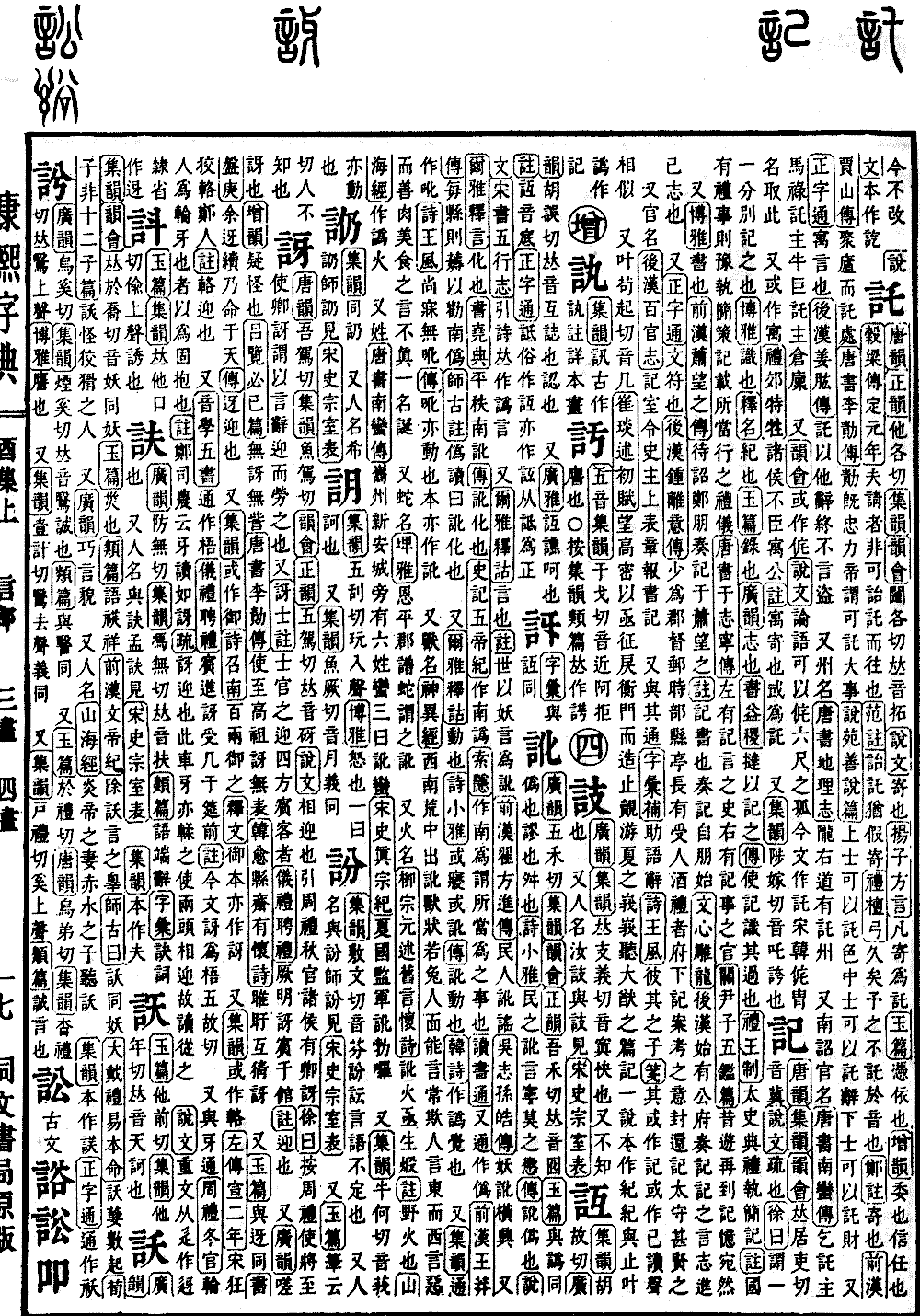
You Collection, Upper Volume
Radical: Speech (yán)
Kangxi stroke count: 11
Page 1149, Entry 01
Pronounced é.
Jade Chapters (Yupian): Same as the character variant (é). It means false, erroneous, or incorrect.
Book of Odes (Shijing), Lesser Odes (Xiao Ya): The people’s false speech, why does no one punish them?
Commentary (Zhuan): False, meaning deceitful.
Analytical Dictionary of Characters (Shuowen) and History of Song (Song Shu), Treatise on the Five Elements (Wuxing Zhi): Both cite the Book of Odes (Shijing) using the variant (é).
Also, from the Literary Expositor (Erya), Treatise on Explanations (Shigu): To speak.
Annotation: The world considers strange or deceptive talk to be (é).
History of the Former Han (Qian Han Shu), Biography of Zhai Fangjin: The people’s false rumors.
Chronicles of Wu (Wu Zhi), Biography of Sun Hao: Strange and false reports rising everywhere.
Also, from the Literary Expositor (Erya), Treatise on Explanations (Shiyan): To transform.
Book of Documents (Shujing), Canon of Yao (Yaodian): Order the works of the south.
Commentary (Zhuan): (é) means to transform.
Records of the Grand Historian (Shiji), Annals of the Five Emperors (Wudi Ji): Written as (é).
Hidden Meanings (Suoyin): Written as (wéi), meaning that which ought to be done.
Comprehensive Reading (Dushutong): Also used interchangeably with (wěi).
History of the Former Han (Qian Han Shu), Biography of Wang Mang: Every county must weed the fields to encourage the southern transformation.
Annotated by Shigu: (wěi) is read as (é), meaning to transform.
Also, from the Literary Expositor (Erya), Treatise on Explanations (Shigu): To move.
Book of Odes (Shijing), Lesser Odes (Xiao Ya): Some sleep and some move.
Commentary (Zhuan): (é) means to move.
Han Version of the Odes (Han Shi): Written as (é), meaning to awaken.
Also, from the Collected Rhymes (Jiyun): Used interchangeably with (é).
Book of Odes (Shijing), Odes of Wang (Wang Feng): Wishing to sleep without moving.
Commentary (Zhuan): (é) also means to move. Originally also written as (é).
Also, a name of a beast. Classic of Divine Marvels (Shen Yijing): In the southwestern wilderness, there appears the (é) beast; it is shaped like a rabbit with a human face, capable of speech. It often deceives people, saying east when it means west, and saying evil when it means good. Its meat is delicious; eating it causes one to speak untruths. It is also called (dàn).
Also, a name for a snake. Enhanced Encyclopedia (Piya): In the records of Enping Commandery, a snake is called (é).
Also, a name for a fire. Liu Zongyuan, Poem Expressing Old Feelings (Shujiu Yanhuaishi): The wild fire burns rapidly.
Annotation: Wild fire. Classic of Mountains and Seas (Shanhaijing) writes it as (é).
Also, a surname. Book of Tang (Tang Shu), Treatise on the Southern Barbarians (Nanman Zhuan): Beside the new security wall of Xizhou, there are six barbarian clans; the third is the (é) barbarian.
History of Song (Song Shi), Annals of Emperor Zhenzong: The Xixia state inspector (é) Boluo.
Also, from the Collected Rhymes (Jiyun): Pronounced é. Also means to move.