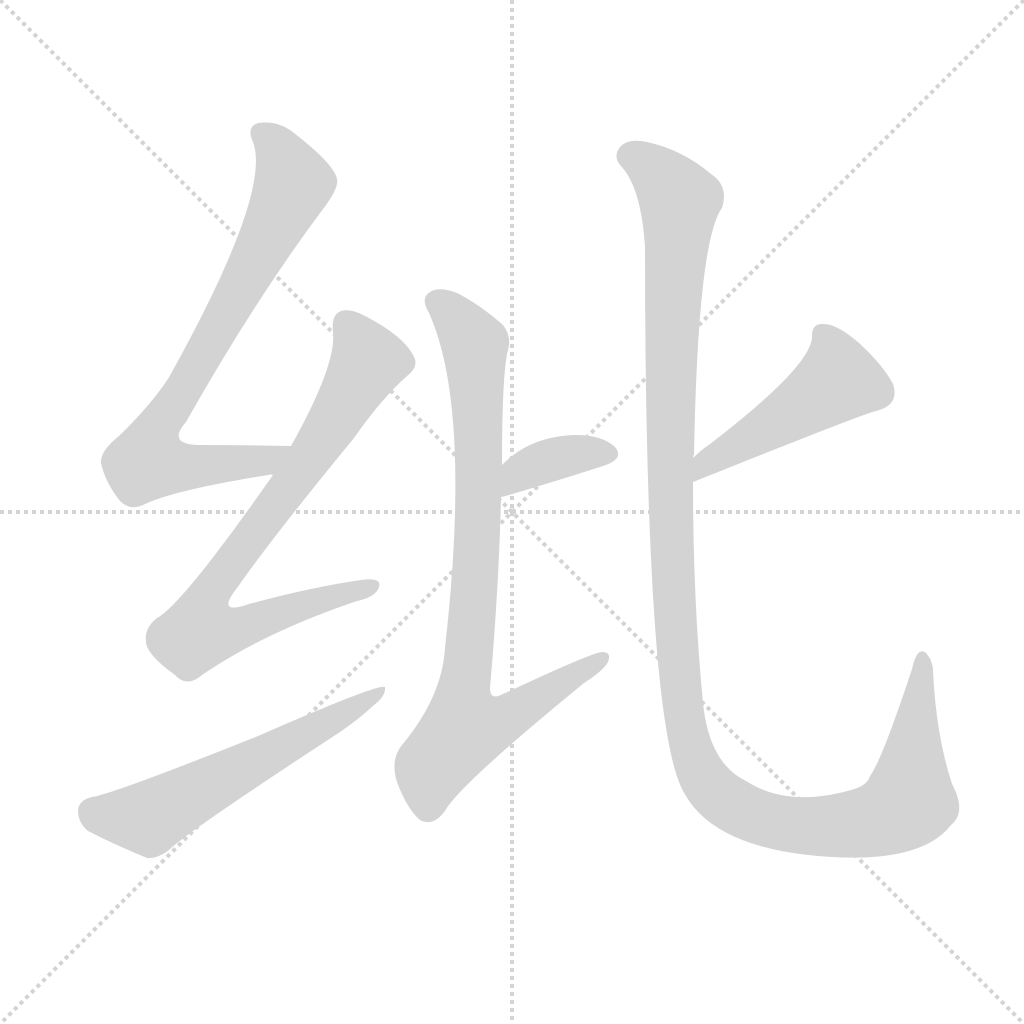
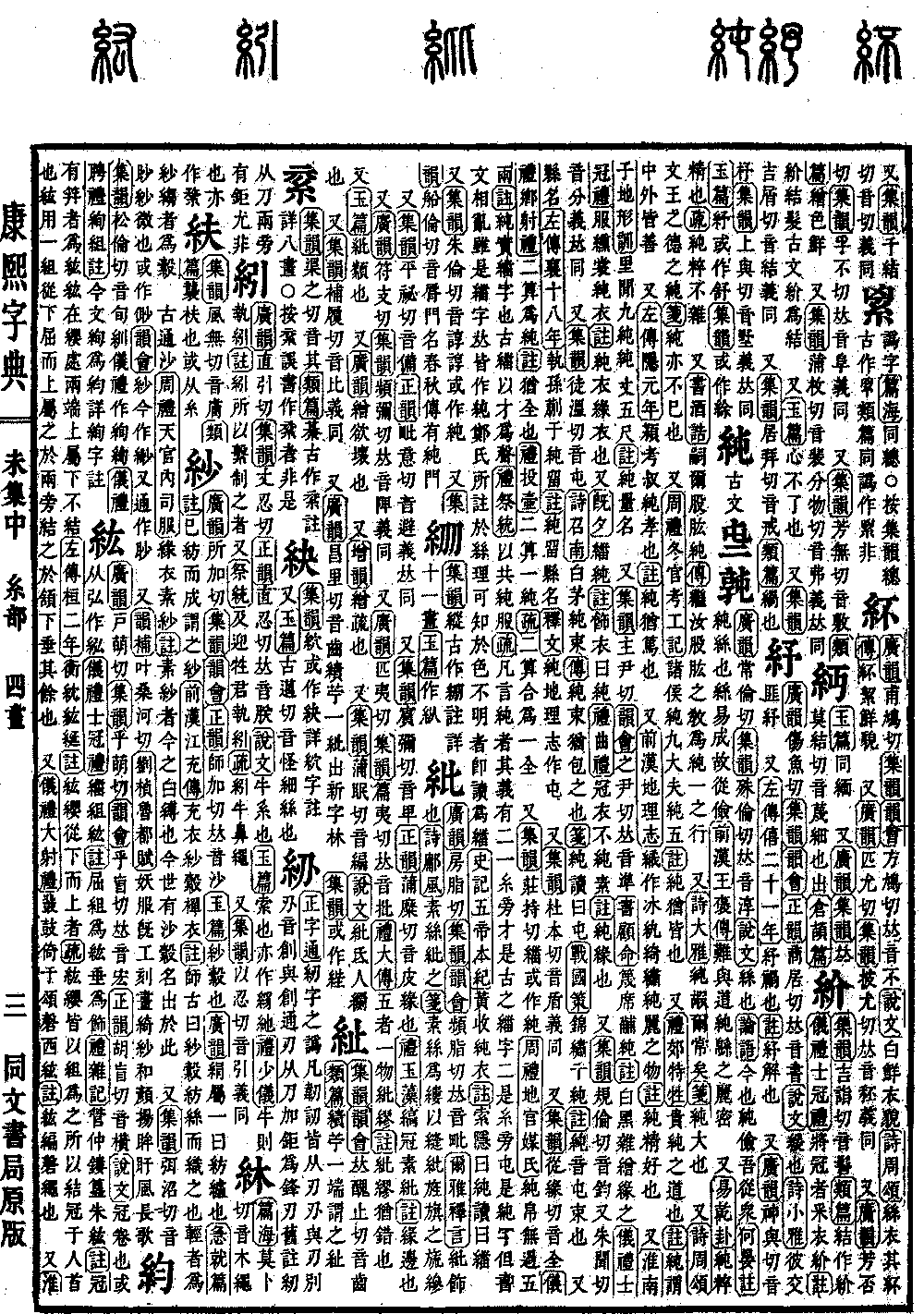
Wei Collection, Lower Volume
Radical: Silk (mì)
Kangxi Strokes: 10
Page 917, Entry 03
Pronounced pi.
Classic of Poetry (Shijing), Records of Rites (Yili), in the section Interpretation of Words (Shiyan): Pi means to decorate.
Book of Odes (Shijing), Odes of Yong (Yongfeng): White silk threads pi it.
Commentary: Using white silk thread to sew and decorate the streamers of banners.
Pronounced bei.
Pronounced bi.
Meaning is the same.
Pronounced pi.
To hem or edge.
Book of Rites (Liji), Jade Beads (Yuzao): A white cap with a plain hem.
Commentary: An edging or border.
Pronounced pi.
Meaning is the same.
Pronounced pi.
Book of Rites (Liji), Great Record (Dazhuan): These five things are all pi-miao.
Commentary: Pi-miao is like being mistaken or erroneous.
As stated in the Comprehensive Dictionary (Yupian): Pi means a knot or a flaw.
Also: Silk that is about to deteriorate.
Also: As stated in the Additional Rhymes (Zengyun): Loose silk.
Pronounced pian.
As stated in the Explaining Graphs and Analyzing Characters (Shuowen): Pi refers to the Di people.
Pronounced bi.
Meaning is the same.
Pronounced chi.
To spin one spool of ramie.
From New Character Forest (Xin zilin).
According to the Collective Rhymes (Jiyun), this character is sometimes written in a variant form.
Verification: As stated in the Collective Rhymes, pronounced bian. I note that bian is not the result of the sound-combination pu-mian. Following the original text, the pronunciation has been corrected to pian.