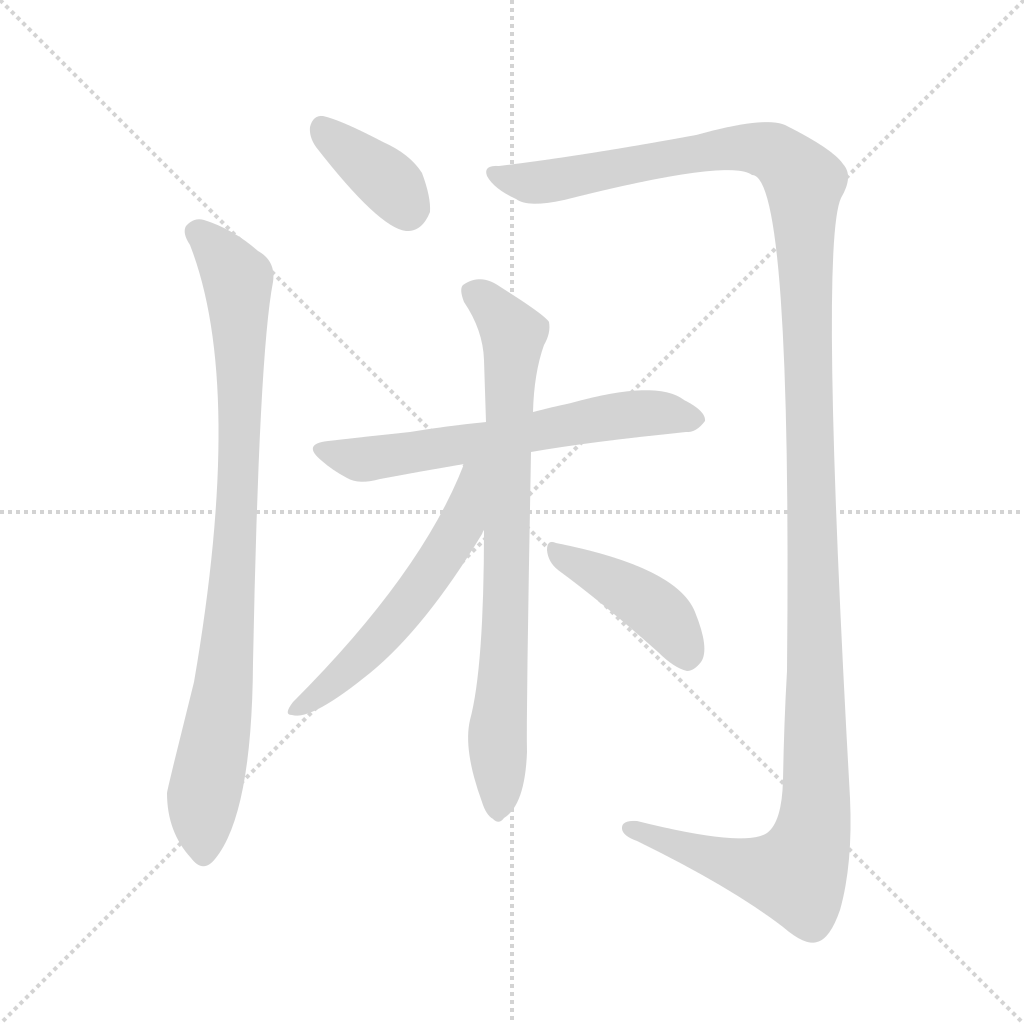
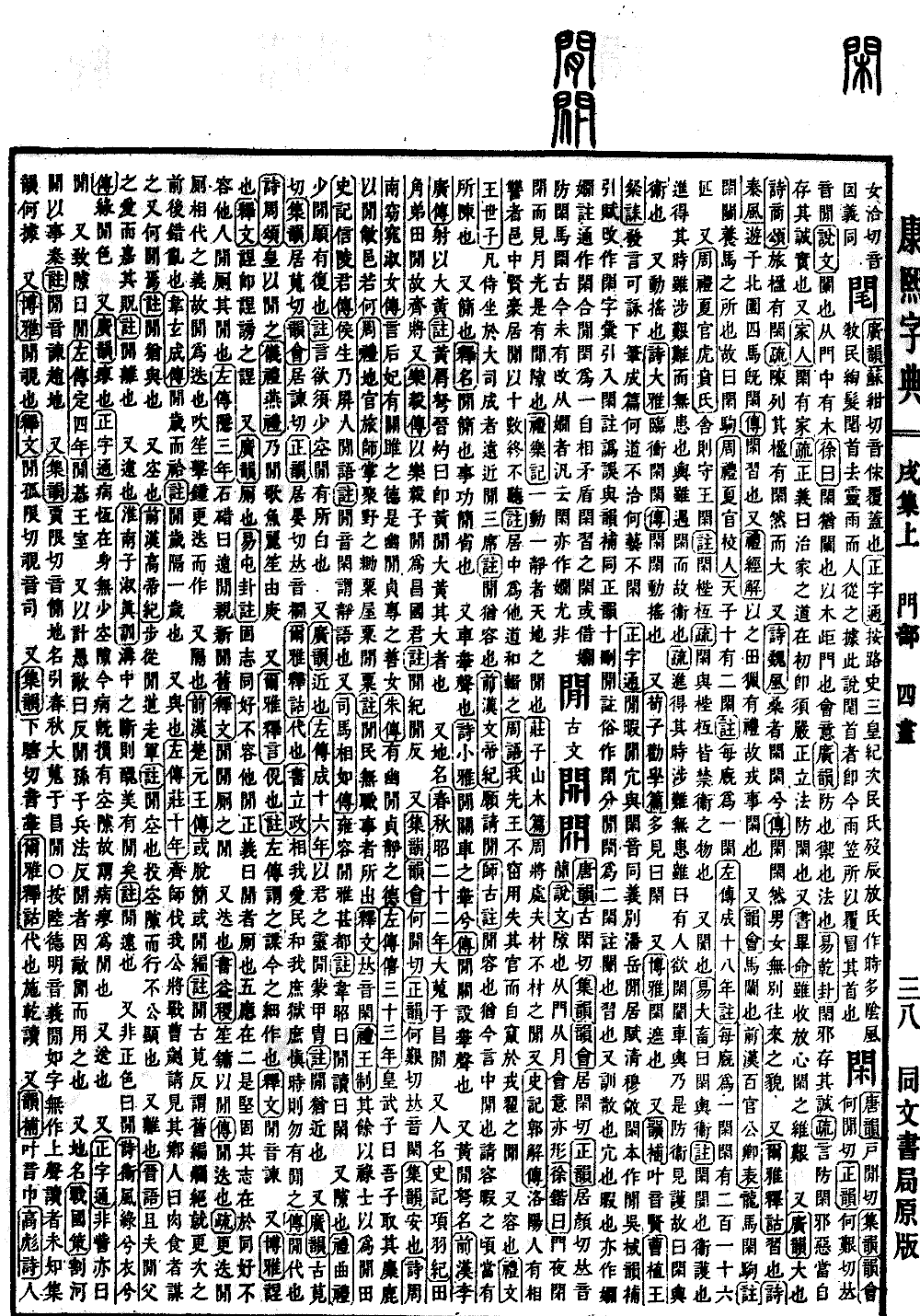
Xu Collection, Upper Volume
Radical: Gate (mén)
閑; Kangxi stroke count: 12; Page 1332
Pronounced xian
According to Explaining Graphs and Analyzing Characters (Shuowen Jiezi), it means a barrier. Composed of the character for Gate, with wood in the middle. Xu says: This means a barrier. It refers to obstructing a gate with wood. It is an ideographic compound.
According to Broad Rhymes (Guangyun), it means to prevent, to guard, or a law.
Book of Changes (Yijing), Hexagram Qian: Prevent evil and preserve one's sincerity. The commentary says: This means to prevent and block evil, and one should preserve one's own sincerity.
Also, in the hexagram Jiaren: Regulate the household. The commentary says: The way to manage a family lies in the beginning; one must strictly establish laws and preventions.
Also, in Book of Documents (Shujing), Bi Ming: Although you recover your wandering heart, to restrict it is difficult.
Also, according to Broad Rhymes (Guangyun), it means great. Book of Odes (Shijing), Shang Song: The pillars are large. The commentary says: Arranged in a row, the pillars are spacious and large.
Also, Book of Odes (Shijing), Wei Feng: The mulberry gatherers are leisurely. The commentary says: Leisurely refers to the appearance of men and women coming and going without distinction.
Also, according to Erya, Explaining Words (Erya Shigu): It means to practice. Book of Odes (Shijing), Qin Feng: Wandering in the north garden, the four horses are already trained. The commentary says: Trained means practiced.
Also, in Book of Rites (Liji), Jingjie: Because there is propriety in hunting, military affairs are practiced.
Also, according to Rhyme Collection (Yunhui), it is a horse enclosure. In the Former Han Dynasty (Qianhan), Table of Officials and Ministers: The dragon horses and stable colts. The commentary says: The enclosure for raising horses is called a stable, hence stable colts. In Rites of Zhou (Zhouli), Xia Guan, Xiaoren: The Son of Heaven has twelve stables. The commentary says: Each stable is one enclosure. In Zuo Tradition (Zuozhuan), 18th year of Duke Cheng commentary: Each enclosure holds two hundred and sixteen horses.
Also, in Rites of Zhou (Zhouli), Xia Guan, Huben Shi: When stopping, guard the royal enclosure. The commentary says: The enclosure is a wooden barrier. The commentary says: The enclosure and the barrier are both protective devices.
Also, it means to obstruct. Book of Changes (Yijing), Hexagram Dachu: Blocking the carriage and providing protection. The commentary says: Blocking means to obstruct. Protection means to defend. If one advances at the right time, even if one encounters difficulties, there is no harm. Although the carriage encounters an obstruction, it is protected. The commentary says: Advancing at the right time and encountering difficulties without harm, although someone wishes to block the carriage, it is actually being protected, hence it is said to block the carriage and provide protection.
Also, it means to sway. Book of Odes (Shijing), Da Ya: The battering rams sway. The commentary says: Swaying refers to the movement.
Also, in Xunzi, Exhortation to Learning: Seeing much is called being experienced.
Also, according to Boya, it means to shade.
Also, in Rhyme Supplement (Yunbu), it rhymes with xian. Cao Zhi, Eulogy for Wang Can: Every word is worth reciting, every line of writing becomes a finished work. What path is not harmonious, what art is not practiced?
According to Correct Character Guide (Zhengzitong), the characters for leisure and idleness share the same pronunciation but have different meanings. Pan Yue's Rhapsody on Living in Leisure (Xianju Fu) originally used the variant for leisure; Wu Yu's Rhyme Supplement (Yunbu) cited the rhapsody but changed it to the character for enclosure. The Dictionary of Characters (Zihui) incorporated this change into the notes, which is an error shared with the Rhyme Supplement. The Zheng-yun lists leisure under the tenth rhyme category, noting that it is commonly written with the character for enclosure. It divides leisure and the character for enclosure into two. The note for enclosure says: barrier, practice. It also defines it as scattered, idle, or leisure. It is also written as the variant form (xian). The note for the variant (xian) says: it is commonly used as the character for enclosure. Combining these into one is self-contradictory. The character for enclosure used in the sense of practice is sometimes borrowed as the variant (xian), but for phrases like prevention or horse enclosure, historically there has never been a change to the variant (xian). To generally say that one is also written as the other is particularly incorrect.