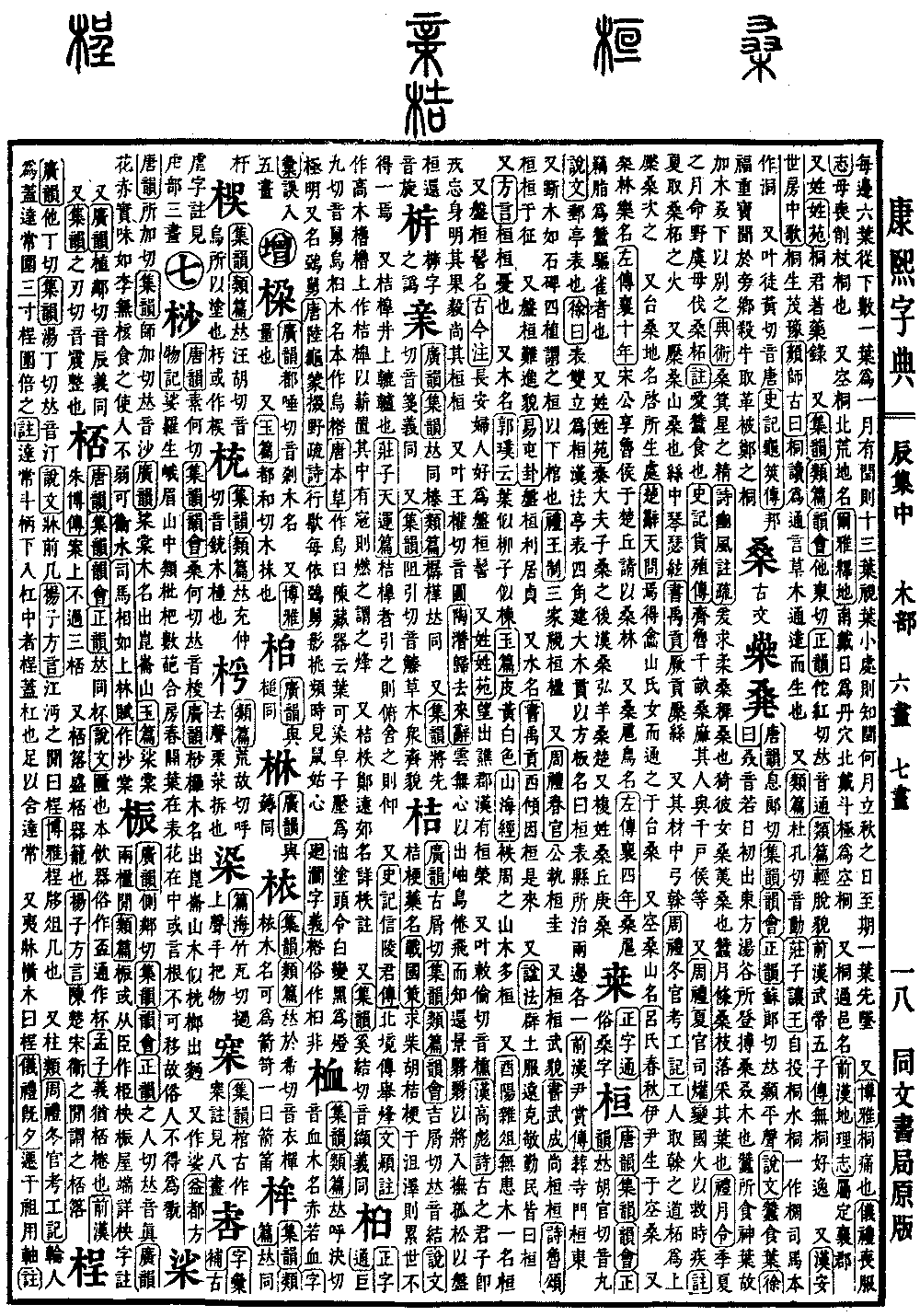
Chen Collection, Middle Volume
Radical: Tree (mù)
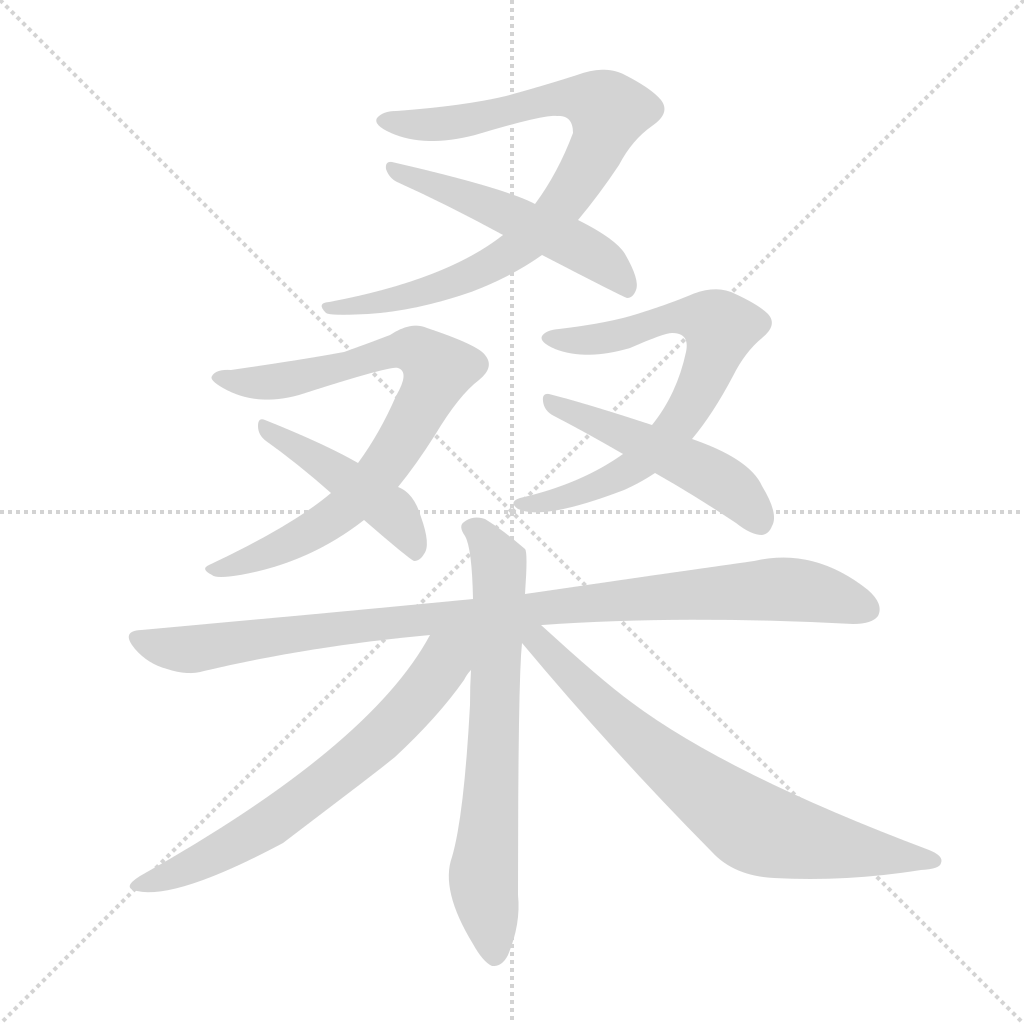
Sang
Pronounced sang (level tone).
Explaining the character (Shuowen Jiezi): It is the leaf consumed by silkworms.
Xu Xuan notes: The pronunciation of the character with three hands resembles the word for if (ruò). The Fusang tree is the tree climbed by the sun as it rises from Tang Valley in the east. Because this is the miraculous leaf consumed by silkworms, it is distinguished by adding tree (mù) below the character with three hands (ruò).
The Arts of Divination (Dianshu): Sang and Ji are the essences of the stars.
Book of Odes (Shijing), Bin Feng, Commentary and Sub-commentary: Seeking soft mulberry refers to young mulberry leaves. Elegant maiden mulberry refers to newly sprouted mulberry. In the month of the silkworm, prune the mulberry refers to cutting down branches to collect leaves.
Book of Rites (Liji), Monthly Ordinances (Yueling): In the third month of late spring, officials in charge of mountains and fields are commanded not to cut down mulberry or cudrania trees. The commentary states this is to protect the food of the silkworms.
Records of the Grand Historian (Shiji), Biographies of Money-makers (Huozhi Liezhuan): In the states of Qi and Lu, those who cultivate a thousand acres of mulberry and hemp possess wealth equal to that of a lord of a thousand households.
Also in the Rites of Zhou (Zhouli), Summer Offices, Officials of Fire-lighting (Siguan): Changing the wood used for fire within the state can cure seasonal illnesses. The commentary states that in summer, mulberry and cudrania wood are used for fire.
Also Yan Mulberry: This is mountain mulberry, from which silk can be used to make strings for zithers and lutes.
Book of Documents (Shangshu), Tribute of Yu (Yugong): There, the tribute in baskets consists of mountain mulberry silk.
Also its wood can be used for bow frames.
Rites of Zhou (Zhouli), Winter Offices, Record of Trades (Kaogongji): Regarding the method for bow-makers to select materials for bow frames, cudrania is best, and mountain mulberry is second.
Also Tai Sang: A place name. This is where Qi of Xia was born.
Songs of Chu (Chuci), Heavenly Questions (Tianwen): How did he obtain the lady of the Tushan clan and unite with her at Tai Sang?
Also Kong Sang: A mountain name.
Lü's Springs and Autumns (Lüshi Chunqiu): Yi Yin was born at Kong Sang.
Also Sang Lin: The name of a piece of music.
Zuo Tradition (Zuozhuan), Tenth Year of Duke Xiang: The Duke of Song hosted the Marquis of Lu at Chuqiu and requested the performance of the Sang Lin music.
Also Sang Hu: A bird name.
Zuo Tradition (Zuozhuan), Seventeenth Year of Duke Zhao: The nine Hu are nine types of agricultural officials. Commentary: The Sang Hu is the thief-fat bird.
Also a surname.
Genealogies of Surnames (Xingyuan): Descended from Zi Sang, a grandee of the Qin state; there were Sang Hongyang and Sang Chu in the Han dynasty.
Also compound surnames such as Sang Qiu and Geng Sang.
This is the seal script variant of Sang.
Corrections:
Book of Rites (Liji), Monthly Ordinances (Yueling): For in the month of late summer, command the field officials not to cut mulberry and cudrania, corrected based on the original text to late spring.
Book of Documents (Shangshu), Tribute of Yu (Yugong): Regarding its tribute of mountain mulberry silk, corrected based on the original text to bamboo baskets.
Rites of Zhou (Zhouli), Winter Offices, Record of Trades (Kaogongji): Regarding the artisan's method of selecting frames, cudrania is best, mountain mulberry is second, corrected based on the original text to bow-maker.
Zuo Tradition (Zuozhuan), Fourth Year of Duke Xiang: Sang Hu, the thief-fat bird, is the one that drives away sparrows for the silkworms. Following careful verification, this is the commentary from the seventeenth year of Duke Zhao, not the text of the fourth year of Duke Xiang; it is now corrected according to the Zuo Tradition, Seventeenth Year of Duke Zhao, stating the nine Hu are the nine agricultural officials. Commentary: The Sang Hu is the thief-fat bird.
Page 526, Entry 01